


What Is Infrasound, and Why Can’t You Hear It?

The human ear can detect sounds between roughly 20 and 20,000 hertz. Anything below 20 hertz is classified as infrasound, and it cannot be heard in the ordinary sense. It can, however, be felt.
This distinction matters a great deal when it comes to the Great Pyramid. The frequencies measured inside its chambers fall well within this inaudible range, which is precisely why visitors experience something they struggle to name. It isn’t a sound you recognize; it’s a pressure, a weight in the air, a faint trembling that seems to pass through the body rather than enter the ears.
Researchers have noted that infrasound affects the human brain in several different ways, and can stimulate feelings of nausea, anxiety, paranoia, and awe. For the most sensitive individuals, it can lead to a sense of separation from the physical world accompanied by an out-of-this-world sensation. That’s a significant neurological effect from something technically inaudible.
The Dead-End Passage: A Hidden Resonance Tube
One of the more striking discoveries concerns the rock-cut Dead-end Passage inside the pyramid’s enigmatic Subterranean Chamber, which might well have functioned as a sound resonance tube, generating infrasound with a base frequency in the range of 5 Hz.
The narrow tunnel, measuring 53 feet (16.2 meters) in length, heads south from the southeast corner of the Subterranean Chamber. British engineer Rodney Hale had suggested it might have functioned as a resonance tube, citing its long pipe-like appearance and the fact that it had been deliberately cut and dressed along its entire length, indicating it must have had a true function.
The most striking finding with respect to the Dead-end Passage was the strong presence of infrasound, with spikes of activity at 5.13 Hz and 16.13 Hz. The spike at 5.13 Hz was strong enough to be recorded on a smartphone voice recorder, which is remarkable given how insensitive standard microphones are at frequencies that low.
The King’s Chamber Measurements
The largest amplitude sound frequency recorded in the King’s Chamber was at 49.5 Hz. In the Subterranean Chamber, significant spikes were observed at 30 Hz, 32 Hz, and 52 Hz, along with readings at 15 Hz and 19.75 Hz, both within the infrasonic range. A similar peak of infrasound activity at 15 Hz was also noted in connection with the King’s Chamber.
These infrasonic sounds were all recorded in near perfect silence, and given the limited sensitivity of voice recorders below 20 Hz, these peaks are almost certainly much stronger still in actual amplitude.
Acoustic researchers who spent nights taking measurements inside the King’s Chamber observed a good distribution of room modes, and found that the red granite sarcophagus displayed several resonant modes that directly corresponded to these room modes. Lying in the sarcophagus, it is nearly impossible to hum any note other than ones related to the main resonances. That’s a detail that’s hard to explain away as coincidence.
The Schumann Resonance Connection
German professor of physics Winfried Otto Schumann discovered in 1952 that the atmosphere contains resonating electromagnetic waves with a frequency of around 8 hertz. Called the Schumann resonance, it is a natural phenomenon occurring when electricity discharges in the atmosphere, creating a low-frequency resonance effect with a measured dominant frequency of 7.83 hertz between Earth’s surface and the ionosphere at roughly 80 km altitude.
The Schumann frequency varies by location on Earth, and calculated for the position of Giza it comes to 8.1 hertz. The King’s Chamber appears to have been built for a resonance frequency of 16.2 hertz, exactly double this local Schumann value.
The chamber’s precise dimensions, measuring approximately 10.47 meters in length, lock in a standing wave at exactly 16.2 Hz, the second harmonic of the local Schumann frequency. This creates a powerful infrasound pressure wave that fills the entire chamber and is felt more as pressure and vibration than as conventional sound.
The F-Sharp Chord: A Musical Fingerprint Inside Stone

Acoustic researchers measuring the resonances of the King’s Chamber found a patterned musical signature to those frequencies that formed an F-sharp chord. Ancient Egyptian texts reportedly indicate that F-sharp was the resonant harmonic center of planet Earth.
F-sharp happens to be the resonant frequency inside the Grand Gallery of the Great Pyramid at Giza, and the floor of the corbelled chamber is inclined at an angle of 26.3027 degrees, making its vertical height twenty-eight feet. The architectural precision embedded in these numbers is difficult to brush aside as accidental.
The overall observation from acoustic researchers is that the pyramid’s dimensions, its construction materials, and the box inside the King’s Chamber were designed to passively, meaning with zero electricity, enhance whatever sounds were present inside the chamber. That kind of passive acoustic engineering implies a level of intentional design that mainstream Egyptology has not fully addressed.
The Granite Sarcophagus as a Tuned Instrument
Measurements obtained through intoning inside the Great Pyramid’s granite sarcophagus showed its principal resonant frequencies to be between 65 Hz and 160 Hz, with the greatest spikes of activity falling between 114 Hz and 122 Hz.
Since the sarcophagus’s optimum resonant frequency range of 114 to 122 Hz synchronizes near perfectly with the pitch of the male voice, it seems reasonable to suggest it was designed with male intoning in mind. This is considered further evidence that the pyramid builders possessed an advanced knowledge of sound technology.
The granite sarcophagus is made of rose granite rich in quartz. When excited by sound, it rings at a prime resonant frequency of 117 Hz, a figure measured by acoustic researcher John Stuart Reid. The granite beams making up the roof of the King’s Chamber each weigh up to 90 tons and were quarried at Aswan, approximately 600 miles away. The logistical effort to source such specific stone from such a distance raises obvious questions about purpose.
The Pyramid as an Electromagnetic Concentrator
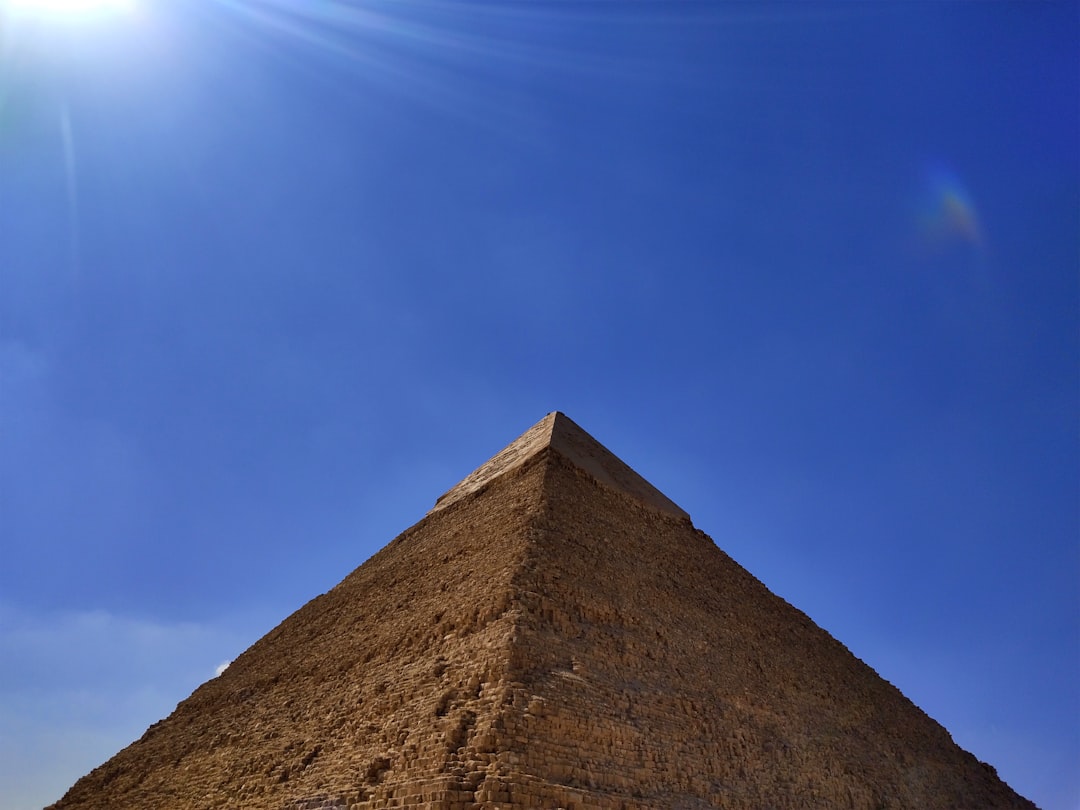
An international research group applied methods of theoretical physics to investigate the electromagnetic response of the Great Pyramid to radio waves. Scientists predicted that under resonance conditions, the pyramid can concentrate electromagnetic energy in its internal chambers and under the base.
The researchers estimated that resonances in the pyramid can be induced by radio waves with a length ranging from 200 to 600 meters. Their simulations predict that the chambers act as resonators, concentrating electromagnetic energy inside. The pyramid as a whole also focuses radio waves incident from above into a region just below the structure.
This study was published in the Journal of Applied Physics. The researchers themselves acknowledged that the unusual electromagnetic properties of the pyramid are almost certainly a coincidence of its structure. That said, the physics are real regardless of the intent behind the construction, and the energy concentration effects are verifiable through numerical modeling.
The 4-Minute Window: Quiet Periods and Sustained Readings

Measurements of the resonant frequencies of the Subterranean Chamber’s Dead-end Passage were based on four quiet periods, each 3.5 minutes in length. This is where the idea of a sustained low-frequency hum lasting roughly 4 minutes comes into clearest focus. During these quiet measurement windows, infrasound activity was consistently present and recordable.
The most striking finding with respect to the Dead-end Passage was the strong presence of infrasound, with spikes of activity at 5.13 Hz and 16.13 Hz. These were not brief anomalies but sustained readings captured across multiple quiet intervals. The consistency across separate recording periods suggests a structural source, not environmental noise.
Any wind pressure across the pyramid’s internal air shafts, especially when it was new and smooth, behaved like blowing across the neck of a bottle, creating an infrasound harmonic vibration in the chamber at precisely 16 Hz. Wind passing through the structure may well be one of the natural mechanisms that sustains the hum for these brief but measurable durations.
Piezoelectric Effects in the Stone Itself

The quartz-rich limestone and granite of the King’s Chamber, which contains between 20 and 35 percent quartz in the granite sections, can convert electromagnetic energy into tiny mechanical vibrations via the inverse piezoelectric effect, turning electromagnetism into physical strain.
By examining the frequencies within the inner rooms, mapping sound travel, and studying the piezoelectric properties of granite, researchers have sought to determine whether the pyramid’s design could generate measurable energy through its own stone composition. Quartz crystals generate a small electric charge when subjected to mechanical pressure, and granite is composed substantially of quartz. A structure built almost entirely of granite-encased chambers is, in a very literal sense, a piezoelectric environment.
The length, taper, and height of the Grand Gallery create a low-frequency waveguide that channels and concentrates weak ambient infrasound traveling through the pyramid’s air passages and stone mass. The corbelling minimizes reflections and concentrates energy upward, functioning like a megaphone that delivers a stronger traveling sound wave to the antechamber.
The Broader Pattern: Ancient Acoustic Knowledge
The same pattern of frequencies found in both the Great Pyramid and megalithic monuments like the West Kennet Long Barrow have also been recorded in a number of caves in southwest Europe bearing painted art from the Upper Palaeolithic age, dating from roughly 42,000 to 9,600 BCE.
A 1996 paper in the Journal of the Acoustical Society of America, authored by Paul Devereux and Robert G. Jahn, detailed a number of ancient structures in England and Ireland which were apparently designed to enhance bass frequencies in the voice range. Among their conclusions, Devereux and Jahn believed this was done because of the group chanting used in ritual practice.
A 2025 white paper on ResearchGate presents an analysis of the Great Pyramid of Giza as a resonant structure encoding fundamental physical constants through its geometry and internal acoustic modes. Whether the builders intended this or whether it is a byproduct of their mathematical precision remains the central unresolved question. What is not in dispute is that the acoustic behavior of the Great Pyramid is real, measurable, and deeply unusual for any structure of any age.
What Science Still Doesn’t Know

One of the widespread myths claims that the acoustic resonance frequency of the Great Pyramid is 33 Hz. Mathematical calculations, however, demonstrate that this value does not correspond to the pyramid’s actual physical parameters, and research suggests its wave response at that frequency would be negligible under Earth’s physical conditions. Separating genuine measured data from accumulated myth is a challenge that continues to slow serious research.
The precise functions of the King’s Chamber, Queen’s Chamber, and subterranean chamber remain unclear, but their unique acoustic properties have been noted by many visitors and researchers alike. The measurements are consistent and reproducible. The interpretation of those measurements remains wide open.
It has been suggested by various researchers that the Great Pyramid is not a tomb at all but a kind of temple, and that these resonant frequencies were deliberately designed into the structure. While many far-fetched properties have been ascribed to the power of the pyramid, a possible argument exists that some of the phenomena people experience inside it may be caused by the acoustical properties that have been measured.
The Great Pyramid has never needed legends to be remarkable. The stone is real, the frequencies are measurable, and the chambers behave in ways that no simple burial monument would require. Whatever the builders intended, they left behind a structure that hums at the edge of human perception, and four thousand years later, we’re still pressing our ears to the wall trying to understand why.