


What “Level 5” Actually Means

Not all AI assistants are equal. OpenAI’s internal classification system ranges from Level 1, which includes current AI models that can engage in conversational language, all the way to Level 5, where AI could perform the work of an entire organization.
The five stages, as reported from OpenAI’s internal framework, are: Level 1 Chatbots with conversational language; Level 2 Reasoners capable of human-level problem solving; Level 3 Agents that can take actions; Level 4 Innovators that can aid in invention; and Level 5 Organizations that can do the work of an entire organization.
The pinnacle of this classification system, Level 5 “Organizations,” represents AI systems capable of performing the work of entire organizations – managing complex workflows, making strategic decisions, and optimizing operations across various departments and functions. We are not there yet, but the trajectory is moving fast.
Where We Actually Stand in 2026
Today’s most advanced large language models, such as GPT-4o used by ChatGPT, are rated at the lower threshold of Level 3 by OECD researchers. These systems excel in accessing world knowledge, working across multiple languages, and iterative learning through fine-tuning and post-processing.
However, LLMs are held back by their inability to engage in well-formed analytical reasoning, a tendency to hallucinate incorrect information, and an incapacity to learn dynamically. Despite fulfilling most other language capability aspects at Level 3, these weaknesses keep them from advancing further.
Artificial intelligence assistants have rapidly transitioned from novelty tools to integral components of modern business operations. By 2025, major AI systems are automating complex processes, producing material, analyzing data, and supporting strategic decisions. With advances in natural language processing, multimodal capabilities, and tighter integration with enterprise tools, AI assistants now play a critical role across industries including finance, healthcare, education, and software development.
The Hallucination Problem: The Clearest Giveaway

One of the most reliable ways to gauge an AI assistant’s actual capability is to test how it handles facts – especially in niche or high-stakes domains. A truly advanced system should know what it doesn’t know. Most don’t.
A critical insight from MIT research published in January 2025 revealed that when AI models hallucinate, they tend to use more confident language than when providing factual information. Models were found to be roughly one third more likely to use phrases like “definitely,” “certainly,” and “without doubt” when generating incorrect information. The core paradox: the more wrong the AI is, the more certain it sounds.
Systems optimized for complex chain-of-thought reasoning actually hallucinate more on open-ended factual benchmarks. OpenAI’s o3 series experienced hallucination rates of 33 to 51 percent on PersonQA and SimpleQA – more than double its earlier o1 model, which hovered around 16 percent, according to OpenAI’s own published data and Techopedia’s 2025 analysis.
Response Speed: Still a Signal, But a Complicated One

A tell-tale sign that you’re chatting with an AI and not an actual person is the speed of their responses. Modern AI models like ChatGPT and Gemini can generate lengthy paragraphs of text almost instantly. An actual person can’t respond at that pace, especially if they’re sharing detailed, complex answers relevant to your question. If the replies seem nearly instantaneous, you’re likely chatting with an AI.
Advanced voice AI systems now use sub-300ms response latency, making interactions feel instant and entirely human-like. Voice AI delivers this speed consistently, which is itself something no human can replicate over long conversations.
The Detection Gap: Humans Are Bad at This
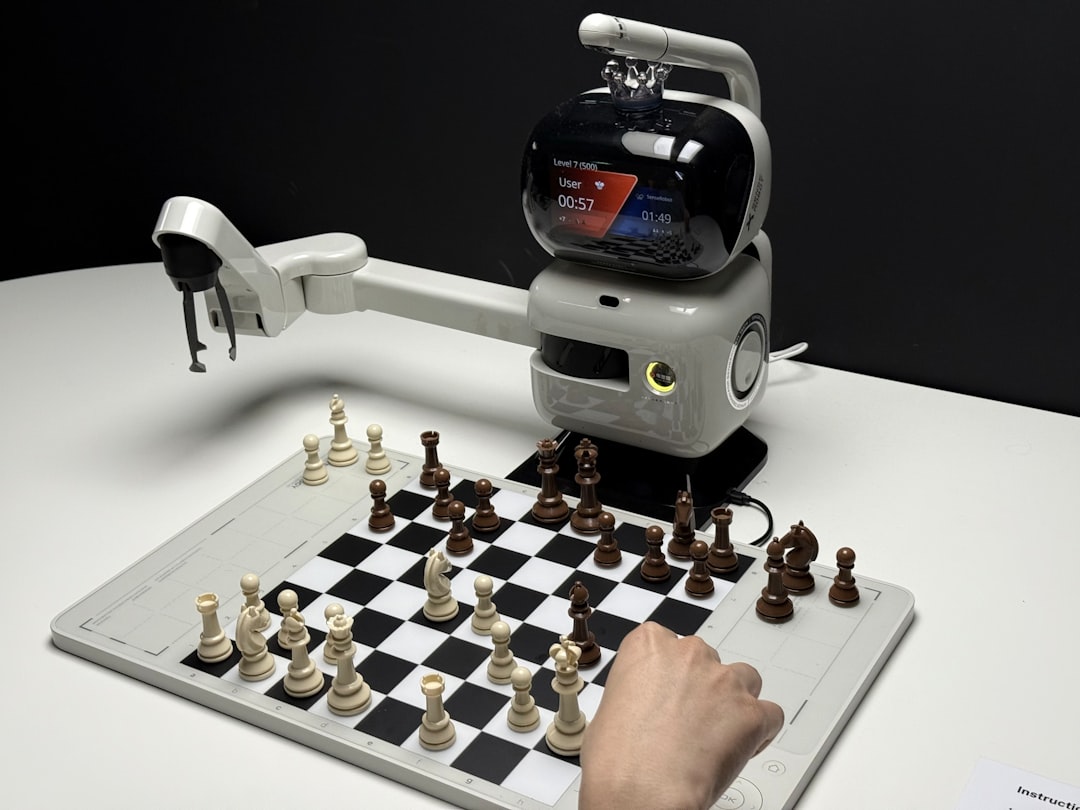
The uncomfortable truth is that most people cannot reliably tell when they’re talking to an AI – particularly an advanced one. That’s not a personal failure. It’s a structural one.
A 2024 study found that users correctly identified AI voices only 58 percent of the time – barely above chance. That finding points to the need for system-level transparency, not guesswork.
According to a MarkTechPost 2025 survey, roughly 65 percent of consumers cannot tell the difference between AI-generated speech and human voices. This is not a niche problem – it affects the vast majority of everyday users interacting with modern AI systems.
Repetitive Patterns and Circular Responses

Lower-capability AI systems – those at Level 1 or early Level 2 – tend to fall into predictable loops. When pressed, they recycle phrasing. When challenged, they escalate back to the same solution. A high-functioning Level 5-adjacent assistant should handle friction, contradiction, and re-framing without breaking down.
AI chatbots often reply in specific patterns because they recycle a set of pre-programmed responses. Humans don’t chat or talk that way. If you ask a person the same question twice, you’ll likely get different answers – they might rephrase their response or add more information. In contrast, bots aren’t programmed to be this flexible, which makes their answers seem somewhat repetitive.
Many AI models also repeat a part of your question to structure their responses. If you notice this pattern consistently, it’s a meaningful red flag that you’re dealing with a lower-tier system.
Context Retention Across a Conversation

One of the clearest markers of a sophisticated AI assistant is whether it genuinely holds context across an entire conversation – not just the last two exchanges. Advanced systems remember what you said three topics ago. Basic ones forget within a few turns.
Long-term semantic memory in AI enables systems to remember users across sessions, effectively mimicking real human relationships and conversational continuity. That said, this feature exists across a wide range of AI quality levels, so memory alone isn’t proof of high capability.
When AI agents handle excessively long input goals, they may fail to capture long-range contexts and instead over-rely on the most recent tokens – a failure mode researchers call contextual misuse. When an assistant loses the thread of what you were discussing earlier in a long session, that’s often this exact limitation surfacing.
Emotional Nuance and Genuine Escalation Judgment

A telling test for advanced AI is how it handles emotionally charged or ambiguous situations. Low-tier systems respond to frustration with generic placation. High-tier systems recognize when the situation has shifted.
Advanced AI assistants should do more than just reply – they should detect emotions. This means recognizing frustration and escalating to a human when needed, recognizing satisfaction and adjusting accordingly, and dynamically changing tone to acknowledge emotions rather than sounding robotic.
Current AI is still largely lacking in cognitive empathy, because genuine emotions between humans are genuinely hard to understand and explain. Creating an empathetic dialogue deliberately, then watching how the AI responds, can be surprisingly revealing about its actual capability level.
Autonomy and Proactive Action

The jump from Level 2 to Level 3 in OpenAI’s framework isn’t just about talking smarter – it’s about doing things independently. True Level 3 systems act; they don’t just respond.
The key distinction in autonomy frameworks centers on the role of the user. Autonomy is defined as the extent to which an AI agent is designed to operate without user involvement. Importantly, a highly capable agent can still be designed to behave only semi-autonomously, eliciting user feedback at regular intervals, while a less capable agent can behave autonomously when tackling well-scoped and simple tasks.
AI assistants are increasingly doing more than reacting to instructions – they are becoming more proactive on their own. In tools with agentic features, the AI doesn’t just list your tasks; it actively finds time in your calendar and schedules them, acting as an autonomous time manager. That shift from reactive to proactive is a meaningful dividing line.
Transparency and Self-Disclosure

Perhaps the most important marker of a genuinely high-capability AI assistant isn’t what it knows – it’s what it admits it doesn’t know, and whether it tells you what it is. Transparency has become both an ethical and regulatory issue.
Fooling people into thinking they’re talking to a human is widely regarded as unethical and, in a growing number of jurisdictions, increasingly illegal. Transparency – including disclosing AI use at the start of a call or conversation – is now considered essential for trust and legal compliance.
Transparency must be baked into the system, not bolted on as an afterthought. Effective trust-building includes clear verbal disclosure at conversation start, visual or audio indicators in outputs, user-accessible logs showing data sources and decision paths, and clear escalation paths to human agents when needed.
Conclusion: The Humanity Test Is Actually a Trust Test

What we’re really doing when we run the “humanity test” isn’t trying to catch a machine in a lie. We’re trying to figure out how much we can trust what we’re being told – and by whom. The hallucination data, the emotional clumsiness, the repetitive phrasing – these are all proxies for a more fundamental question about reliability and honesty.
The picture is genuinely mixed. AI hallucinations are evolving from a blanket failure mode into a situational risk. Where grounding is strong and tasks are constrained, the frequency of hallucinations drops. Where reasoning is expansive and factual recall is open-ended, they surge.
The most advanced AI assistants in 2026 are impressive enough that detection by feel alone is increasingly unreliable. The more productive question isn’t “is this human?” but “how capable, honest, and grounded is this system?” That reframing – from suspicion to informed assessment – is probably where most of us need to land.