

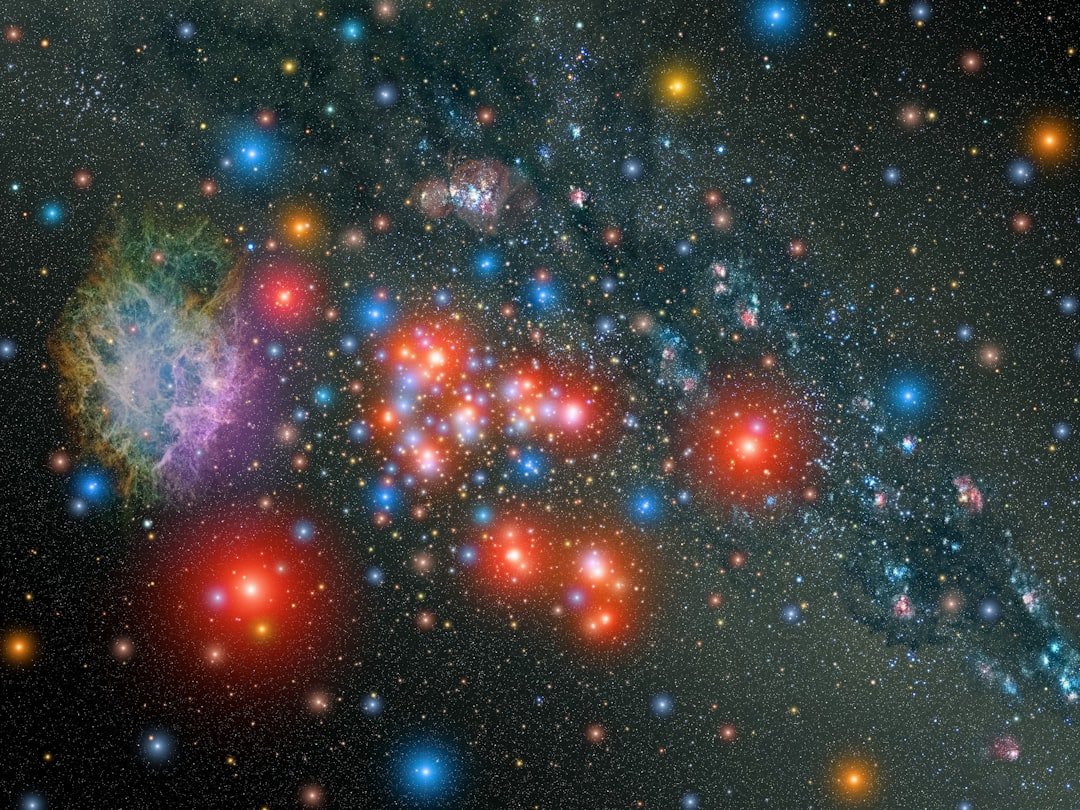
A Cosmic Overlap in a Tiny Sky Patch (Image Credits: Unsplash)
High in the spring sky, the constellation Coma Berenices harbors a stunning assembly of celestial wonders invisible to the naked eye. The Coma Berenices galaxy cluster, also known as the Coma Cluster, packs thousands of galaxies into a compact region, offering amateur astronomers a profound window into cosmic architecture. With April and May providing optimal evening visibility, observers equipped with telescopes can delve into this distant realm under clear, dark conditions.[1]
A Cosmic Overlap in a Tiny Sky Patch
Picture a circular area roughly one and a half degrees across – smaller than the moon’s apparent diameter – brimming with more galaxies than stars visible on the darkest night. The Coma Cluster’s core occupies this modest span, yet it hints at a vast structure extending farther. Galaxies here overlap in telescope views, creating a dense tapestry that challenges even seasoned skywatchers.[1]
Located at right ascension 12 hours 59 minutes and declination plus 27 degrees 59 minutes, the cluster sits near Coma Berenices’ northern edge, sandwiched between Leo and Boötes. This position near the North Galactic Pole minimizes interference from our Milky Way’s dust and gas, sharpening views of these remote objects. Professional mosaics reveal intricate details, but backyard scopes capture the essence for patient observers.
Unveiling the Cluster’s Immense Scale
The cluster’s heart lies 320 million light-years distant, receding from Earth at over 15 million miles per hour. It stretches across 20 million light-years, dwarfing the Milky Way’s 100,000-light-year width and our Local Group’s 10-million-light-year expanse, which holds about 50 galaxies. Scientists confirm over 1,000 member galaxies, with faint dwarfs pushing the tally into the thousands – far exceeding naked-eye stars on clear nights.[1][2]
Diverse forms populate this gathering: giant ellipticals dominate the center, forged from ancient mergers, while spirals and irregular dwarfs resemble the Magellanic Clouds. Infrared surveys uncover many dwarfs elusive in visible light, highlighting the cluster’s richness. Other clusters dot the same sky region, adding layers to explorations.[1]
| Feature | Milky Way | Local Group | Coma Cluster |
|---|---|---|---|
| Size (light-years) | 100,000 | 10 million | 20 million |
| Galaxies | 1 | ~50 | 1,000+ |
| Distance from Earth | Our home | Local | 320 million |
Spotlight on the Cluster’s Brightest Jewels
Two colossal elliptical galaxies anchor the scene: NGC 4889 and NGC 4874, each two to three times the Milky Way’s size. NGC 4889 appears amid a backdrop of hundreds of fainter galaxies, its glow piercing the throng. NGC 4874 commands attention nearby, underscoring the central dominance of these merger remnants.[1]
Deeper in, NGC 4911 presents a striking face-on spiral, its structure preserved amid the cluster’s gravitational bustle. A brighter, bluer spiral about one-third from the center shows reddish-brown dusty arms, signs of past interactions. These standouts reward sweeps with mid-sized telescopes, though dwarfs demand larger apertures.
- NGC 4889: Giant elliptical, foreground to background galaxies.
- NGC 4874: Fellow central giant, vast in scale.
- NGC 4911: Elegant spiral deep within.
- Unnamed blue spiral: Dusty arms indicate disturbances.
From Dark Matter Discovery to Modern Insights
In the 1930s, astronomer Fritz Zwicky studied the Coma Cluster and tallied its galaxies’ visible mass. Galaxy motions at the edges demanded far more gravity than observed, leading Zwicky to propose “dunkle Materie” – dark matter. This invisible component, now known to outweigh visible matter by at least five to one, shapes cosmic evolution.[1]
Zwicky’s work marked a pivotal shift in cosmology. Today, telescopes like Hubble and Spitzer reveal globular clusters and infrared dwarfs, refining our grasp. The cluster remains a laboratory for gravity, expansion, and galaxy formation.
Essential Tips for Springtime Hunts
Dark skies prove essential; city lights wash out this faint target. Binoculars and small telescopes fall short – opt for at least a 6-inch aperture, ideally 16 inches for overlaps. April and May evenings position it high overhead post-sunset.[1]
Start from Leo’s tail or Boötes’ keel to star-hop. Patience yields rewards: even modest setups show brighter members. Check forecasts for moonless nights. For deeper dives, consult resources like EarthSky.
Key Takeaways
- Over 1,000 galaxies in a 1.5-degree patch, best in April-May evenings.
- 320 million light-years away, home to dark matter’s discovery.
- Telescope essential; dark skies unlock giants like NGC 4889 and 4874.
The Coma Cluster reminds us of the universe’s hidden depths, where thousands of galaxies whisper ancient stories. Grab your telescope this spring – what will you uncover? Tell us in the comments.