

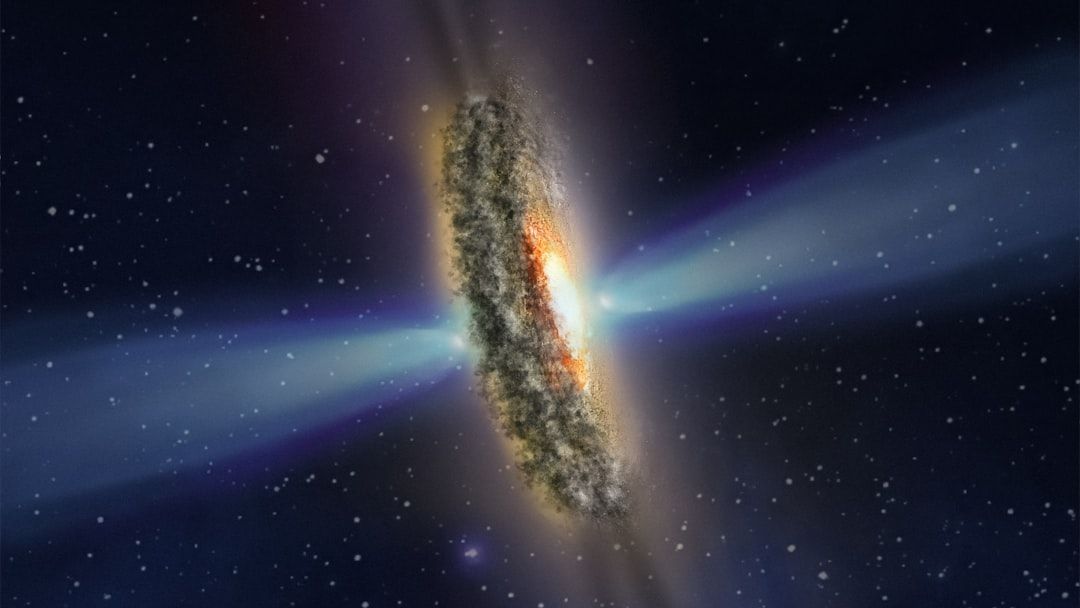
Unprecedented Clarity from Distant Observations (Image Credits: Unsplash)
Deep in the cosmos, where the universe was barely out of its toddler phase, astronomers pinpointed a pair of blazing quasars locked in a gravitational embrace. This system, existing just one billion years after the Big Bang, marks one of only two confirmed quasar duos at such vast distances. Observations from cutting-edge telescopes confirmed the merger, shedding light on how supermassive black holes grew amid the chaos of nascent galaxies. The find challenges assumptions about cosmic evolution in an era when structures were just beginning to take shape.
Unprecedented Clarity from Distant Observations
Researchers first spotted the system, cataloged as J2037–4537, back in 2021, but doubts lingered about its true nature. High-resolution data from the Atacama Large Millimeter/submillimeter Array, or ALMA, finally settled the debate. The array’s sensitivity allowed scientists to map the faint emissions from cold gas and dust surrounding the quasars. This revealed not isolated beacons, but two active cores intertwined in a merging galaxy pair.
At a redshift of 5.7, the system peers back to a time when the universe was less than 10 percent of its current age. Quasars shine as the most luminous objects known, fueled by supermassive black holes devouring surrounding material. Yet pairs like this remain elusive, making J2037–4537 a standout case in early cosmic history.
The Tidal Bridge That Sealed Confirmation
Gravitational lensing had offered a simpler explanation: perhaps a single quasar’s light bent into twin images by a massive foreground object. ALMA observations dispelled that notion by tracing the [C II] emission line, a signature of star-forming gas. Instead of duplicates, the data showed a physical link – a tidal bridge of gas stretching between the quasars.
“The dust continuum and [C ii] line emissions clearly reveal the tidal bridge between the two quasars,” the research team noted in their study posted on arXiv. This bridge formed as the galaxies tugged at each other during their approach, exchanging material in the process. Such features demand real interaction, not mere optical tricks. The confirmation elevated the system to a true merger event, rare for its epoch.
Galaxies in Overdrive: Stars and Black Holes Alike
Each galaxy in J2037–4537 packs at least 10 billion solar masses, with star formation rates surpassing 500 solar masses annually. This frenzy underscores the role of mergers in kickstarting explosive growth. The central black holes, voraciously feeding, power the quasars’ brilliance while the galaxies churn out new stars. Together, these processes paint a picture of synchronized evolution on cosmic scales.
Though separated by thousands of light-years, the black holes inch closer over eons. Simulations predict they will form a bound binary in about 2.1 billion years, culminating in a merger. Such events ripple spacetime with low-frequency gravitational waves, now hinted at by pulsar timing arrays. The excess signals detected recently might stem from more frequent early mergers like this one, prompting a reevaluation of black hole demographics.
Details from the continuum and [C II] emissions further illuminate the environment. Both components align in a best-fit lensing model, but the tidal connection overrides lensing alone. Star formation tracers confirm active disks around each core, fueling the quasars amid the merger’s turmoil. This holistic view enriches models of how early structures coalesced from primordial gas clouds.
The system’s dynamics also highlight gaps in current theories. If dual quasars proliferated in the young universe, they could explain the gravitational wave puzzle without invoking exotic physics. Ongoing surveys seek more examples to test this hypothesis, building on ALMA’s precision.
Probing the Cosmos’ Formative Years
The study underscores ALMA’s prowess in unveiling hidden structures at extreme distances. By resolving gas flows and dust lanes, it pierces the veil of cosmic time. J2037–4537 joins a sparse roster of early quasar pairs, bolstering evidence for merger-driven growth. Future detections could map the prevalence of such systems across redshifts.
This merger offers a snapshot of black hole seeding and maturation. It suggests mergers amplified growth rates, aligning with quasar abundance in the reionization era. As pulsar arrays refine their wave backgrounds, systems like this provide essential calibration. The discovery invites deeper questions about the universe’s assembly line for its largest beasts.