

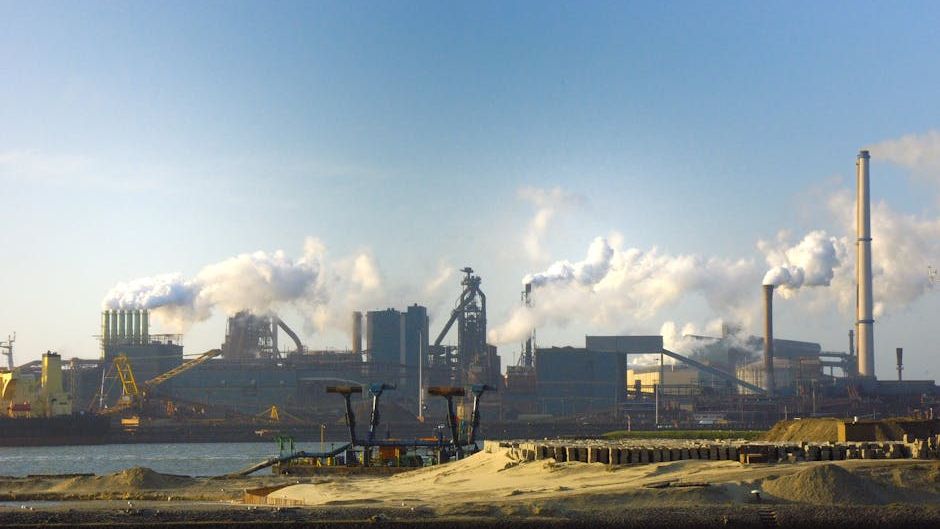
US Steel to build $2B lower-carbon iron plant in Arkansas – Image for illustrative purposes only (Image credits: Pexels)
Osceola, Arkansas — United States Steel Corporation announced a $1.9 billion investment to construct the nation’s first direct reduced iron facility at its Big River Steel Works.[1][2] This development arrives at a pivotal moment for the steel industry, as producers face mounting pressure to reduce carbon emissions while maintaining domestic competitiveness. The project links iron ore mining in Minnesota directly to steel output here, promising greater efficiency and sustainability in an era of global supply chain shifts.
A Strategic Pivot to Lower-Emission Ironmaking
Traditional steel production relies on blast furnaces that burn coal-derived coke, a process responsible for substantial greenhouse gas emissions. Direct reduced iron, or DRI, offers a cleaner path by using natural gas to strip oxygen from iron ore pellets, yielding a sponge-like iron product ideal for electric arc furnaces.[2] U.S. Steel positions this facility as a cornerstone of its net-zero emissions goal by 2050.
The new plant will produce DRI on-site, enabling hot charging straight into Big River’s four electric arc furnaces. This setup cuts energy demands compared to shipping cold DRI from distant suppliers. Company leaders highlighted the innovation during the April 29, 2026, reveal, noting it as the first U.S. operation co-located for such seamless integration.[1]
U.S. Steel President and CEO David B. Burritt emphasized the breakthrough. “From iron ore in Minnesota to steel production in Arkansas, this $1.9 billion investment strengthens our ability to create steel that is truly mined, melted, made in America, from start to finish,” he stated.[1]
Vertical Integration Seals the Supply Chain
The DRI facility draws on upgrades at U.S. Steel’s Minnesota Ore Operations, where a 2022 investment enhanced production of DRI-grade pellets at the Keetac plant. These pellets will travel from Minnesota mines to Osceola, closing the loop on raw materials without relying on imported DRI.[3] Such vertical control shields against global disruptions and ensures consistent quality for downstream steel products.
A partnership with Nippon Steel accelerated the timeline, advancing the project years ahead of initial projections. This collaboration forms part of Nippon’s broader $11 billion commitment to U.S. Steel operations through 2028. The result fortifies Big River Steel Works as a hub for next-generation steelmaking, serving sectors from automotive to energy infrastructure.[1]
Facility components include a reformer, heat recovery systems, gas compressors, and supporting infrastructure, all tailored to feed the site’s electric arc furnaces efficiently.[2]
Jobs and Growth Ripple Through Northeast Arkansas
The investment will generate approximately 200 full-time positions at Big River Steel Works, plus 35 embedded contractor roles. Construction phases could employ up to 2,000 workers at peak, injecting vitality into Mississippi County’s economy.[4] Local leaders hailed the news as a testament to the region’s manufacturing prowess.
U.S. Rep. Rick Crawford captured the enthusiasm. “I’m excited to see U.S. Steel’s $1.9 billion investment… We are very fortunate to have U.S. Steel as a trusted partner in our community,” he remarked.[4] Gov. Sarah Huckabee Sanders linked it to broader fiscal gains, while Sens. John Boozman and Tom Cotton praised Arkansas’s business climate and workforce.
What Matters Now: This project not only cuts emissions but cements Osceola as a linchpin in American steel revival, blending innovation with job creation amid trade tensions and green mandates.
Big River Steel Works: Foundation for Expansion
U.S. Steel acquired Big River Steel in 2021, drawn to its modern electric arc furnace operations that already emphasized scrap recycling and lower emissions. A subsequent $3 billion Big River 2 expansion, completed ahead of schedule in late 2025, added capacity and solidified the site’s role in sustainable production.[2]
Today, the complex stands ready to absorb DRI output, producing advanced steels like verdeX®, which boast 70-80% lower CO2 footprints through high recycled content and efficient processes. The DRI addition elevates this further, positioning U.S. Steel ahead in a market where DRI accounts for just 9% of global ironmaking.[1]
- Eliminates DRI import dependency for Big River.
- Enhances furnace efficiency via hot charging.
- Supports U.S. Steel’s American-made supply chain.
- Aligns with customer demands for greener materials.
Challenges persist, including natural gas reliance for DRI reduction, though future hydrogen adaptations could deepen cuts. Still, this facility signals steel’s viable path to decarbonization without sacrificing scale.
As construction ramps up, U.S. Steel’s Osceola venture reflects a measured yet ambitious stride toward resilient, low-carbon industry leadership. The full integration promises enduring advantages in a transforming global landscape.