

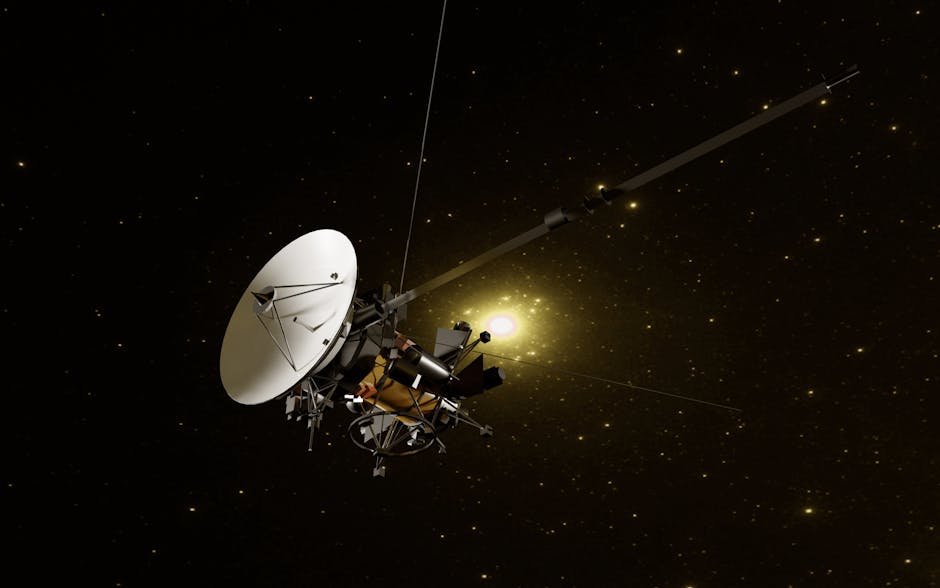
A Four-Year Mission That Defied Time (Image Credits: Pexels)
Nearly 49 years after their departure, NASA’s Voyager 1 and Voyager 2 spacecraft persist in transmitting data from the outer reaches of the solar system. Designed for a modest four-year exploration of Jupiter and Saturn, these probes capitalized on a rare planetary alignment to extend their journeys far beyond initial plans. Today, they offer humanity’s only direct glimpse into interstellar space, where the Sun’s protective bubble meets the galaxy’s vast medium.[1][2]
A Four-Year Mission That Defied Time
Engineers never anticipated the Voyagers would endure so long. Launched aboard Titan IIIE Centaur rockets, Voyager 2 lifted off first on August 20, 1977, followed by Voyager 1 sixteen days later on September 5. The numbering reflected their planned sequence for encountering Jupiter, not launch order.
Both spacecraft executed stunning flybys of the outer planets. Voyager 1 revealed Jupiter’s faint ring system and active volcanoes on its moon Io. Voyager 2 achieved the unprecedented feat of visiting all four gas giants – Jupiter, Saturn, Uranus, and Neptune – delivering close-up images that transformed planetary science.[1]
Crossing into the Unknown: The Heliopause Surprise
Scientists once pictured the heliopause as a sharp demarcation where solar wind yields to interstellar particles. Voyager 1 pierced this boundary in 2012, with Voyager 2 following in 2018 from a distinct location. Data from both revealed a far messier reality: a turbulent zone of fluctuating plasma, magnetic fields, and cosmic rays.[1]
These crossings exposed unexpected variations tied to the Sun’s 11-year activity cycle. Cosmic ray intensities shifted unpredictably, and magnetic field orientations defied models. The probes confirmed the local interstellar medium as a sparse mix of hydrogen, helium, dust, and high-energy particles from distant supernovae – measurements no other mission has matched.
Divergent Trajectories, Complementary Data
Voyager 1’s path veered out of the solar system’s ecliptic plane after Saturn, directing it toward the constellation Ophiuchus. Voyager 2 stayed closer to the plane, enabling its Uranus and Neptune encounters. These routes provided dual perspectives on the heliosphere’s asymmetry.
| Feature | Voyager 1 | Voyager 2 |
|---|---|---|
| Heliopause Crossing | 2012 | 2018 |
| Planetary Visits | Jupiter, Saturn | Jupiter, Saturn, Uranus, Neptune |
| Current Direction | Ophiuchus | Solar plane |
Despite differences, both continue measuring plasmas, fields, and particles with three operational instruments each.[1]
Sustaining the Unthinkable: Power and Perseverance
Radioisotope thermoelectric generators fueled by plutonium-238 initially supplied 470 watts per probe. Output has dwindled to under 250 watts, declining four watts annually. NASA’s Jet Propulsion Laboratory engineers triage power meticulously, shutting down nonessentials and uploading software fixes to 1970s-era computers.[1]
Signals traverse billions of miles, with round-trip times nearing 48 hours. Voyager 1 now sits about 15.8 billion miles from Earth, or roughly 169 AU, speeding at 38,000 miles per hour relative to the Sun. Annual costs hover at $5 million, a fraction of modern missions, sustained by generational knowledge transfer.
Milestones Marking an Epic Voyage
The Voyagers’ timeline underscores their resilience:
- 1977: Launches exploit rare planetary alignment every 175 years.
- 1979-1989: Flybys yield discoveries like Jupiter’s rings and Neptune’s winds.
- 2012: Voyager 1 enters interstellar space.
- 2018: Voyager 2 follows suit.
- 2026: Voyager 1 reaches one light-day (~173 AU, 16 billion miles) in November.
- 2027: 50th anniversary with reduced instruments.
- 2030s: Expected science silence as power fails.
These markers highlight an active experiment, not a relic.[1][3]
Key Takeaways
- The heliopause emerges as dynamic and location-dependent, upending static models.
- Voyager data sets baselines for interstellar medium composition and behavior.
- No successor looms, risking a decades-long data gap post-2030s.
The Voyager missions bridge our solar neighborhood to the Milky Way, proving that bold engineering and curiosity yield enduring rewards. As these pioneers fade, their legacy demands contemplation: will we send successors to continue the conversation with the cosmos? What do you think of their improbable journey? Tell us in the comments.