

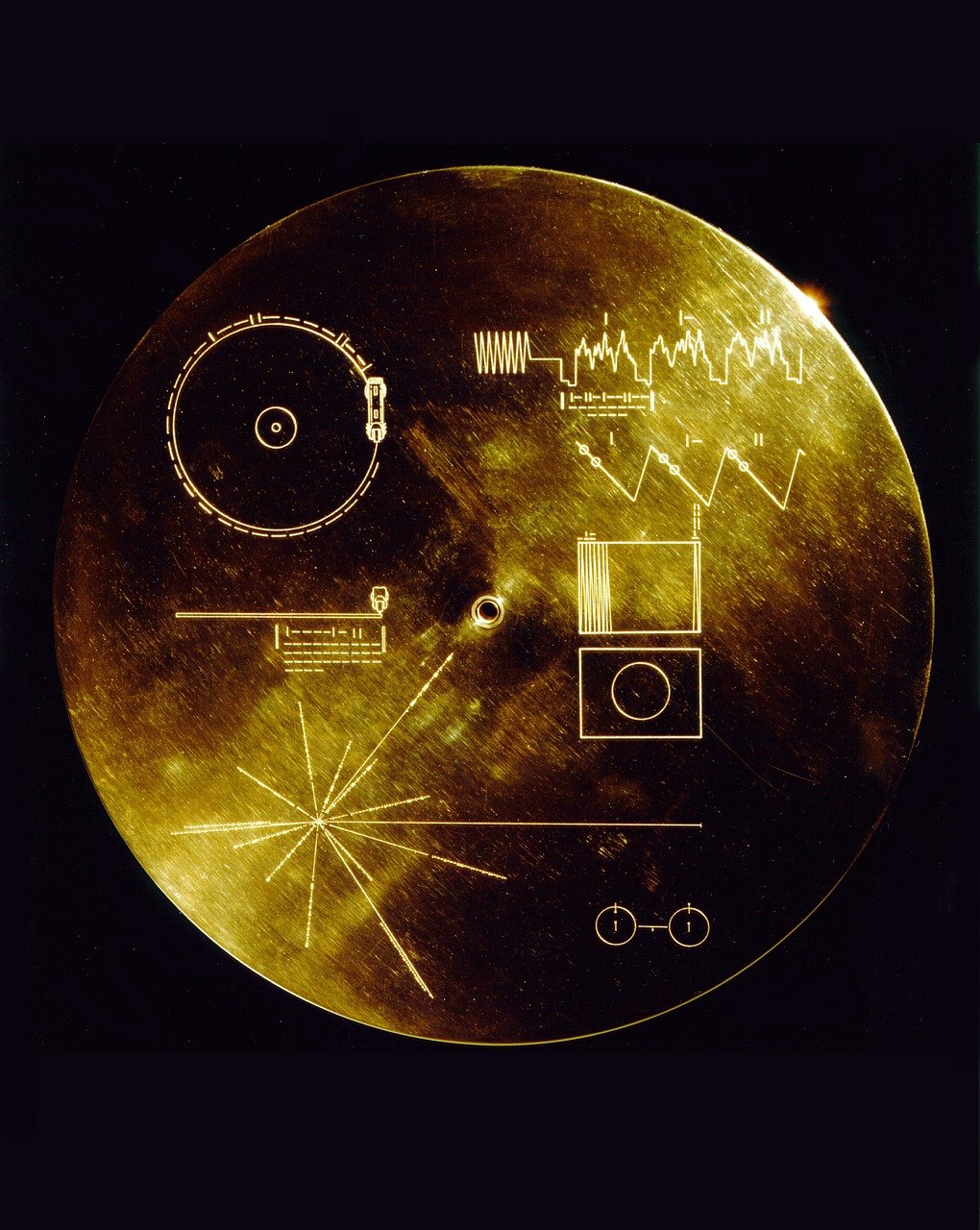
The Urgent Assembly of Earth’s Cosmic Mixtape (Image Credits: Pixabay)
In the summer of 1977, NASA tasked astronomer Carl Sagan with an impossible mission: assemble a snapshot of Earth for two Voyager spacecraft hurtling toward interstellar space. With launches looming just months away, Sagan and a small committee had only six weeks to select sounds, music, images, and messages for a gold-plated copper phonograph record.[1][2] This 12-inch disk, expected to endure for a billion years, became humanity’s deliberate self-portrait, shaped by optimism, cultural biases, and the era’s aspirations.
The Urgent Assembly of Earth’s Cosmic Mixtape
Astronomer Frank Drake, writer Ann Druyan, science journalist Timothy Ferris, and artist Jon Lomberg joined Sagan in a cramped office to curate content for an audience that might never exist. They aimed to explain humans to strangers unfamiliar with faces, voices, or history, producing a deliberately incomplete yet hopeful portrait.[1] Voyager 2 lifted off on August 20, followed by Voyager 1 on September 5, leaving no room for delays in pressing, testing, and mounting the records.
The team encoded roughly 90 minutes of audio at 16-2/3 RPM, alongside over 100 analog images, all protected in aluminum covers with playback instructions etched nearby. Challenges mounted from space limits and rights issues, forcing tough choices under Cold War-era pressures. Their work reflected educated Americans’ view of universal values, blending science, art, and emotion.[1]
Sounds of Life: From Nature’s Whisper to Rockets’ Roar
The audio began with Earth’s primal forces – volcanoes erupting, earthquakes rumbling, thunder crashing, and rain pattering – before shifting to wildlife like frogs, crickets, birds, hyenas, elephants, chimpanzees, and wild dogs. Humpback whale songs added a nod to other intelligent life on the planet.[1] Human elements followed: a heartbeat, footsteps, laughter, and a mother’s first words to her newborn, evoking tenderness and beginnings.
Technology’s march appeared next, from a tractor’s hum and a horse-drawn cart to a train, jet, and the Saturn V rocket launch, tracing progress from agriculture to spaceflight. A distant pulsar signal underscored cosmic context. Notably absent were sounds of destruction, like deforestation or warfare, preserving a narrative of unblemished ascent.[1]
- Natural phenomena: surf, wind, thunder, earthquakes, volcanoes
- Animal calls: birds, frogs, whales, primates
- Human intimacy: laughter, cries, kisses
- Machines of advancement: tools, vehicles, spacecraft
Music’s Universal Language: Classics, Folk, and Rock
Bach dominated with multiple pieces, anchoring a Western classical core alongside Beethoven’s Fifth Symphony, Mozart, and Stravinsky. Global flavors enriched the mix: Navajo night chant, Javanese gamelan, Georgian folk song “Tchakrulo,” Indian raga, Peruvian panpipes, Azerbaijani bagpipes, and Japanese shakuhachi.[1] Chuck Berry’s “Johnny B. Goode” injected rock ‘n’ roll energy, despite debates over its maturity.
Exclusions highlighted gaps: The Beatles’ “Here Comes the Sun” fell to EMI rights refusal, while hip-hop, gospel, sub-Saharan rhythms beyond one Pygmy song, and Arabic music stayed off due to time and oversight. This playlist mapped traditions through a 1977 lens, prioritizing mathematical harmony and romanticized folk over emerging genres.[1][3]
Images and Greetings: A Polished Vision of Earth
Dozens of greetings spanned ancient and modern languages, including English from Sagan’s young son Nick, fostering a parental tone. Images numbered over 100, depicting life positively without war, pollution, famine, or nudity – NASA vetoed explicit figures after Pioneer plaque backlash.[1] The focus stayed on aspiration, avoiding religion, politics, slavery, or genocide.
Printed messages from President Jimmy Carter and U.N. Secretary-General Kurt Waldheim accompanied the visuals. Silhouettes replaced nudes, and vertebrate evolution diagrams showed anatomy indirectly. These choices painted Earth as a beacon of beauty, sidestepping shadows for an Enlightenment ideal.[3]
A Hidden Heartbeat: The Love Story in Brainwaves
Ann Druyan’s contribution pulsed with personal revelation. On June 3, 1977, days after confessing love to Sagan, she lay in a New York lab as EEG captured her hour-long thoughts – spanning history, challenges, and romance – compressed into one minute for the record.[1] This intimate data, kept private for years, wove individual joy into the collective message.
The pair married in 1981, collaborating on Cosmos and Pale Blue Dot until Sagan’s death in 1996. Druyan’s brainwaves symbolized vulnerability amid curation, hinting that love endures as humanity’s core impulse.[4]
Today, Voyager probes race at 38,000 miles per hour, instruments fading as power wanes, yet the exterior records persist. This artifact exposes 1977’s blend of hope and selectivity, more a mirror for us than a decoder for aliens. A modern redo might confront climate crises or digital chaos, but the act of choosing endures as profound self-reflection.[1]
Key Takeaways
- The record prioritizes progress and beauty, omitting destruction and conflict.
- Western classics frame global sounds, revealing cultural defaults.
- Druyan’s brainwaves encode personal love, humanizing the cosmic effort.
What would you add to today’s Golden Record? Tell us in the comments.