

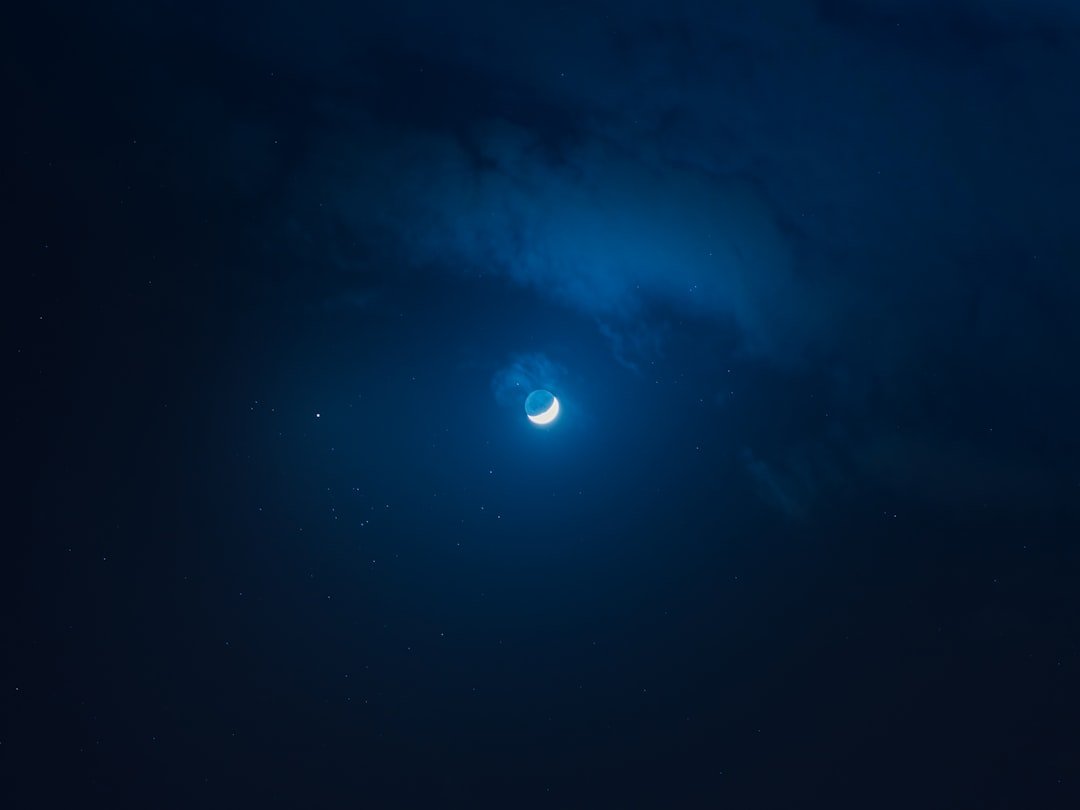
Stunning Proximity Lights Up the West (Image Credits: Unsplash)
Stargazers prepare for a captivating celestial display on April 22, 2026, as the waxing crescent moon glides into close alignment with brilliant Jupiter after sunset. This conjunction places the two luminaries high in the western sky, creating a scene reminiscent of ancient astronomical wonders. Observers from various latitudes can enjoy the pairing, which highlights the dynamic motion of our nearest neighbor alongside the solar system’s largest planet.[1][2]
The event unfolds as twilight deepens, with the moon appearing just north of Jupiter amid the stars of Gemini. Such alignments remind viewers of the predictable yet mesmerizing rhythms of the heavens.[3]
Stunning Proximity Lights Up the West
The moon reaches its closest point to Jupiter at 22:04 UTC on April 22, passing 3 degrees 33 minutes to the north of the planet. At that moment, both share the same right ascension in the constellation Gemini, standing about 49 degrees above the southwestern horizon for mid-northern observers. The waxing crescent moon, five days past new and illuminated at around 42 percent, boasts a magnitude of -11.6, far outshining Jupiter’s steady -2.1 glow.[1]
Jupiter appears as a steady, non-twinkling beacon, its disk spanning 35 arcseconds. The pair remains visible well into the night, with the moon setting after midnight and Jupiter lingering until around 1 a.m. local time by month’s end. This separation allows easy naked-eye detection, though binoculars reveal finer details like the moon’s rugged terminator line.[2]
Navigating to the Gemini Pairing
To locate the duo, face west-southwest as the sun dips below the horizon. Seek the prominent twin stars Castor and Pollux marking Gemini’s heads; Jupiter shines roughly 10 degrees below them, with the crescent moon positioned just above the planet. A fourth-magnitude star, Wasat, lies about 1 degree southeast of Jupiter for added reference.[4][2]
From urban areas, the moon’s brightness punches through light pollution, drawing the eye to Jupiter nearby. Rural skies enhance the view, revealing fainter Gemini stars framing the scene. The configuration shifts slowly westward as the night progresses, offering extended viewing opportunities.[1]
Bonus Sights Accompany the Main Event
April 22 coincides with the peak of the Lyrid meteor shower, active from April 14 to 30. Meteors streak from Lyra, rising late evening and best seen predawn when the radiant nears the zenith. The young moon sets early, preserving dark skies for up to 20 meteors per hour under ideal conditions.[4][3]
Lower in the west, brilliant Venus gleams near the Pleiades star cluster in Taurus, with faint Uranus nearby for binocular hunters. This planetary parade adds depth to the evening tableau, connecting Jupiter’s realm to other solar system wanderers. Gemini’s backdrop completes the picture, evoking mythological twins guarding the sky.[5]
Practical Tips for Optimal Viewing
Choose a spot with a clear western view, away from city lights if possible. Begin observations 30 minutes after sunset, when the sky darkens enough for contrast. Steady binoculars magnify the moon’s craters and earthshine on its dark side, while a small telescope unveils Jupiter’s four Galilean moons and equatorial bands.[4]
Account for local twilight times, as the pair culminates high overhead early evening. Dress warmly for late-night sessions, and use a star app for precise alignment. Avoid optical aids initially to appreciate the raw beauty naked eyes provide.
- Monitor weather for clear skies, prioritizing low humidity.
- Arrive early to acclimate eyes to darkness.
- Track the moon’s motion relative to Jupiter over hours.
- Combine with Lyrid watching after moonset.
- Photograph with wide-angle lens at low ISO.
Key Takeaways
This moon-Jupiter rendezvous underscores the accessible wonders overhead, inviting everyone to connect with the cosmos on a clear April evening. Simple observation yields profound appreciation for orbital dances shaping our skies. What do you think about it? Tell us in the comments.