

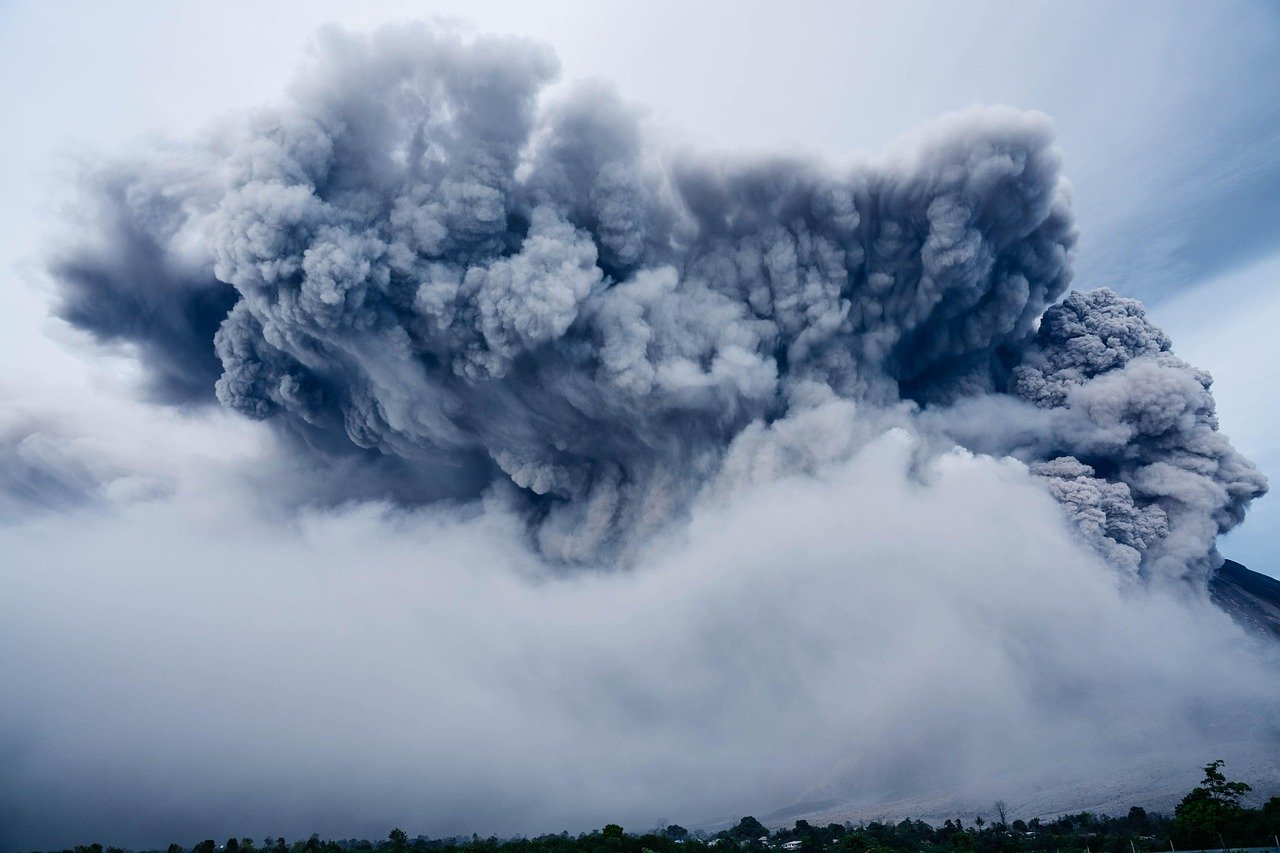
Mount Tambora’s Unprecedented Blast (Image Credits: Pixabay)
Global temperatures plunged in 1816, transforming what should have been a warm summer into a season of frost, snowfalls, and darkened skies across Europe and North America. Mount Tambora’s colossal eruption in Indonesia the year prior released enormous quantities of ash and sulfur aerosols that lingered in the atmosphere, blocking sunlight and triggering widespread crop failures.[1][2] This atmospheric shroud not only cooled the planet by about 3 degrees Celsius but also dimmed the sun’s brilliance, allowing sunspots – dark patches on the solar surface – to become visible to the unaided human eye for the first time in recorded history.[1]
Mount Tambora’s Unprecedented Blast
Mount Tambora, located on the Indonesian island of Sumbawa, had rumbled intermittently since 1812 before unleashing its fury on April 10, 1815. The explosion registered a volcanic explosivity index of 7 – the second-highest category possible and the largest in nearly 10,000 years – propelling 25 cubic miles of debris and 60 megatons of sulfur into the stratosphere.[1][2] Witnesses more than 1,000 miles away mistook the roar for cannon fire, while the initial blast claimed around 10,000 lives directly.
The eruption’s aftermath proved deadlier still. Fine particles circled the Northern Hemisphere, creating a persistent “dry fog” that resisted wind and rain. Global cooling followed, with an estimated 80,000 additional deaths from famine and disease in the ensuing year.[1] Scientists later linked this event to the climatic chaos of 1816, though contemporaries lacked such understanding.
A Dimmed Sun and Visible Sunspots
Solar Cycle 6 reached its peak in May 1816, filling the sun’s face with prominent sunspots – cooler regions caused by intense magnetic activity. Normally invisible without telescopes, these features appeared starkly against the hazy sky that summer. The volcanic aerosols scattered blue light while allowing longer wavelengths to pass, reddening sunsets and muting the sun’s glare.[1][3]
Harvard-educated minister Jonathan Fisher in Maine sketched these solar blemishes in his journals throughout 1816 and into 1817. Reports from Europe echoed the phenomenon, with the London Chronicle noting: “The large spots which may now be seen upon the sun’s disk have given rise to ridiculous apprehensions and absurd predictions. These spots are said to be the cause of the remarkable and wet weather we have had this summer.”[1] Many feared the sun itself was failing, predicting the end of warmth and even the world.
Devastation Across Continents
New England saw snow in June, with frosts killing crops repeatedly through the season. Europe faced relentless rain and cold, leading to riots over food shortages. Famine gripped regions from Switzerland to China, though impacts peaked in the Northern Hemisphere.[1][4]
Migration surged as families sought viable farmland. In the United States, settlers pushed westward from the frost-ravaged Northeast. The crisis amplified existing vulnerabilities, turning a natural disaster into a humanitarian catastrophe.
- Snow and ice persisted into July in parts of New England.
- Crop yields in Europe dropped by half or more in affected areas.
- Food riots erupted in Switzerland and France.
- Temperatures in some U.S. states fell 10 degrees below average for summer months.
- Global harvest failures contributed to price spikes lasting into 1817.
Lasting Cultural Ripples
The gloomy weather confined vacationers, including Lord Byron and Mary Shelley, to a villa on Lake Geneva. Amid endless rain, they conceived ghost stories that birthed Frankenstein and Byron’s poem Darkness, which opened: “I had a dream, which was not all a dream. The bright sun was extinguish’d, and the stars Did wander darkling in the eternal space.”[1] Artist Caspar David Friedrich captured the eerie mood in works reflecting the cold, shadowed landscape.
These creations endure as testaments to human resilience amid unexplained peril. The era’s blend of scientific ignorance and superstition fueled apocalyptic fears, yet also sparked innovation in literature and migration patterns that reshaped societies.
The Year Without a Summer stands as a stark reminder of nature’s power to disrupt global systems. Volcanic aerosols demonstrated their capacity to alter climate on a planetary scale, a lesson echoed in modern studies of eruptions like Pinatubo.[5] Today, on the anniversary of Tambora’s blast, researchers continue to probe such events’ ties to solar observations and weather extremes. What lessons from 1816 resonate most with you today? Share in the comments.
Key Takeaways
- Mount Tambora’s 1815 VEI-7 eruption injected sulfur that cooled Earth by 3°C, creating the “dry fog” of 1816.
- Sunspots from Solar Cycle 6 became naked-eye visible due to atmospheric dimming, sparking fears of solar doom.
- Crop failures led to ~90,000 deaths, mass migrations, and iconic works like Frankenstein.