

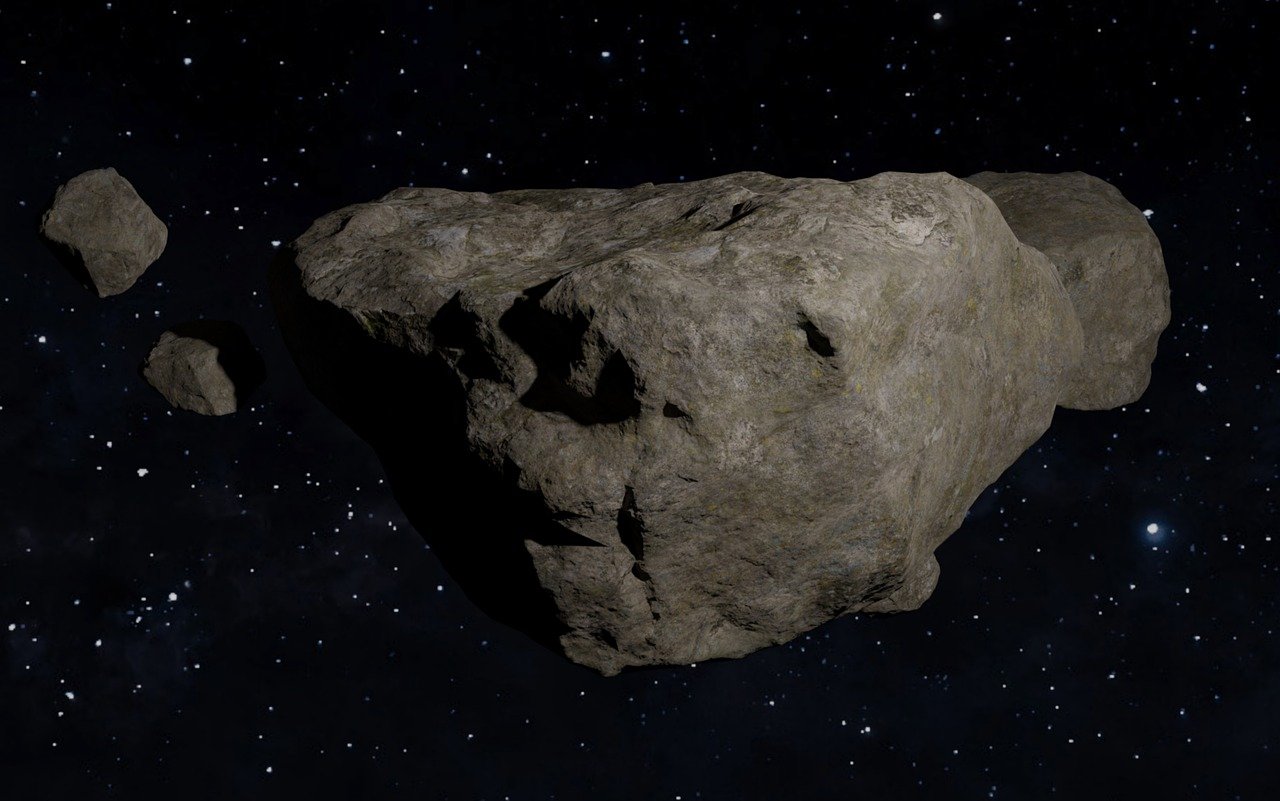
Unveiling the ‘God of Chaos’ (Image Credits: Pixabay)
Europe, Africa, and western Asia stand poised for a remarkable astronomical display on April 13, 2029. Asteroid Apophis, a massive near-Earth object nicknamed for an ancient Egyptian deity of destruction, will streak across evening skies closer to our planet than orbiting satellites. This event marks the nearest passage of such a large asteroid in recorded history, captivating billions with its naked-eye visibility and offering scientists unprecedented insights into cosmic visitors.[1][2]
Unveiling the ‘God of Chaos’
Asteroid 99942 Apophis was discovered on June 19, 2004, at Arizona’s Kitt Peak National Observatory by astronomers Roy A. Tucker, David J. Tholen, and Fabrizio Bernardi. Initial calculations sparked alarm, suggesting a small chance of collision with Earth in 2029 or later decades. Refined observations quickly dispelled those fears, confirming no impact risk for at least the next century.[1]
Researchers named the asteroid Apophis after the serpent-like enemy of the sun god Ra in Egyptian mythology, evoking chaos and darkness. Stretching roughly 340 meters across – comparable to the length of the Eiffel Tower stacked sideways – the peanut-shaped rock belongs to the S-type classification, composed primarily of stony materials akin to LL chondrites. Its tumbling rotation, with a period around 30 hours, adds to its enigmatic profile.[3][1]
A Razor-Thin Passage Through Our Skies
At 21:46 UTC on April 13, 2029, Apophis will reach its closest point, just 31,600 kilometers above Earth’s surface – five times the planet’s radius and nearer than geostationary satellites at 36,000 kilometers altitude. Traveling at 6 kilometers per second on approach, Earth’s gravity will accelerate it to 7.4 kilometers per second before it recedes. This proximity ensures peak brightness of magnitude 3.1, making it discernible without telescopes in dark suburban or rural skies.[1]
Observers across Europe, Africa, and western Asia – potentially 2 billion people – will track its northwest path from Centaurus through Perseus to Pisces over about 24 hours, spanning a 205-degree arc. Angular speed could hit 42 degrees per hour at peak, creating a blazing trail visible for one evening. Weather and light pollution will influence views, but the spectacle promises to rival major meteor showers in drama.[2][1]
Earth’s Gravity Reshapes a Cosmic Wanderer
The flyby represents a natural experiment for planetary scientists. Tidal forces from Earth will stretch and squeeze Apophis, potentially triggering landslides, seismic activity, or shifts in its rotation state. These disturbances could expose subsurface materials, altering its surface from an Sq spectral type toward a fresher Q-type. Post-encounter, its orbit expands: semi-major axis from 0.92 AU to 1.1 AU, shifting classification from Aten to Apollo group with a lengthened period of about 1.2 years.[4][3]
Space agencies seize this rare window. NASA’s OSIRIS-APEX mission, repurposed from the Bennu sample return, arrives shortly after closest approach to map changes and eject surface particles. The European Space Agency advances its RAMSES probe to rendezvous during the event, deploying CubeSats for gravity field measurements and high-resolution imaging. Ground-based radar from facilities like Goldstone will refine shape models, while global telescopes monitor trajectory perturbations.[5][4]
Observing Tips for the Flyby
Preparation enhances the experience for enthusiasts. Clear horizons facing south to southwest prove ideal during evening twilight. Binoculars or small telescopes reveal details like its elongated form at opposition-like closeness.
- Check local astronomy apps for real-time position trackers closer to 2029.
- Prioritize sites with low light pollution, such as rural hills in Spain, Morocco, or Turkey.
- Join coordinated campaigns via NASA’s International Asteroid Warning Network for citizen science data.
- Monitor weather forecasts; the event unfolds over one night but peaks briefly.
- Use apps like Stellarium to simulate the path from your location.
Such events occur roughly every few thousand years for asteroids this size, underscoring the flyby’s uniqueness.[3]
Key Takeaways
- Apophis passes safely at 31,600 km, visible to naked eye for 2 billion in the Eastern Hemisphere.
- Earth’s gravity induces potential quakes and orbit shift on the 340-meter asteroid.
- Missions like OSIRIS-APEX and RAMSES deliver close-up data for planetary defense.
Apophis’ 2029 rendezvous reminds humanity of our dynamic solar neighborhood and the value of vigilant monitoring. This safe spectacle bolsters readiness against future threats, transforming potential peril into profound knowledge. What viewing plans do you have, or how might this shape asteroid defense strategies? Share in the comments.