

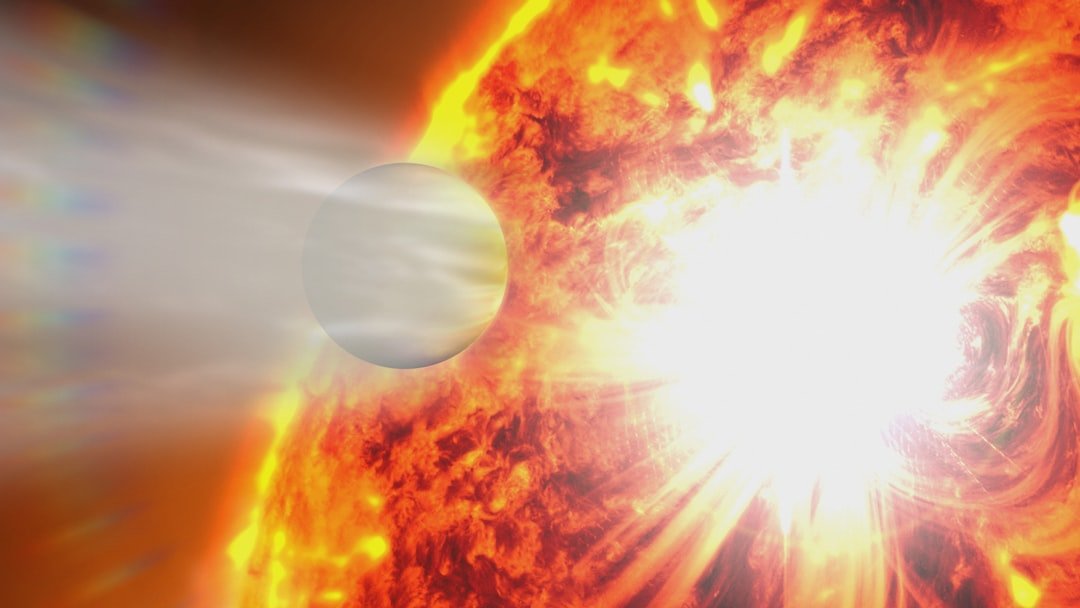
Satellites Face Immediate and Lasting Damage (Image Credits: Unsplash)
United Kingdom – A comprehensive report from British scientists has illuminated the severe threats posed by an extreme solar storm to the technologies that underpin daily life. Released in January 2026 by the Science and Technology Facilities Council, the document analyzes worst-case space weather scenarios occurring roughly every 100 to 200 years.[1][2] These events, driven by powerful coronal mass ejections from the sun, could trigger geomagnetic storms capable of disrupting satellites, navigation systems, and electrical infrastructure worldwide. With Solar Cycle 25 approaching its maximum activity phase, the findings underscore vulnerabilities in an increasingly space-reliant society.
Satellites Face Immediate and Lasting Damage
Charged particles from a massive solar eruption represent one of the gravest dangers to orbiting spacecraft. These bursts penetrate satellite shielding, damaging electronics and degrading solar panels that power the vehicles.[1] In severe instances, such exposure shortens operational lifespans by years or leads to outright failure.
Additionally, X-rays from solar flares heat and expand Earth’s upper atmosphere, heightening drag on low-Earth orbit satellites. This phenomenon accelerated the re-entry and destruction of up to 40 Starlink satellites during a 2022 event, complicating efforts to track space debris and active spacecraft.[1] Operators would struggle to maintain constellations essential for internet, imaging, and defense applications.
GPS and Navigation Systems Under Siege
Global Navigation Satellite Systems like GPS rely on precise signals vulnerable to ionospheric disturbances from geomagnetic storms. The report describes widespread degradation or complete loss of service lasting several days as the ionosphere becomes unstable.[1]
Such outages ripple through aviation, shipping, and agriculture. A strong event in May 2024 already inflicted $500 billion in losses on U.S. farming due to navigation failures.[1] Precision farming, autonomous vehicles, and financial timestamping would grind to a halt without backups.
Power Grids on the Brink of Collapse
Geomagnetic storms induce powerful currents in long power lines, mimicking short circuits and tripping protective relays. Regional blackouts could ensue, with transformers overheating and failing prematurely.[1][2]
Repair challenges compound the crisis: damaged high-voltage transformers require months or years to replace, slashing grid capacity and prolonging outages. Past incidents, such as the 2003 storm that darkened parts of Sweden and South Africa, offer stark precedents.[1] At northern latitudes like the UK’s, effects intensify due to stronger induced currents.
Broader Disruptions to Communications and Aviation
Solar flares emit radio waves that overwhelm high-frequency signals on Earth’s dayside for about an hour, blacking out radar and navigation aids. Longer-term, ionospheric scintillation disrupts very high and ultra-high frequency bands used by aircraft and ships for days.[1]
Flight operations might pause, while aircrews at high latitudes face elevated radiation doses, prompting duty restrictions. Mobile networks remain resilient, but undersea cables and long-haul links could falter indirectly through power losses.
- Radio blackouts: Up to 1 hour per flare event.
- HF communications: Degraded for days.
- VHF/UHF aviation links: Unreliable during peak storm.
- Radiation risks: Heightened for polar flights.
- Secondary effects: Cascading failures in water, fuel, and finance sectors.
Historical Echoes and Urgent Preparations
The May 2024 geomagnetic storm marked the strongest since 2003, yet fell short of worst-case projections. Improved solar monitoring now provides hours or days of warning, enabling protective measures like satellite safing or grid adjustments.[1]
Analyses peg economic tolls in the trillions for major economies, with UK damages alone reaching tens of billions of pounds. Recovery could span years, emphasizing needs for hardened transformers, GPS alternatives like eLoran, and stockpiled spares.[2]
| Impact Area | Duration | Potential Consequences |
|---|---|---|
| Satellites | Weeks to permanent | Electronics failure, orbital decay |
| GPS | Several days | Navigation blackouts, economic losses |
| Power Grids | Days to years | Blackouts, transformer replacements |
- Worst-case events recur every 100-200 years, with global repercussions.
- Modern forecasting aids mitigation but cannot eliminate risks.
- Investments in resilient infrastructure remain critically underfunded.
While no doomsday awaits, the report stresses proactive defenses to safeguard interconnected systems. Societies must balance these rare threats against everyday demands. What steps should governments prioritize? Share your thoughts in the comments.