

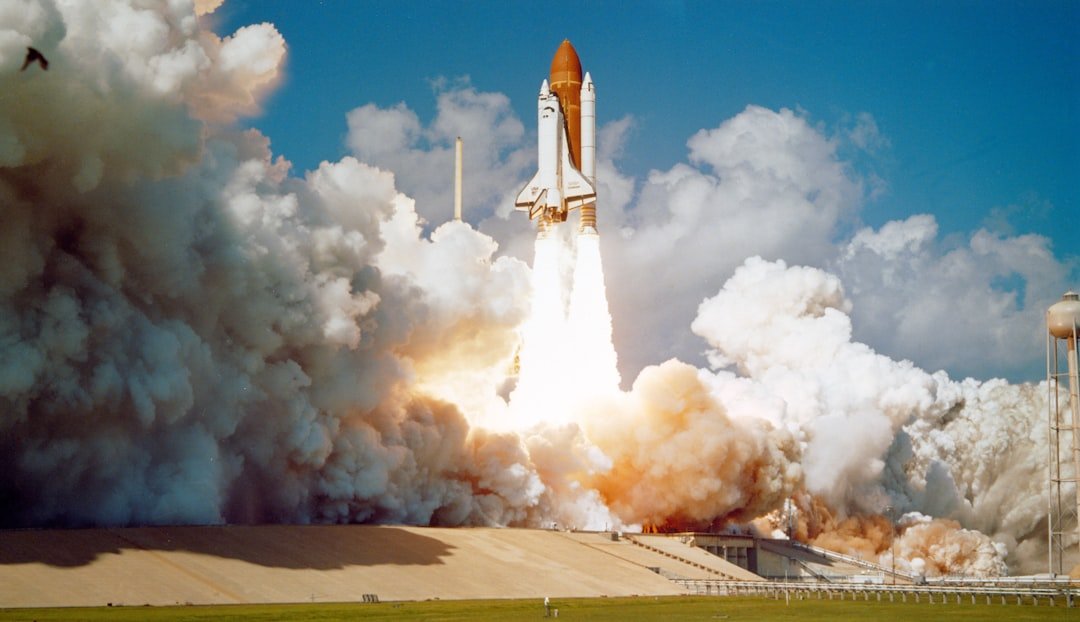
A Vision Born in the 1970s (Image Credits: Unsplash)
Kennedy Space Center, Florida – Exactly 45 years ago, on April 12, 1981, the roar of Space Shuttle Columbia’s engines shattered a six-year lull in American crewed spaceflight. This maiden voyage, known as STS-1, tested a revolutionary reusable spacecraft designed to carry astronauts, satellites, and supplies into orbit routinely.[1][2] Pilots John Young and Robert Crippen guided the orbiter through its paces, proving the viability of a winged vehicle that could launch like a rocket and land like an airplane. The mission’s success paved the way for decades of orbital achievements, even as it carried immense risks.
A Vision Born in the 1970s
President Richard Nixon greenlit the Space Shuttle program in 1972, seeking a cost-effective alternative to expendable rockets. NASA envisioned a fleet of reusable orbiters to support routine access to space, including satellite deployments and future space stations. The first test vehicle, Enterprise, underwent atmospheric glide tests, while Columbia became the inaugural operational shuttle.[1]
Development spanned nearly a decade, involving thousands of engineers and billions in funding. Engineers integrated solid rocket boosters, external fuel tanks, and three space shuttle main engines into a system never before flown with humans aboard. STS-1 represented the boldest “all-up” test in aviation history, where every major component operated simultaneously for the first time.[3]
The Veteran Crew Tackles Unprecedented Risks
John Young, a NASA icon with Gemini, Apollo, and lunar landing experience, commanded the flight. At 50, he became the first person to fly six space missions. Robert Crippen, a naval aviator on his debut flight, served as pilot. NASA selected them in 1978 for their expertise in high-stakes testing.[2]
The duo strapped in for over six hours on launch day after a computer glitch scrubbed an April 10 attempt. Risks loomed large: engineers later estimated a one-in-nine chance of catastrophe, far higher than NASA’s public one-in-100,000 figure. Thermal tiles could dislodge, engines might fail asymmetrically, or the orbiter could tumble uncontrollably. Young later reflected that undisclosed issues during reentry nearly prompted an ejection.[4][5]
Liftoff to Orbit: A Nail-Biting Ascent
Columbia thundered skyward at 7:00 a.m. EST from Pad 39A, accelerating to 17,500 mph. The crew monitored four onboard computers and witnessed payload bay doors opening flawlessly in orbit. Over 54 hours, they completed 37 Earth laps, testing systems from hydraulics to life support.[6]
Mission control tracked anomalies like unexpected vibrations and tile damage from launch debris. Still, the shuttle performed admirably, validating the reusable design. Crippen’s heart rate spiked to 130 beats per minute near liftoff, while Young’s stayed calm at 90.[7]
Reentry and the First Winged Landing
On April 14, weather forced a shift from Kennedy to Edwards Air Force Base. Columbia fired its orbital maneuvering engines for deorbit burn, then endured 3,000-degree plasma during reentry. The crew glided unpowered for 13 minutes, touching down at 214 mph on the lakebed runway.
This marked the first orbital return on wheels, not parachutes. Post-flight inspections revealed 16,000 dislodged tiles and burn-throughs, yet the vehicle survived. Young and Crippen emerged unscathed, waving to cheering crowds.[8]
Enduring Legacy of the Shuttle Program
STS-1 launched 135 missions over 30 years, deploying Hubble, building the International Space Station, and flying 355 astronauts. Tragedies struck with Challenger in 1986 and Columbia in 2003, claiming 14 lives and prompting safety overhauls. Atlantis’ STS-135 landing on July 21, 2011, closed the chapter.[1]
- Reusability slashed costs compared to Apollo-era rockets.
- Shuttles serviced observatories and ferried modules to orbit.
- Program bridged to private spacecraft like SpaceX’s Crew Dragon.
- Over 4,000 orbits by Columbia alone across 28 flights.
- Coincided with Yuri Gagarin’s 20th flight anniversary.
Key Takeaways
- STS-1 proved humans could fly reusable orbiters despite high risks.
- Young and Crippen’s calm piloting set the standard for shuttle crews.
- The mission enabled decades of science, from Hubble repairs to ISS assembly.
Forty-five years on, STS-1 stands as a testament to human ingenuity and courage, transitioning spaceflight from one-off rockets to sustainable platforms. As Artemis eyes lunar returns and Mars, Columbia’s legacy endures in every winged ascent. What lessons from that first flight resonate most with you today? Share in the comments.