

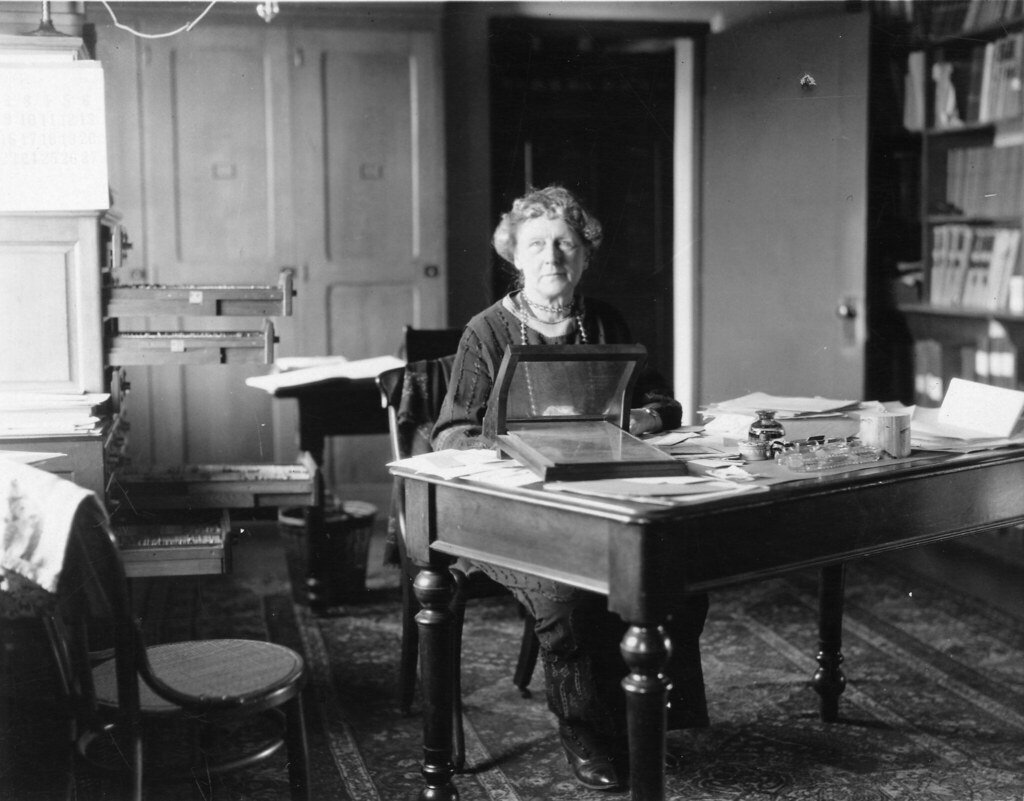
Sparking a Lifelong Passion Under Delaware Skies (Image Credits: Flickr)
Cambridge, Massachusetts – On April 13, 1941, pioneering astronomer Annie Jump Cannon died at the age of 77, leaving behind a monumental contribution to the field. Her meticulous classification of hundreds of thousands of stars revolutionized how scientists organize and study the night sky. From humble beginnings in Delaware to her groundbreaking work at Harvard, Cannon’s life exemplified dedication amid challenges faced by women in science.
Sparking a Lifelong Passion Under Delaware Skies
Annie Jump Cannon entered the world in Dover, Delaware, on December 11, 1863. Her mother ignited her fascination with the stars during childhood evenings spent stargazing together. This early exposure laid the foundation for a career that would span decades.
Cannon pursued formal education at Wellesley College in Massachusetts, where she majored in physics and astronomy. Upon graduation, she turned her attention to photography, honing skills that later proved invaluable in astronomical analysis. Tragedy struck in 1894 with her mother’s death, prompting Cannon to return to her celestial roots. She enrolled as a special student at Radcliffe College, affiliated with Harvard, marking the start of her professional journey.
Joining the Ranks of Harvard’s Trailblazing Women
At Harvard College Observatory, Cannon joined a team dubbed “Pickering’s women” under director Edward Pickering. These skilled researchers, often called computers, performed detailed calculations and examinations of star photographs. Predecessors like Williamina Fleming and Antonia Maury had already advanced stellar studies, setting the stage for Cannon’s innovations.
Tasked with analyzing photographic plates, Cannon scrutinized over 1,100 stars. She developed a refined classification system based on stellar colors, which correlate directly with surface temperatures. This sequence – O, B, A, F, G, K, M – became the standard Harvard spectral classification. Astronomers still recall it through the mnemonic “Oh! Be A Fine Girl – Kiss Me!”
Publishing a Cosmic Catalog and Rising Prominence
Cannon’s system debuted in the Henry Draper Catalogue, a comprehensive inventory of stellar spectra. The International Astronomical Union formally adopted it in 1922, cementing its global acceptance. Her exhaustive efforts elevated her to curator of astronomical photographs at Harvard Observatory.
Throughout her career, Cannon classified an astonishing 350,000 stars by hand – more than any other astronomer in history. She also identified numerous variable stars and novae, expanding knowledge of stellar behavior. These accomplishments highlighted her precision and endurance in a male-dominated era.
- Developed the OBAFGKM spectral sequence based on temperature.
- Contributed to the Henry Draper Catalogue, classifying thousands of stars.
- Served as curator of Harvard’s observational photographs.
- Discovered variable stars and novae through diligent plate analysis.
- Classified 350,000 stars over her lifetime.
Accolades and a Legacy That Shines On
Cannon broke barriers with a Ph.D. from the University of Groningen in the Netherlands, becoming the first woman to earn one there. She later received an honorary doctorate from Oxford University, among other distinctions. In 1938, Harvard named her the William Cranch Bond Astronomer.
Her influence persists through the Annie Jump Cannon Award, established by the American Astronomical Society in 1933. This honor recognizes promising female postdoctoral researchers in North American astronomy. Recipients have advanced fields like stellar evolution and gravitational lensing, carrying forward her pioneering spirit.
Key Takeaways:
- Cannon’s spectral system remains the backbone of modern stellar classification.
- She overcame gender barriers to classify 350,000 stars manually.
- The Annie Jump Cannon Award continues to empower women in astronomy.
Annie Jump Cannon’s work turned chaos into order among the stars, providing tools that astronomers rely on today. Eighty-five years after her death, her classification scheme guides observations from Earth and beyond. What aspect of her story inspires you most? Share in the comments below.