

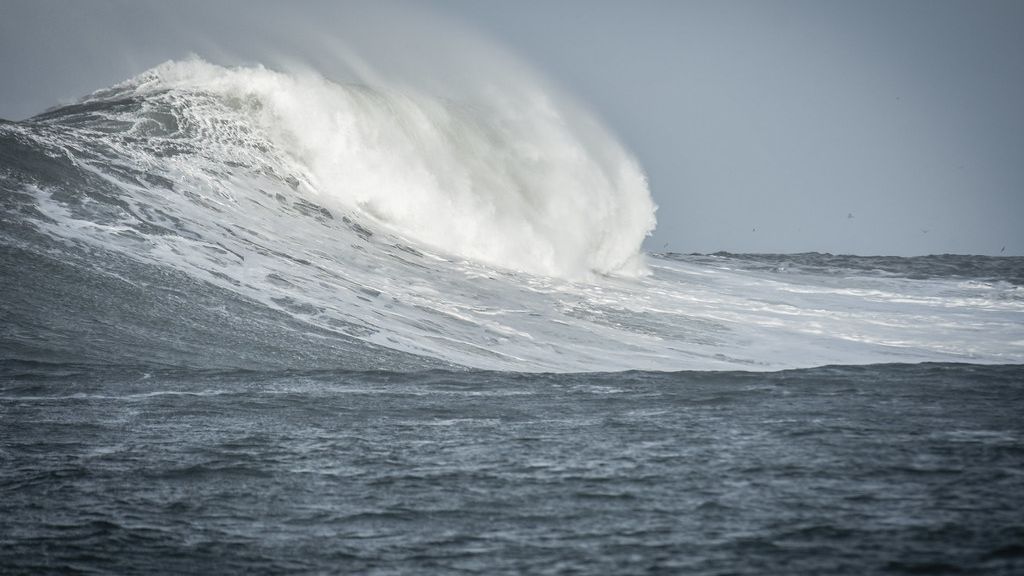
Development of the PlanetWaves Framework (Image Credits: Flickr)
Earth’s oceans respond predictably to wind, from subtle ripples to towering swells. Researchers at the Massachusetts Institute of Technology have now modeled how such dynamics shift dramatically on other celestial bodies. Their work, detailed in a recent study, examines waves in everything from hydrocarbon seas to molten rock surfaces, revealing environments where breezes generate giants and gales produce mere flutters.
Development of the PlanetWaves Framework
The team introduced the PlanetWaves model to forecast wave formation and behavior on rocky planets and moons. This tool accounts for diverse liquids, atmospheres, and gravitational forces, extending beyond Earth’s familiar water-based systems. Published on April 3, 2026, in JGR Planets, the peer-reviewed paper applied the model to Saturn’s moon Titan, ancient Mars, and three exoplanets.
Validation came first from Earth data, including measurements from buoys on Lake Superior. The model accurately predicted required wind speeds and resulting wave heights there. Researchers then scaled it to extraterrestrial settings, incorporating factors like liquid density and viscosity.
Titan’s Methane Seas: Waves from a Whisper of Wind
Saturn’s moon Titan stands out as the only known world besides Earth with stable surface liquids – vast lakes and seas of methane and ethane. The PlanetWaves simulations indicated that even mild winds could produce substantial waves on these bodies. Titan’s lower gravity and thinner atmosphere facilitate this, allowing waves to grow tall and propagate slowly.
Lead author Una Gaylin Schneck, a graduate student in MIT’s Department of Earth, Atmospheric and Planetary Sciences, highlighted the implications for future missions. Instruments landing on Titan’s lakes would need to endure these potentially powerful motions. Co-author Taylor Perron, a professor in the same department, added that the model addresses gaps in observations, limited so far to radar from the Cassini spacecraft amid Titan’s hazy shroud.
Ancient Mars and Exoplanets: A Spectrum of Wave Behaviors
On ancient Mars, the model suggested waves once formed readily in lakes and a possible northern ocean under a denser atmosphere. As that air thinned over time, stronger winds became necessary to stir the waters. This evolution aligns with geological evidence of past liquid surfaces now dry.
The study extended to three exoplanets, each presenting unique challenges. LHS 1140 b, a super-Earth with potentially habitable water oceans, would see diminished waves from Earth-like winds due to its higher gravity. Kepler 1649 b, resembling Venus, features lakes of dense sulfuric acid; simulations showed ripples demand fierce gusts. Most extreme was 55 Cancri e, a lava-covered world where 80 mph hurricane-force winds barely raised waves a few centimeters high, hindered by viscous molten rock and strong gravity.
Andrew Ashton, an associate scientist at the Woods Hole Oceanographic Institution and study co-author, emphasized how these scenarios upend Earth-centric assumptions. The model captures initial ripple formation through full swells, influenced by surface tension and pressure. Such insights could explain features like the scarcity of river deltas on Titan, where waves might erode sediments before they accumulate.
These findings not only test planetary conditions but also refine mission designs and interpretations of remote data. For instance, they inform probes targeting Titan’s Kraken Mare, the solar system’s largest hydrocarbon sea beyond Earth.
Key Influences on Wave Formation
Gravity, atmospheric density, and liquid properties dictate wave characteristics across worlds. Past efforts focused mainly on gravity’s role, but PlanetWaves quantifies additional variables like viscosity and composition. Schneck noted this comprehensive approach as a major advance.
Different liquids yield distinct responses: hydrocarbons on Titan flow more readily than Earth’s water under similar winds, while lava resists motion intensely. Atmospheric pressure modulates energy transfer from wind to surface, further diversifying outcomes.
The PlanetWaves model opens a window into unseen ocean dynamics, from Titan’s enigmatic shores to distant exoplanets. As missions advance, these predictions will guide exploration and deepen our grasp of liquid worlds. Ultimately, they remind us that familiar phenomena like waves adapt profoundly to alien contexts, challenging intuition and spurring discovery.