

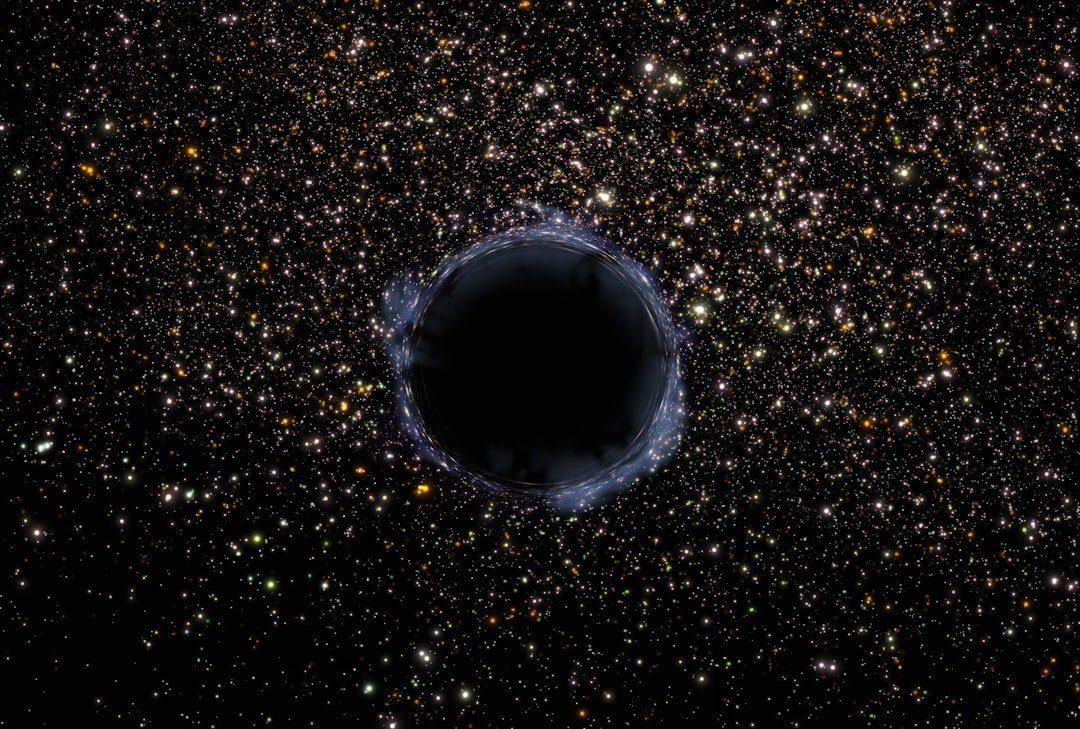
Decades of Data Reveal Hidden Jets (Image Credits: Unsplash)
Astronomers have achieved a milestone by uncovering direct evidence of two supermassive black holes orbiting each other at the core of galaxy Markarian 501. This binary system, captured through long-term radio observations, marks the closest such pair ever reliably detected. Researchers predict the giants could merge within the next century, offering a rare window into one of the universe’s most violent events.
Decades of Data Reveal Hidden Jets
Over 23 years, scientists gathered high-resolution radio observations on dozens of occasions across multiple frequencies. These efforts exposed two powerful particle jets streaming from the galactic center at nearly the speed of light. One jet pointed directly toward Earth, appearing exceptionally bright, while the second emerged more subtly from behind the primary black hole.
The team tracked the second jet’s movement, which shifted counterclockwise around the larger black hole over mere weeks. Such dynamic changes provided unmistakable signs of orbital motion. In June 2022, the system produced a striking ring of radiation – an Einstein ring formed by gravitational lensing as light from the fainter jet bent around its companion.
Pinpointing the Black Holes’ Dance
The black holes, with combined masses between 100 million and a billion times that of the sun, maintain a separation of 250 to 540 astronomical units – roughly the distance from Earth to the sun multiplied by that factor. They complete orbits every 121 days, placing them in the final stages before merger. Direct imaging proved impossible due to the galaxy’s vast distance, but jet patterns confirmed their presence.
Analysis of brightness variations and positional shifts over time ruled out alternative explanations. The swaying orbital plane evoked the sensation of motion on a ship, as described by the researchers. This configuration aligns with theoretical models of binary supermassive black holes in merging galaxies.
Cosmic Implications and Future Waves
Supermassive black holes anchor nearly every large galaxy, growing through mergers during galactic collisions. Prior detections of close pairs remained unreliable, leaving gaps in understanding the merger process. Markarian 501 now stands as a prime example, validating long-held theories.
Future observations may detect low-frequency gravitational waves from the system via pulsar timing arrays. These ripples could intensify as the black holes spiral inward. The discovery enhances models of black hole evolution and galaxy formation across the cosmos.
- First direct imaging of jets from a close supermassive black hole binary.
- Orbital period of 121 days, separation of 250-540 AU.
- Potential gravitational wave source observable soon.
- 23 years of radio data spanning multiple frequencies.
- Einstein ring observed in June 2022.
Insights from the Lead Researchers
Silke Britzen, lead author from the Max Planck Institute for Radio Astronomy in Bonn, expressed astonishment at the findings. “We searched for it for so long, and then it came as a complete surprise that we could not only see a second jet, but even track its movement,” she said. Britzen added, “Evaluating the data felt like being on a ship. The entire jet system is in motion. A system of two black holes can explain this: The orbital plane sways.”
Co-author Héctor Olivares from Goethe University Frankfurt highlighted the merger’s prospects. “If gravitational waves are detected, we may even see their frequency steadily rise as the two giants spiral toward collision, offering a rare chance to watch a supermassive black hole merger unfold.”
The study, accepted for publication in Monthly Notices of the Royal Astronomical Society, builds on work detailed in an EarthSky report.
Key Takeaways
- This marks the first confirmed close pair of supermassive black holes, resolving a long-standing observational challenge.
- The 100-year merger timeline positions Markarian 501 as a unique laboratory for studying extreme gravity.
- Advancements in radio astronomy enabled the breakthrough, paving the way for gravitational wave confirmations.
As astronomers monitor Markarian 501, this discovery promises to reshape our grasp of black hole mergers and galactic growth. The impending collision underscores the dynamic nature of the universe. What implications do you see for future observations? Share your thoughts in the comments.