

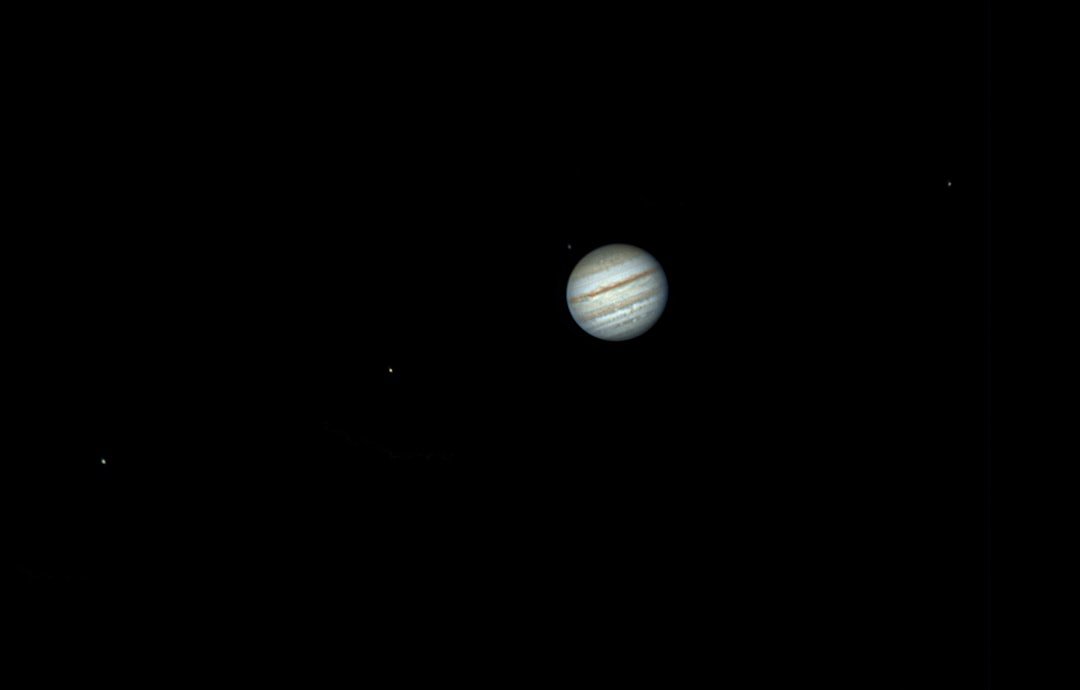
Europa Takes Center Stage with a Shadow Transit (Image Credits: Unsplash)
Evening skies across the central and western United States offer a prime view of Jupiter this Monday, April 13. The planet gleams as the brightest beacon in Gemini the Twins, gradually descending toward the western horizon after sunset. Observers with binoculars or small telescopes can witness a sequence of subtle yet mesmerizing events involving two of its largest moons, Europa and Io.
Europa Takes Center Stage with a Shadow Transit
A small, dark silhouette emerges on Jupiter’s disk as twilight deepens. Europa, the icy moon, transits the planet’s face from east to west. Skywatchers on the East Coast spot its shadow first at the eastern limb around 11:42 p.m. EDT.
The shadow’s appearance proves faint at first, requiring steady magnification to detect. It crosses the disk and vanishes from the western edge less than 20 minutes later. Meanwhile, Europa itself slips off the planet’s western side and heads toward Io’s position farther west.
The Highlight: Moons Crossing Paths
Io moves eastward from its western post while Europa continues westward, setting up a rare conjunction. Shortly after midnight CDT, the two moons align closely, with Io positioned just 5 arcseconds north of Europa.
This crossing occurs as Jupiter sinks lower in the sky. Io then approaches the planet more closely and vanishes behind the western limb in an occultation at 1:15 a.m. CDT. Europa’s shadow follows suit, disappearing from view about 20 minutes later for viewers in the western two-thirds of the U.S.
Ganymede and Callisto remain visible to Jupiter’s east, with Ganymede nearer and Callisto farther out. The configuration highlights the dynamic orbits of these Galilean satellites.
How to Spot the Event Sequence
Jupiter stands out prominently in Gemini after sunset, around 7:37 p.m. local time from central U.S. locations. A steady pair of binoculars reveals the planet and its four main moons as pinpoints of light.
Small telescopes at 50x magnification or higher bring out the transits, shadows, and crossings. Patience pays off, as contrasts sharpen under dark skies away from city lights.
- Locate Jupiter low in the west as darkness falls.
- Monitor for Europa’s shadow near 11:42 p.m. EDT (adjust for your time zone).
- Track Europa exiting west, approaching Io.
- Watch the crossing post-midnight CDT.
- Note Io’s occultation and final shadow exit.
Catch a Brightening Comet the Night Before
Comet C/2025 R3 (PanSTARRS) reached greater brightness on April 12. This visitor adds to the week’s celestial highlights, visible under clear conditions.
For broader viewing, consult detailed almanacs tailored to local horizons. The waning crescent Moon, at 14 percent illumination, rises late and sets early, minimizing interference.
| Event | Time (Central U.S.) |
|---|---|
| Sunrise | 6:25 a.m. |
| Sunset | 7:37 p.m. |
| Moonrise | 4:26 a.m. |
| Moonset | 3:52 p.m. |
Times reference 40° N., 90° W.; adjust for your latitude and longitude.
Why These Moments Captivate Astronomers
Such alignments showcase gravitational interplay among Jupiter’s moons, discovered by Galileo centuries ago. Events like these occur periodically due to their resonant orbits but demand precise timing and clear views.
Western observers enjoy the full show into early morning hours. Eastern viewers catch the initial phases before the planet sets.
Key Takeaways
- Europa’s shadow transits first, visible from ~11:42 p.m. EDT.
- Io and Europa cross ~5 arcseconds apart after midnight CDT.
- Best seen with telescopes; Jupiter in Gemini west after sunset.
This orbital ballet reminds us of the solar system’s intricate machinery. Grab your gear and step outside – what lunar dance will you catch next? Share your views in the comments.