

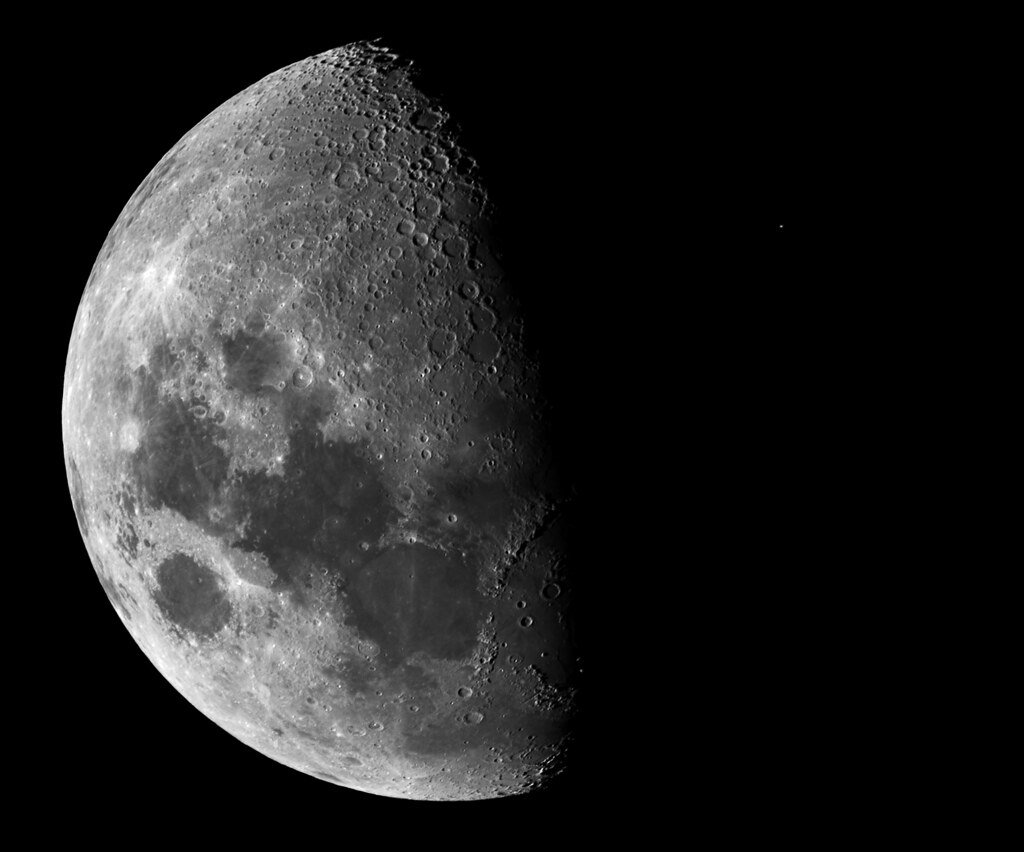
A Star Vanishes in an Instant (Image Credits: Flickr)
Eastern United States – Astronomy enthusiasts across North America prepare for a striking celestial performance on April 25-26, 2026. The waxing gibbous Moon, nearly 71% illuminated, will slide in front of Regulus, the blazing heart of the constellation Leo. This occultation offers observers a chance to witness the star’s sudden disappearance and dramatic reappearance, capping off the current series of such events visible from the continent.
A Star Vanishes in an Instant
Regulus will blink out abruptly as the Moon’s dark leading edge overtakes it, a hallmark of lunar occultations. Unlike a gradual eclipse caused by atmospheric dimming, the Moon’s negligible atmosphere ensures a sharp cutoff. Observers often describe the moment as mesmerizing, with the star simply gone one second and present the next.
Reappearance follows at the bright trailing limb, sometimes revealing a bluish tint due to contrast with the Moon’s surface. Videos from earlier 2026 events capture this precision, highlighting why telescopes enhance the experience. The event’s brevity in some locations adds urgency, lasting from seconds along grazing paths to over an hour centrally.
Mapping the Path of Visibility
The occultation track sweeps through the eastern United States, Central America, and northeastern South America. Nighttime viewing favors areas between white lines on prediction maps, with twilight conditions in blue zones and daytime in red-dotted regions. Cyan-shaded areas mark moonrise or moonset opportunities.
Along the northern boundary near Princeton, New Jersey, a grazing occultation unfolds around 9:00 p.m. local time, with Regulus flickering behind lunar mountains for about eight minutes. In Miami, the star remains hidden for roughly one hour and 24 minutes. Times vary by location; detailed predictions for cities appear in specialized resources from Sky & Telescope.
Regulus: Leo’s Radiant Core
Regulus anchors Leo as its alpha star, shining at first magnitude about 78 light-years distant. This blue-white subgiant spins rapidly, completing a rotation every 15.9 hours. The speed flattens it at the poles and bulges the equator, measurements confirmed through occultations and interferometry.
Only four such bright stars – Regulus, Spica, Antares, and Aldebaran – cross the Moon’s path regularly. Each endures its own occultation season, shaped by the lunar orbit’s 18.6-year cycle. Patience rewards skywatchers, as clouds or poor timing often obscure these spectacles.
Mastering the Observation
Secure a clear horizon eastward, where the Moon rises prominently. Twilight viewers along the Eastern Seaboard catch the disappearance with the naked eye, though glare challenges reappearance spotting for at least 15 minutes. Midwest observers time it near sunset, while western sites demand optical aid amid daylight.
Telescope users gain the edge with magnification and glare reduction. Binoculars suffice for many, but dual setups aid photographers: one for imaging, another for timing.
- Position scopes apart to avoid vibrations.
- Employ remote shutter releases.
- Attempt daytime views; Regulus remains detectable even in sunlight.
- Report grazes or unusual colors to astronomical databases.
- Consult local predictions for exact timings in UT, adjusting for time zones (subtract 4 hours for EDT, 5 for CDT, etc.).
The Cycle Draws to a Close
This April event concludes the North American occultation series that began in July 2025 and runs through December 2026. Future opportunities arrive in June 2036, underscoring the rarity of these alignments. Each provides fresh insights into stellar dimensions and lunar limb precision.
Global tracks shift predictably, but regional visibility hinges on geometry. Enthusiasts track predictions years ahead, planning travels for optimal sites.
Key Takeaways
- April 25-26, 2026: Final North American occultation of Regulus.
- Eastern U.S. prime for naked-eye disappearance; telescopes essential elsewhere.
- Check city-specific times and maps for your location.
As the Moon claims Regulus one last time this cycle, it reminds us of the sky’s intricate dances. Will you venture out to witness this stellar vanishing act? Share your plans or past occultation stories in the comments.