

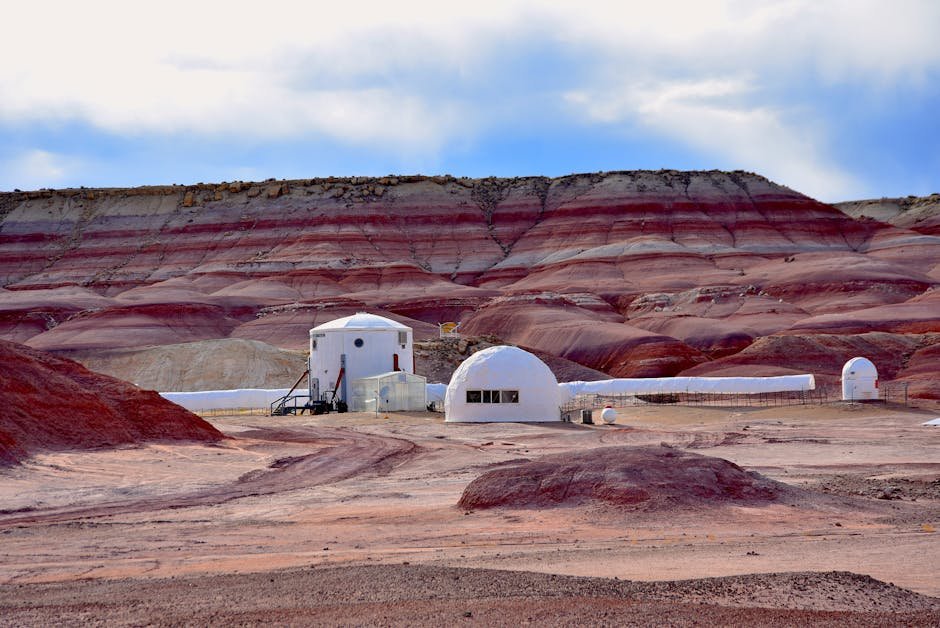
Compact Launches, Massive Expansion (Image Credits: Pexels)
Efforts to establish permanent human presence on the Moon gained momentum with Max Space’s introduction of advanced expandable habitats designed for scalability across space environments. These modules launch in a compact form aboard a single rocket and inflate to provide significantly more interior volume than traditional rigid structures. The technology addresses a critical challenge in space exploration: delivering ample habitable space efficiently for long-duration missions.[1][2]
Compact Launches, Massive Expansion
A habitat measuring 350 cubic meters in pressurized volume fits entirely within one Falcon 9 rocket fairing before expanding up to 20 times its stowed size at the destination. This capability allows for rapid deployment of crew quarters, research labs, or storage areas without multiple launches. Max Space positions these structures as an evolutionary step beyond rigid modules, emphasizing their lightweight design and reconfigurable interiors that maximize three-dimensional space in microgravity.[3]
The company’s Thunderbird Station exemplifies this approach, targeting a 2029 launch for four crew members in low Earth orbit with potential adaptation for lunar orbits. Engineers achieve this through multi-layered materials like Kevlar, which provide superior strength and micrometeoroid protection compared to aluminum or titanium hulls. Testing exceeds NASA standards in thermal, vibration, and vacuum conditions, ensuring reliability for harsh environments.[2]
Proven Legacy Fuels Confidence
Expandable habitats trace a 40-year heritage, including NASA’s TransHab module tested in 1999 at 342 cubic meters and Bigelow Aerospace’s Genesis I and II, which orbited for 18 to 19 years starting in 2006 and 2007. The BEAM module, attached to the International Space Station since 2016, continues to demonstrate durability. Max Space builds on these successes with enhanced safety factors three times beyond requirements.[1]
Saleem Miyan, co-founder and CEO of Max Space, highlighted the maturity of the technology: “Max Space was built to solve the hardest problem in lunar exploration: delivering safe, scalable, and permanent human space at an economically viable mass.”[3] This foundation supports applications from free-flying stations to surface installations, including rover garages, farming modules, and tourism facilities.
Strategic Partnerships Accelerate Lunar Ambitions
Voyager Technologies committed a multi-million-dollar investment in March 2026 to propel Max Space’s habitats toward operational lunar use. The collaboration integrates Voyager’s systems for power, propulsion, and surface logistics with Max Space’s modules, aligning with NASA’s Artemis goals for a sustained Moon presence. Demonstrations on the ground and in space aim for completion by decade’s end, though leaders push for faster timelines.[3][4]
Dylan Taylor, Voyager’s chairman and CEO, explained the rationale: “Expanding human presence beyond low-Earth orbit requires infrastructure that is scalable, resilient, and purpose-built for permanence.” A February 2026 partnership announcement outlined joint efforts for lunar surface habitats, leveraging Thunderbird Station developments for quick pivots to Moon-specific needs. This includes optimizations for gravity environments and regolith mitigation technologies.[4]
Roadmap to Multiplanetary Habitats
Max Space outlined a clear progression of missions to scale capabilities. An early demo, Mission Evolution, launches in February 2027 on a Falcon 9 rideshare with 5 cubic meters of volume to validate systems in orbit. Thunderbird follows in 2029 at 350 cubic meters, paving the way for Max Moon variants totaling 800 cubic meters and larger structures up to 10,000 cubic meters for megastructures.[1]
Here is the company’s development timeline:
- 1999: NASA TransHab ground tests (342 m³).
- 2006-2007: Genesis I and II in orbit (11.5 m³ each).
- 2016: BEAM on ISS (16 m³, ongoing).
- February 2027: Mission Evolution demo (5 m³).
- 2029: Thunderbird Station (350 m³).
- Future: Max Moon (800 m³), Max 1,000 (1,000 m³), Max Megastructure (10,000 m³).
These habitats extend to Mars surface use, warehousing, and in-space manufacturing, transforming how humanity expands off-world.
Max Space’s expandable habitats stand poised to make lunar and deep-space living feasible at scale, reducing costs and launch demands while enhancing crew well-being. As partnerships solidify and demos approach, the vision of permanent off-world communities draws closer. What role do you see these technologies playing in humanity’s space future? Share your thoughts in the comments.
Key Takeaways