

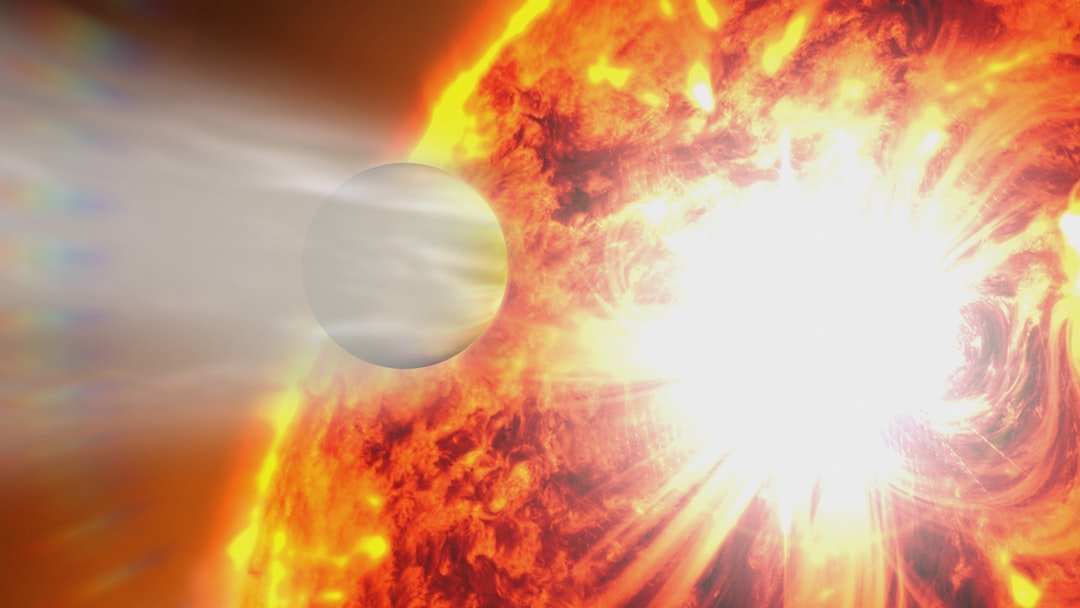
Unveiling the Latest Far-Side Fury (Image Credits: Unsplash)
Astronomers tracked a striking sequence of solar eruptions on the sun’s far side leading into April 16, 2026. The latest event unfolded around 11:45 UTC on April 15 from the northwest solar horizon, ejecting a massive blob of coronal material into space. These hidden blasts, invisible from Earth, underscored the sun’s unpredictable dynamics during a period of building activity.
Unveiling the Latest Far-Side Fury
Observers using NOAA’s GOES-19 satellite captured the third blast in vivid detail through its 305 angstrom ultraviolet channel. The eruption produced a prominent coronal mass ejection, or CME, visible as a huge outflow that formed a partial halo in NASA’s SOHO LASCO C3 coronagraph. No corresponding flare appeared on the Earth-facing disk, confirming the event’s origin behind the solar limb.
This northwest horizon outburst marked a shift from earlier explosions in the southwest. Space weather experts noted the CME’s scale rivaled its predecessors, though initial assessments ruled out any Earth-directed components. The sequence highlighted an active region likely rotating into view soon.
Tracing the Week’s Hidden Solar Onslaught
The first blast erupted around 18:00 UTC on April 13 over the southwestern horizon. GOES-19 imagery showed a dramatic lift-off, with much of the event obscured by the limb. A resulting CME headed toward Mars, expected to arrive by April 18 according to NASA ENLIL models.
Just a day later, on April 14-15, a second eruption struck the same southwestern area. This filament eruption hurled plasma skyward, though most material fell back. SOHO’s LASCO C2 also detected an additional northeast far-side burst, bringing the total to five events observed this week across instruments.
EarthSky reported, “Wow! The sun is giving a show on the far side.”
Earth-Facing Sun Takes a Breather Amid the Chaos
While the far side raged, the visible solar disk produced only low-level activity. Flares reached modest peaks, including a C1.2 event from active region AR4419 and numerous B-class outbursts. Sunspot counts stayed low with three main regions: AR4419 classified as beta-gamma, alongside two alpha or beta groups.
Solar wind speeds remained subdued, keeping Earth’s magnetic field quiet at Kp indices of 0-2. Two Earth-viewed CMEs from minor events also veered harmlessly away. This contrast emphasized the sun’s divided temperament during solar maximum approaches.
- Flare tally in last 24 hours: 10 events, one C-class.
- Earlier periods: Very low activity with 8-12 B-class flares daily.
- Key producer: AR4419, capable of stronger outbursts.
- Geomagnetic conditions: Stable, no storms from far-side blasts.
Forecasts Point to Heightened Activity Ahead
Experts raised flare probabilities to 80% for C-class, 30% M-class, and 5% X-class events. A emerging coronal hole in the northeast quadrant promised fast solar wind streams by mid-weekend. Combined with a co-rotating interaction region, this setup forecasted unsettled to active conditions, with Kp up to 4 and chances for G1 minor storms.
Aurora watchers prepared for enhanced displays at high latitudes over April 18-19. “The Earth-facing sun is taking a breather, but the far side tells a different story,” noted contributors from EarthSky.
| Date | Event Location | Key Observation |
|---|---|---|
| April 13 | Southwest horizon | CME toward Mars |
| April 14-15 | Southwest area | Filament eruption |
| April 15 | Northwest horizon | Partial halo CME |
Key Takeaways
- Three GOES-19 confirmed far-side blasts; five total with SOHO data.
- No threats to Earth from these events.
- Weekend aurora potential from coronal hole wind.
These far-side spectacles reminded skywatchers of the sun’s vast, ever-shifting power, even when hidden from direct gaze. As active regions rotate into view, more drama likely awaits. What do you think about this solar surge? Tell us in the comments.