

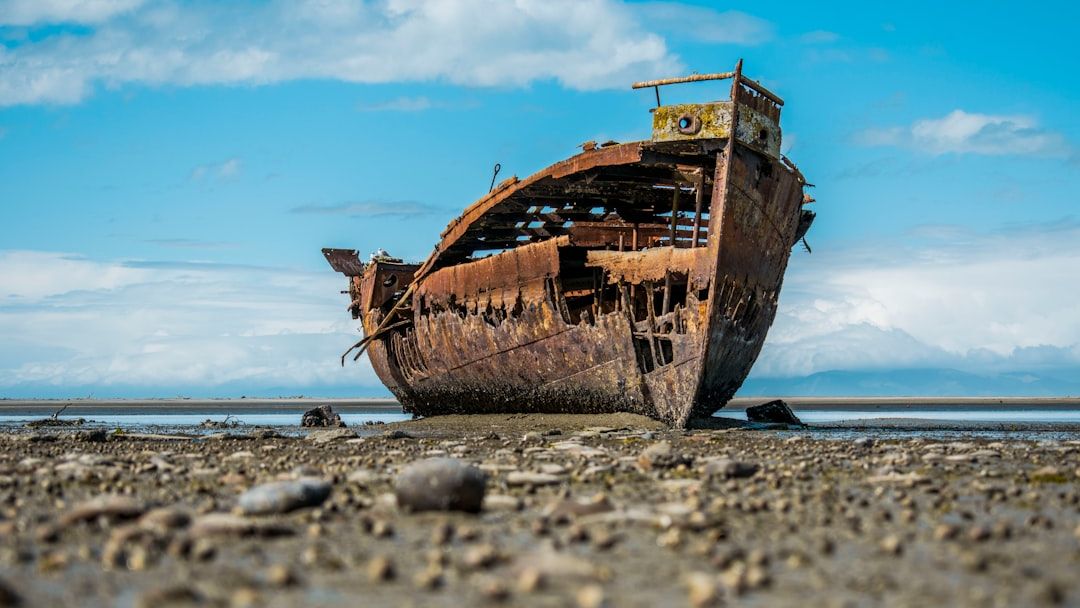
Podcast: Using AI to explore shipwrecks – Image for illustrative purposes only (Image credits: Unsplash)
Alpena, Michigan – Researchers have turned to artificial intelligence to tackle the vast, murky challenge of discovering shipwrecks in the Great Lakes. Assistant Professor Katie Skinner of the University of Michigan detailed these efforts in a recent National Science Foundation podcast, highlighting how machine learning enables underwater robots to scan and identify wrecks independently.[1] Her work promises to shift focus from endless data sifting to meaningful archaeological analysis.
Underwater Robots Gain Smarter Eyes
Katie Skinner leads the Field Robotics Group at the University of Michigan, where her team develops autonomous underwater vehicles equipped with advanced perception systems. These robots integrate computer vision and machine learning to process sonar imagery in real time, distinguishing shipwrecks from the seafloor clutter. Skinner received an NSF CAREER grant to advance multimodal fusion techniques that combine acoustic and visual data for robust navigation in low-visibility waters.[2]
The technology builds on expeditions conducted in 2022 and 2023 within the Thunder Bay National Marine Sanctuary. There, an AUV captured sidescan sonar data from multiple sites, feeding it into AI models trained to segment wreckage automatically. Skinner noted the breakthrough moment during testing: “It was pretty incredible to see that, within five minutes, it did what we had designed it to do.”[3]
Thunder Bay’s Hidden Fleet Awaits
The Thunder Bay National Marine Sanctuary off Michigan’s Alpena coast safeguards nearly 100 documented shipwrecks, with estimates suggesting at least as many remain undiscovered. Harsh weather and deep waters have preserved these 19th-century vessels, but manual surveys proved inefficient amid terabytes of raw data. Maritime archaeologist Stephanie Gandulla, the sanctuary’s resource protection coordinator, collaborates with Skinner’s team to label sonar images accurately, blending robotic prowess with human expertise.[3]
Skinner explained the core problem: “It’s really time consuming to process the data… So we’re developing machine learning methods to allow the robot to learn from data in order to detect shipwreck sites on its own.”[3] This partnership has produced the AI4Shipwrecks dataset, an open-source collection of sonar scans from 28 sites now powering broader AI research through the NSF’s National Artificial Intelligence Research Resource Pilot.[4]
Key AI4Shipwrecks Dataset Highlights:
- Sidescan sonar from 28 shipwreck sites in Lake Huron.
- High-quality labels for machine learning benchmarks.
- Applications in archaeology, ocean mapping, and beyond.
- Publicly available at umfieldrobotics.github.io/ai4shipwrecks.
From Hours of Analysis to Minutes
Traditional workflows demanded hours for each hour of survey data, as experts manually outlined wrecks pixel by pixel. AI flips this script, delivering segmentations – labeling every pixel as ship or seafloor – in roughly five minutes. Early tests on unvisited sites confirmed the models’ ability to spot wreckage fields, including wooden fragments invisible to initial scans.[3]
Skinner emphasized the shift: “The emergence of AI has really opened up new possibilities… Now it’s about how we can efficiently interpret the data… and how AI models can actually allow us to find new things.”[3] Reduced processing times cut boat mission costs and enable quicker follow-ups, freeing divers for targeted dives rather than broad searches.
Fleets of Robots on the Horizon
Looking ahead, Skinner envisions swarms of cooperating AUVs mapping entire underwater regions continuously. Her NSF-funded project targets demonstrations on sites like the historic Montana shipwreck, with spillover benefits for underwater infrastructure and emergency response. The AI4Shipwrecks benchmark paper outlines progress in sonar segmentation, inviting global researchers to refine the models.[4][2]
Listen to Skinner’s full discussion in the NSF podcast or the Dropbox Working Smarter episode with Gandulla. These tools not only unearth the past but equip robots to probe Earth’s most inaccessible frontiers more effectively.[1]