

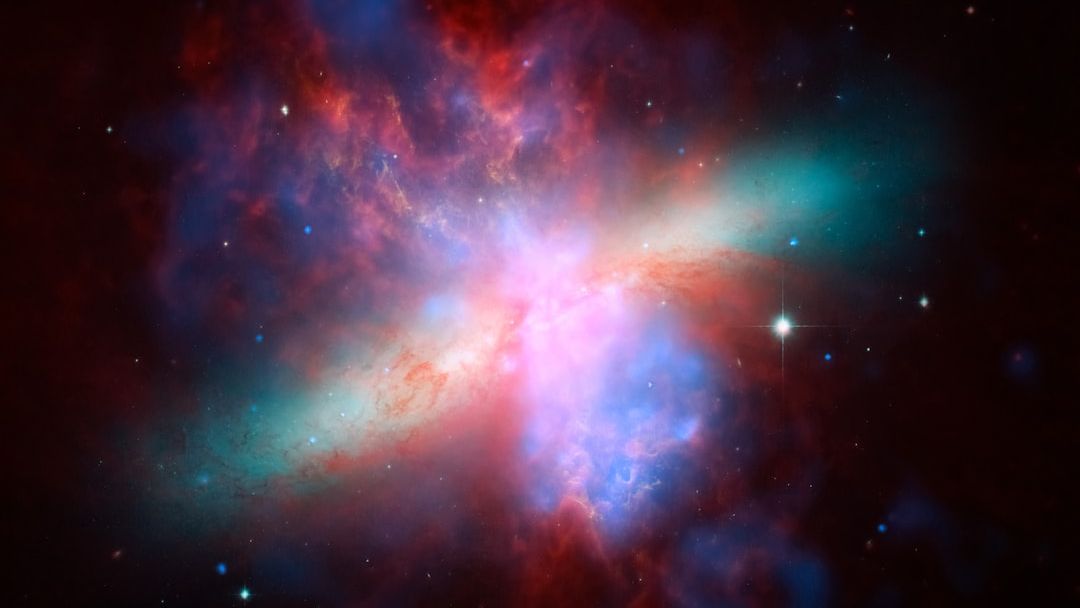
Featured Image: Galaxies Caught in Transition – Image for illustrative purposes only (Image credits: Unsplash)
Astronomers have long puzzled over why some galaxies thrive in isolation while others transform dramatically when surrounded by companions. A new study of nearly 4,000 galaxies reveals that crowded group environments can profoundly alter the size and structure of certain types, offering clues to the forces driving cosmic evolution. Led by researchers at the University of São Paulo, the work highlights how interactions in these stellar neighborhoods accelerate changes, particularly for galaxies caught midway in their development.
Probing Thousands of Galaxies Across Environments
The research team, under Gissel Montaguth, analyzed galaxies from diverse settings: low-mass groups, high-mass groups, compact clusters, and isolated field galaxies. They categorized nearly 4,000 examples into four main types – early-type, late-type, transition, and other – based on morphology and star formation activity. Transition galaxies typically featured disks with suppressed star formation, while “other” galaxies included ellipticals showing residual activity.
This comprehensive sample allowed the scientists to compare how environmental density influences physical properties like size and stellar mass. Field galaxies served as a baseline, free from group dynamics. The approach drew from observations in the local universe, capturing galaxies at various evolutionary stages.
Resilient Types Versus Vulnerable Ones
Early-type and “other” galaxies proved remarkably stable, showing little variation in size or mass-size relations regardless of their surroundings. These mature forms, often compact and elliptical, resisted the pressures of group life. Their resilience suggests internal processes dominate their evolution once established.
In contrast, late-type and transition galaxies displayed clear environmental imprints. Late-type spirals in compact groups appeared smaller than those in looser groups or the field. Transition galaxies exhibited even stronger effects, with a steeper mass-size relationship and reduced sizes in groups.
Interactions as the Key Driver
The patterns point to physical processes like mergers, tidal interactions, and disk truncation as culprits behind these changes. In dense groups, gravitational encounters strip gas and reshape structures more aggressively. Three transition galaxies in the study even bore visible scars from past disturbances, underscoring the role of such events.
Compact groups amplified these effects most sharply, where proximity fosters frequent run-ins. Field and low-mass group dwellers escaped with larger sizes intact. This environmental gradient explains why transition galaxies – poised between active star-forming disks and quiescent ellipticals – shift faster in company.
| Galaxy Type | Environmental Impact | Key Observation |
|---|---|---|
| Early-type & Other | Low | Stable size and mass-size relation across environments |
| Late-type | Moderate | Smaller in compact groups |
| Transition | High | Steeper mass-size relation, smaller sizes in groups |
Broader Insights into Cosmic Neighborhoods
These findings refine models of galaxy evolution in the local universe, emphasizing environment’s selective influence. While isolated galaxies evolve steadily, group membership hastens quenching and compaction for vulnerable types. The study, detailed in the Astrophysical Journal, underscores interactions as a pivotal mechanism.
Future observations could track these processes in real time or extend to higher redshifts. Unresolved questions linger about long-term outcomes – will all transition galaxies converge on early-type forms? The work invites deeper scrutiny of our Milky Way’s group context and its potential trajectory.
Understanding these dynamics not only maps the universe’s past but also hints at influences shaping galaxies like our own. As astronomers decode these cosmic social dynamics, the line between isolation and transformation grows clearer, revealing the intricate web of stellar societies.