

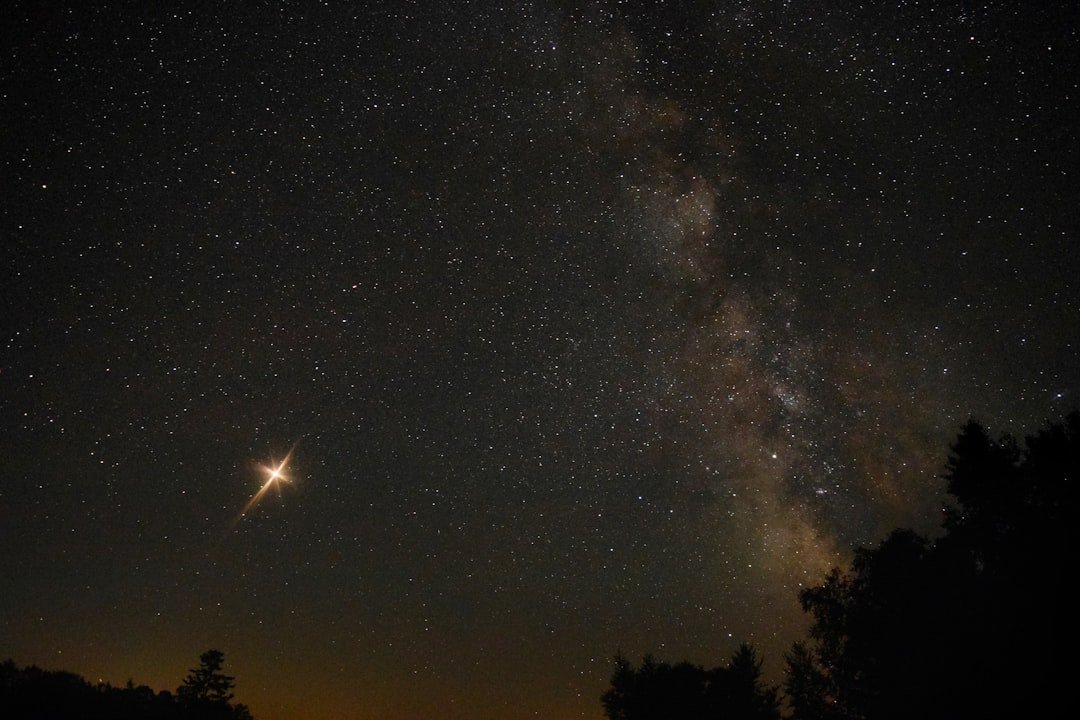
Evening Highlights: Venus and Jupiter Take Center Stage (Image Credits: Unsplash)
April 2026 offers skywatchers a treasure trove of celestial events, with all five bright planets on display from dawn to dusk. Venus dazzles in the evening west, while Jupiter commands the early night sky; mornings bring Mercury, Mars, and Saturn into view, culminating in a striking trio on April 20.[1][2] A new supermoon on April 17 provides dark skies perfect for the Lyrid meteor shower’s peak two days later. These alignments remind us of the dynamic ecliptic path that planets follow against the stars.
Evening Highlights: Venus and Jupiter Take Center Stage
Venus, the brightest planet, appears low in the western sky after sunset throughout April. It starts near the Pleiades star cluster and the star Aldebaran early in the month, climbing higher by late April and lingering up to two hours past sunset.[1] Jupiter, equally brilliant, shines high overhead soon after dark, positioned near the Gemini twins Castor and Pollux. It sets progressively earlier, from three hours past midnight on April 1 to just after midnight by month’s end.
The waxing crescent moon enhances these views. On April 18 and 19, it passes close to Venus, with earthshine illuminating its dark side about an hour after sunset. By April 21 and 22, the moon cozies up to Jupiter and Gemini’s stars, visible until after midnight. These pairings create postcard-worthy scenes for casual observers.[1]
Dawn Delights: Morning Planets Cluster Low
Mercury leads the morning show, hugging the eastern horizon before sunrise. It reaches its greatest elongation from the sun on April 3, making it easiest to spot in the Southern Hemisphere during early April twilight.[1] Mars and Saturn, both dimmer, rise higher as the month progresses, joining Mercury for a compact trio on April 20 – especially striking from southern latitudes about 60 minutes before dawn.
A thin waning crescent moon joins this group around April 15, shining above the planets in bright twilight. On April 13 and 14, look for the moon low east with visible earthshine an hour before sunrise. These pre-dawn sights reward early risers with faint constellations like Capricornus nearby.[1]
Moon Phases and Supermoons Steal the Show
The month features a new supermoon on April 17 at 11:52 UTC, the first of five consecutive supermoons, at just 226,299 miles from Earth. This dark phase idealizes stargazing, as the moon rises and sets with the sun.[1] First quarter arrives April 24, rising near noon and sitting high at sunset.
- April 11-12: Waning crescent in Capricornus 60 minutes before sunrise.
- April 18-20: Waxing crescent near Venus, Pleiades, and Aldebaran 90 minutes after sunset.
- April 24-25: Waxing gibbous by Regulus and Leo’s Sickle.
- April 28-30: Waxing gibbous near Spica in Virgo.
Perigee on April 19 brings the moon even closer at 224,706 miles. Earthshine adds glow to crescent phases, visible to the naked eye.[1]
Lyrids Meteor Shower and Planetary Alignments
The Lyrids peak after midnight on April 22 before dawn, with radiant near Vega in Lyra under moonless skies. Dark sites yield the best meteors per hour. All five planets align along the ecliptic around noon on April 15, a daytime spectacle viewable in theory but best imagined via charts.[1][3]
| Planet | Best Viewing | Location |
|---|---|---|
| Venus | Evening, after sunset | West |
| Jupiter | Early evening | High overhead |
| Mercury | Morning, before sunrise | East |
| Mars | Pre-dawn | East |
| Saturn | Pre-dawn | East |
Venus and Jupiter, 76 degrees apart early April, hint at their June conjunction. Spring constellations like Leo, Virgo, and the Spring Triangle frame the action.[1]
Essential Tips for April Skywatching
Seek dark-sky locations to catch faint sights like Capricornus or zodiacal light. Use the Big Dipper’s pointers to locate Leo southward. Apps like Stellarium provide location-specific rise and set times.
Binoculars reveal details in the Pleiades or earthshine. Patience pays off for low horizon targets; observe 60-90 minutes before/after twilight. Check EarthSky for charts and updates.[1]
Key Takeaways
- All five bright planets visible this April – don’t miss the morning trio on April 20.
- New supermoon April 17 sets stage for Lyrid meteors April 22.
- Moon pairs with Venus (April 18-20) and Jupiter (April 21-22) for easy photo ops.
April 2026 delivers a planet-packed sky that connects us to the cosmos’ grand parade. Whether chasing meteors or moon-planet hugs, these events inspire awe. What celestial sight will you target first? Tell us in the comments.