

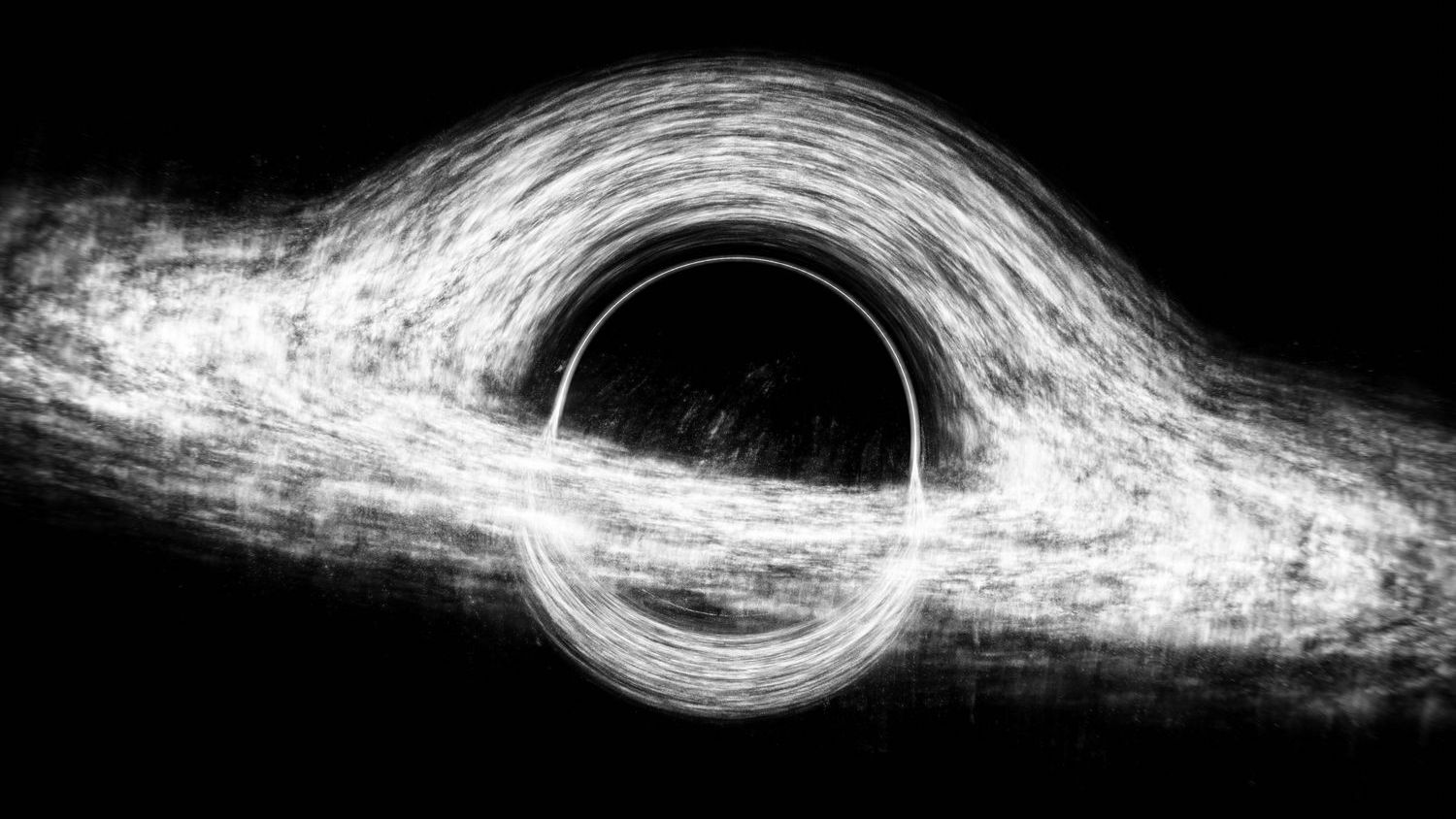
The Enigma of Rapid Black Hole Growth (Image Credits: Unsplash)
Recent observations from the James Webb Space Telescope have intensified a longstanding puzzle in cosmology: the presence of supermassive black holes mere hundreds of millions of years after the Big Bang. These behemoths, with masses reaching billions of solar masses, grew far too quickly under traditional models that rely on the slow accumulation of stellar remnants and gas. A fresh study from researchers at the University of California, Riverside proposes that the decay of dark matter particles supplied the precise energy needed to trigger direct collapse into these monsters, aligning theory with the telescope’s surprising discoveries.[1]
The Enigma of Rapid Black Hole Growth
Standard black hole formation begins with the deaths of massive stars, which leave behind remnants of tens to hundreds of solar masses. Over time, these seeds merge and accrete material to build supermassive black holes at galactic centers. However, the timeline does not match observations. In the universe’s first billion years, such growth demanded implausibly high efficiency rates.
Astronomers expected direct collapse black holes – where vast gas clouds implode without forming stars first – to remain rare events. This process requires specific conditions, like external radiation to heat the gas and prevent fragmentation. The scarcity of such setups made widespread supermassive black hole formation unlikely in the primordial era.[1]
JWST Spotlights Unexpected Giants
Launched in 2021, the James Webb Space Telescope peers back to redshifts corresponding to the universe’s infancy. It has detected active galactic nuclei powered by supermassive black holes at epochs when galaxies were just assembling. These findings reveal black holes disproportionately massive relative to their host galaxies, defying expectations.[1]
The telescope’s infrared gaze penetrates cosmic dust, exposing structures hidden from predecessors like Hubble. Continued surveys uncover more examples, prompting theorists to revisit formation pathways. Yash Aggarwal, a graduate student at UC Riverside who led the new research, noted the timeliness: “With the James Webb Space Telescope now revealing more supermassive black holes in the early universe, this mechanism may help bridge the gap between theory and observation.”[1]
Dark Matter’s Hidden Decay
Dark matter constitutes about 85 percent of the universe’s matter, yet its nature eludes direct detection. The UCR study posits that certain candidates, such as axion-like particles with masses between 24 and 27 electronvolts, decay over cosmic timescales. Each decay releases a minuscule burst of energy – equivalent to a billion trillionth that of an AA battery – into surrounding gas clouds.[1]
This subtle injection permeates the pristine hydrogen-dominated halos of the first galaxies. Flip Tanedo, Aggarwal’s doctoral advisor and co-author, explained: “The first galaxies are essentially balls of pristine hydrogen gas whose chemistry is incredibly sensitive to atomic-scale energy injection.” Such sensitivity turns dark matter decay into a cosmic catalyst.[1]
Mechanism: From Gas Cloud to Black Hole Seed
In the early universe, dark matter halos trapped hydrogen and helium gas after recombination. Without metals or dust for cooling, molecular hydrogen typically radiated heat, fragmenting clouds into stars. Decaying dark matter alters this by photodissociating the molecules, maintaining higher temperatures.
The gas remains atomic, cooling more slowly via Lyman-alpha emission. Gravity then dominates, collapsing the entire cloud – potentially millions of solar masses – into a direct collapse black hole seed. These seeds, far larger than stellar ones, rapidly accrete to supermassive scales. The study, published in the Journal of Cosmology and Astroparticle Physics, models show this window of dark matter properties boosts direct collapse rates significantly.[1]
What matters now: This theory not only explains JWST’s overmassive black holes but tests dark matter models. Future observations could constrain decay lifetimes, linking particle physics to cosmic structure.
Broader Implications for Cosmic Evolution
Co-authors James Dent from Sam Houston State University and Tao Xu from the University of Oklahoma contributed modeling across particle physics and astrophysics. Their interdisciplinary approach highlights how dark matter decay reshapes the first stars and galaxies. Tanedo emphasized: “We showed that the right dark matter environment can help make the ‘coincidence’ of direct collapse black holes much more likely.”[1]
If validated, the idea influences galaxy formation timelines and reionization history. It also offers a novel dark matter detection strategy: supermassive black holes as relics of primordial decays. Similar proposals, like a 2024 UCLA study on photon emissions from decays, reinforce the concept’s viability.[2]
As JWST accumulates data, cosmologists anticipate clearer tests. The presence of these early giants underscores dark matter’s active role beyond mere gravity. This mechanism promises to refine our understanding of how the universe transitioned from simplicity to the complex web of galaxies observed today.