

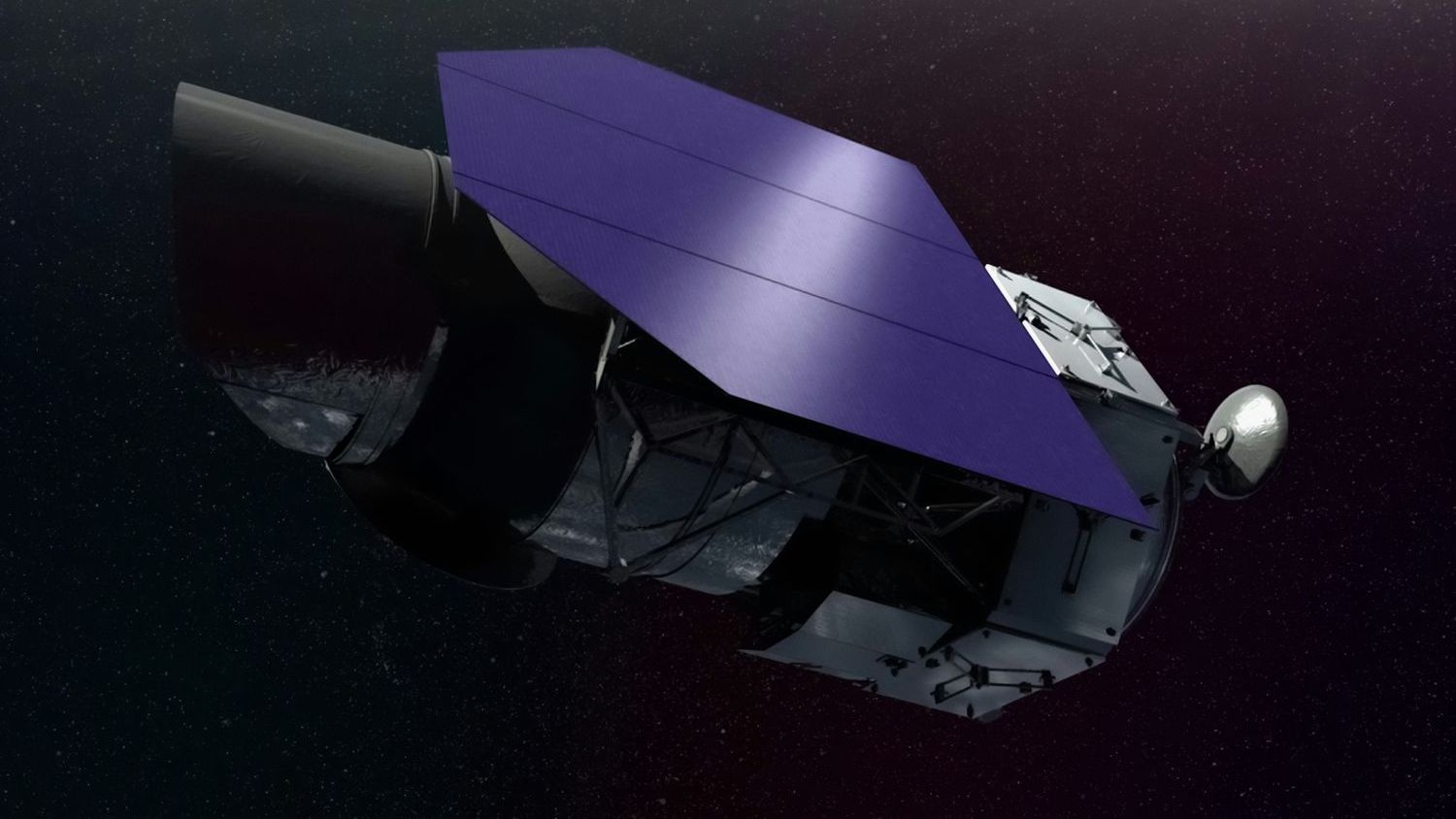
The James Webb Space Telescope is currently observing galaxies that formed 13 billion years ago, and several of them shouldn’t exist according to the model cosmologists were using when Webb launched – Image for illustrative purposes only (Image credits: Unsplash)
The James Webb Space Telescope has begun returning data on galaxies that formed when the universe was less than two billion years old. Several of these objects appear more massive, more structured, and more chemically mature than the standard cosmological model anticipated at the time of the telescope’s launch. The findings do not overturn the broader framework of cosmology, yet they have prompted researchers to revisit key assumptions about how the first galaxies assembled.
The Model Webb Was Built to Test
Before launch, cosmologists relied on the Lambda-CDM framework to describe the universe’s large-scale structure. Within that framework, the first galaxies were expected to emerge as small, irregular systems inside dark-matter halos. These early objects would gradually grow through mergers and gas accretion over billions of years before developing the ordered disks and stable structures seen in the present-day universe.
Webb’s infrared capabilities were specifically chosen to observe the redshifted light from this early epoch. The telescope’s design therefore offered a direct test of those predictions. When the first high-redshift candidates appeared in the data, their properties quickly diverged from the expected timeline in several measurable ways.
Five Distinct Tensions With Early-Galaxy Predictions
One clear mismatch involves stellar mass. Several galaxies detected at redshifts above 10 show inferred masses that sit near or above the upper limit allowed by standard star-formation efficiency in the available time. Another tension appears in internal motion: at least one massive system observed less than two billion years after the Big Bang displays no detectable rotation, a trait normally associated with mature galaxies today.
Morphology presents a third issue. A survey of more than 250 galaxies between roughly 800 million and 1.5 billion years after the Big Bang found most to be turbulent and asymmetric rather than the smooth, rotating disks some simulations had forecast. Dust content adds a fourth problem; samples of dusty galaxies less than a billion years old imply earlier generations of stars than the simple timeline comfortably permits. Finally, the overall pace of chemical enrichment and structural development appears accelerated compared with pre-launch expectations.
What the Phrase “Shouldn’t Exist” Actually Means
The technical literature uses the phrase narrowly. None of the new observations questions the age of the universe, the occurrence of the Big Bang, or the success of Lambda-CDM in describing later cosmic evolution. The cosmic microwave background and large-scale structure measurements remain consistent with the model.
Instead, the data challenge the specific rules that were attached to Lambda-CDM for the first few billion years. These rules govern how efficiently gas converts into stars, how quickly those stars enrich their surroundings, and how rapidly galaxies settle into stable forms. Adjustments to star-formation efficiency, the initial mass function of stars, or dust-correction methods can bring the observations back into agreement, yet each change requires revising a previously accepted parameter.
The Path Forward for Simulations and Observations
Researchers are now re-running cosmological simulations with modified feedback prescriptions and varied star-formation efficiencies to match the new observations. Spectroscopic follow-up of photometrically selected candidates continues, because some apparent high-redshift objects have already been reclassified as lower-redshift contaminants once full spectra became available.
The remaining tension is large enough to demand updates to early-galaxy modeling yet small enough to be absorbed within the broader Lambda-CDM framework. The telescope is therefore performing exactly the role for which it was built: supplying data that refine, rather than replace, the prevailing picture of cosmic history.