

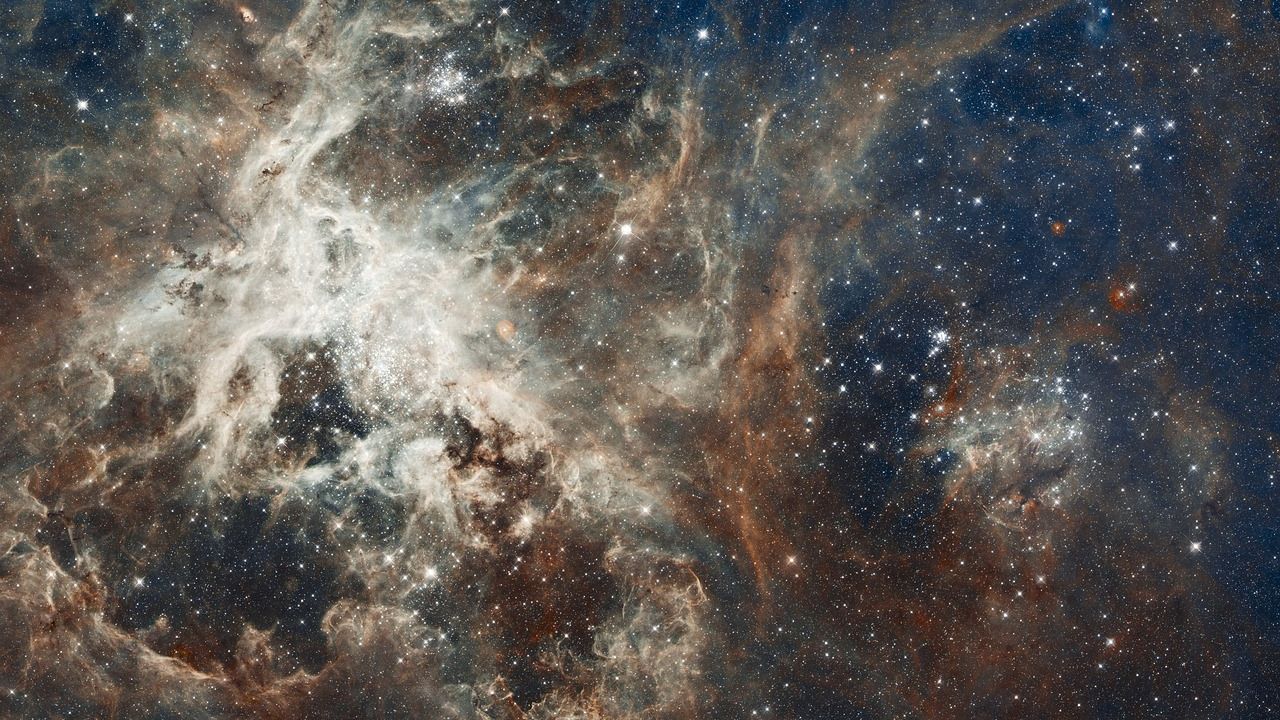
For the First Time, Scientists See the Universe’s Skeleton in Incredible Detail Thanks to JWST – Image for illustrative purposes only (Image credits: Pixabay)
The James Webb Space Telescope has produced the most detailed view to date of the cosmic web, the vast network of filaments and sheets that connect galaxies across space. This new map reaches back to when the universe was roughly a billion years old, revealing structures that earlier instruments could only hint at. The findings come from the COSMOS-Web survey, the largest program carried out with JWST so far, and they show how matter has arranged itself over cosmic time.
The Scale of the COSMOS-Web Survey
Researchers examined more than 164,000 galaxies spread across a patch of sky equivalent to three full moons. The survey was designed specifically to trace the large-scale distribution of matter, including the faint galaxies and dusty regions that previous telescopes missed. Data from the project, including galaxy catalogs and density maps, have now been made available to the wider scientific community.
International teams from the United States, Denmark, Chile, France, Finland, Switzerland, Japan, China, Germany, and Italy contributed to the effort. Their combined work produced both static maps and an animated sequence showing how the web evolved over 14 billion years. The open release follows the long-standing practice of the COSMOS project, allowing other astronomers to examine the same data independently.
A Sharper View of Filaments and Voids
The cosmic web consists of dense filaments and sheets of dark matter and gas that surround enormous empty regions known as voids. Earlier observations from the Hubble Space Telescope often blended these features together, making them appear as single, blurred structures. JWST’s infrared sensitivity has resolved many of those blended features into distinct filaments, giving astronomers a far more precise picture of how galaxies sit within the larger framework.
Lead author Hossein Hatamnia noted that the telescope now places galaxies accurately in both time and space. This precision reveals details that were previously smoothed over, particularly in regions where dust once obscured the view. The result is a skeleton-like map that shows the universe’s underlying architecture with greater clarity than any prior effort.
Reaching the Universe’s Earliest Structures
JWST’s instruments allow scientists to observe the cosmic web at epochs when the universe was only a few hundred million years old. This period had remained largely out of reach before the telescope’s launch in 2021. The new data demonstrate how clusters and filaments grew and connected over billions of years, providing a timeline of structure formation that was previously unavailable.
Physicist Bahram Mobasher of the University of California, Riverside, described the improvement in depth and resolution as truly significant. He explained that what once appeared as a single structure now resolves into multiple filaments, with fine details that earlier instruments could not capture. These observations confirm that the cosmic web was already in place during the universe’s formative stages.
Public Data and Future Studies
The release of the full COSMOS-Web dataset includes not only galaxy positions but also measurements of stellar mass across different redshifts. Astronomers can now use these resources to test models of how dark matter and gas interacted in the early universe. The survey’s wide and deep coverage sets a new standard for mapping large-scale structure.
Future analyses are expected to refine the timing of when the first galaxies began to form within these filaments. The current results already show that the web’s basic pattern emerged earlier than some models had predicted, though researchers continue to examine the precise sequence of events.