

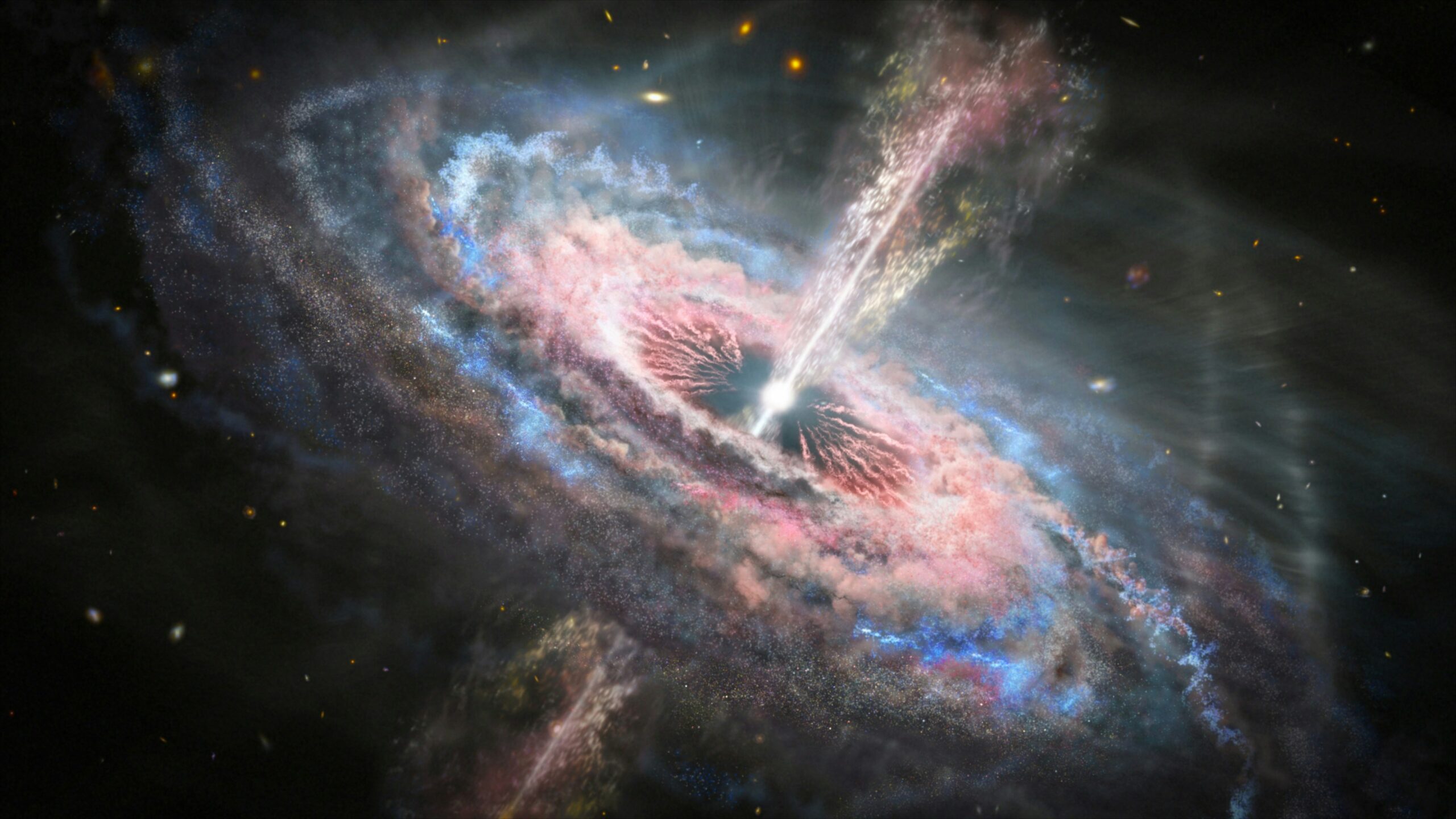
An Explanation for the Massive Black Holes the JWST Found in the Early Universe – Image for illustrative purposes only (Image credits: Unsplash)
Astronomers have long assumed that supermassive black holes and the galaxies around them grew in lockstep over cosmic time. The James Webb Space Telescope upended that picture by revealing black holes far more massive than expected in galaxies that formed just a few hundred million years after the Big Bang. Those observations left researchers searching for a way to reconcile the data with established models of cosmic evolution.
The Surprise in the Early Universe
JWST began delivering images and spectra of distant galaxies almost immediately after its science operations started. Among the first striking results were compact objects whose central black holes appeared to outweigh the stars in their host galaxies by ratios never seen locally. Standard theory predicted that black holes and stellar bulges should maintain a roughly constant mass ratio as they co-evolve through mergers and gas accretion. The new detections broke that pattern, prompting urgent questions about whether black holes could form earlier or grow faster than previously thought possible.
Why the Old Model Fell Short
For decades, observations of nearby galaxies showed that the mass of a central black hole correlates tightly with the mass of the surrounding stars. This relation suggested synchronized growth: gas funneled into the galaxy center feeds both star formation and black-hole accretion at comparable rates. In the early universe, however, galaxies were smaller, gas-richer, and more dominated by dark matter. Under those conditions, the stellar mass represents only a fraction of the total dynamical mass that actually governs black-hole growth. The mismatch made the black holes look over-massive when measured against stars alone.
What Recent Analyses Reveal
New modeling demonstrates that the apparent discrepancy disappears once the comparison shifts from stellar mass to dynamical mass. In gas-rich, dark-matter-dominated systems typical of the first billion years, the stellar component is naturally smaller relative to the total mass. Simulations that assume the local black-hole-to-dynamical-mass relation holds at all epochs successfully reproduce the distribution of black-hole masses reported by JWST. The same calculations also match independent estimates of gas fractions derived from large JWST surveys, lending support to the revised picture without requiring exotic formation channels. Key points from the updated framework include: – Black holes remain consistent with the dynamical-mass relation across redshifts.
– High gas and dark-matter fractions in low-mass galaxies naturally produce the observed stellar-mass offset.
– Over-massive appearances are therefore expected rather than anomalous for the earliest epochs.
Remaining Questions and Next Steps
While the dynamical-mass explanation accounts for many of the JWST detections, it does not yet incorporate full self-consistent black-hole feedback or merger histories. Future observations with higher spectral resolution will test whether the same galaxies also follow local scaling relations when velocity dispersions or total masses are measured directly. Those data should clarify whether the early universe simply hosted a larger population of gas-rich systems or whether additional growth mechanisms operated alongside the standard ones.