

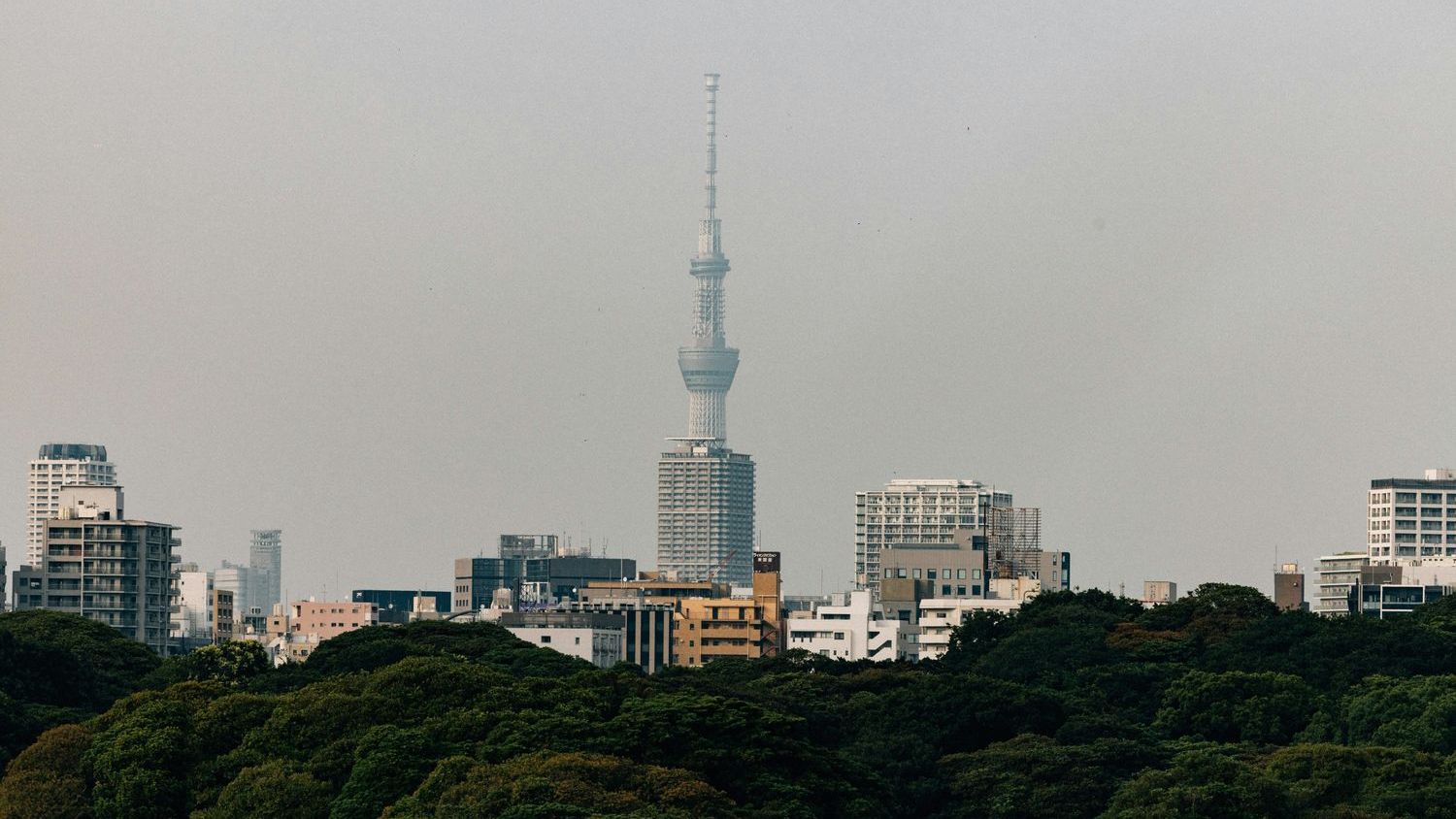
Japan sits on the intersection of four tectonic plates and experiences roughly 1,500 earthquakes a year, which is why the country’s building codes are the strictest on Earth – and why the Tokyo Skytree, the second-tallest structure in the world, is designed to sway rather than resist – Image for illustrative purposes only (Image credits: Unsplash)
Tokyo – The 634-meter Tokyo Skytree opened in 2012 as the second-tallest free-standing structure on the planet. Its core design choice stands out in a country that sits at the meeting point of four tectonic plates and records roughly 1,500 earthquakes each year. Rather than fight every tremor with rigid strength, the tower is built to move in a controlled way that reduces the forces transmitted through the structure.
The Tectonic Setting That Shapes Every Decision
Japan lies where the Pacific Plate slides beneath the North American Plate, the Philippine Sea Plate pushes under the Eurasian Plate, and the North American and Eurasian plates meet along the country’s eastern edge. This convergence zone produces frequent seismic activity, from tiny tremors detected only by instruments to major events that prompt evacuations. A magnitude 7.6 quake in December 2025, for example, triggered tsunami warnings and orders affecting about 90,000 people in the northeast.
National building standards have been updated after every major disaster, including the 1923 Great Kanto quake, the 1995 Kobe event, and the 2011 Tohoku disaster. Each revision added stricter rules on ductility, base isolation, and energy dissipation. The Skytree was engineered with those repeated lessons in mind, not for average conditions but for the rare, high-magnitude scenarios that remain a realistic threat to the Tokyo region.
Ancient Pagoda Wisdom Applied to a Modern Tower
The Skytree’s most distinctive feature draws directly from a construction method used in Japanese wooden pagodas for more than a thousand years. Traditional five-story pagodas, such as the one at Horyu-ji that has stood since the early eighth century, survived earthquakes that destroyed surrounding masonry buildings. Their central pillar is not rigidly tied to the surrounding floors; instead, the levels slide slightly out of phase with the post, dissipating energy through independent movement.
Engineers adapted this principle for the Skytree by placing a reinforced concrete central column, called the shimbashira, inside the steel lattice frame. The column connects firmly at the base but remains decoupled higher up, held by oil dampers that permit relative motion. When the ground shakes, the outer frame and the inner column oscillate at different rates, and the dampers convert that relative movement into heat. The result is a measurable drop in overall seismic response compared with a conventional rigid design.
How Controlled Movement Reduces Damage
The approach belongs to the broader field of base isolation and supplementary damping. A structure fixed rigidly to the ground takes on every acceleration the soil experiences. By allowing partial decoupling, the Skytree shifts its natural period away from the dominant frequencies of earthquake ground motion, lowering the forces that reach the upper sections. This same physics appears in recent research on advanced isolation systems for critical facilities where failure is unacceptable.
During the magnitude 9.0 Tohoku earthquake in 2011, the Skytree was still under construction yet suffered no structural damage. The central column and steel frame performed as intended, even as the tower experienced the long-period shaking typical of distant large events. Smaller quakes since then, including a magnitude 7.3 offshore event in 2022, continue to supply real-world data that operators use to monitor the structure’s health.
The design deliberately lets the upper sections lag behind the base during strong shaking. This controlled disagreement between core and frame converts kinetic energy into harmless heat rather than destructive stress.
Practical Limits and Forward Lessons
Japanese seismologists note that the Nankai Trough remains overdue for a major event by historical standards, with elevated probabilities for an M8 or larger quake in coming decades. Building codes address structural performance but cannot eliminate every risk, such as tsunami inundation or soil liquefaction on reclaimed land. The Skytree’s foundation incorporates deep reinforced walls tailored to Sumida City’s soil profile to resist both lateral loads and differential settlement.
Visitors on the observation decks at 350 and 450 meters rarely notice the motion during moderate events. The slow oscillation registers more as a subtle sense of imbalance than visible swaying. The tower essentially functions as a continuous seismograph, feeding sensor readings back into ongoing refinements of seismic design practices used in other fault-zone cities worldwide.