

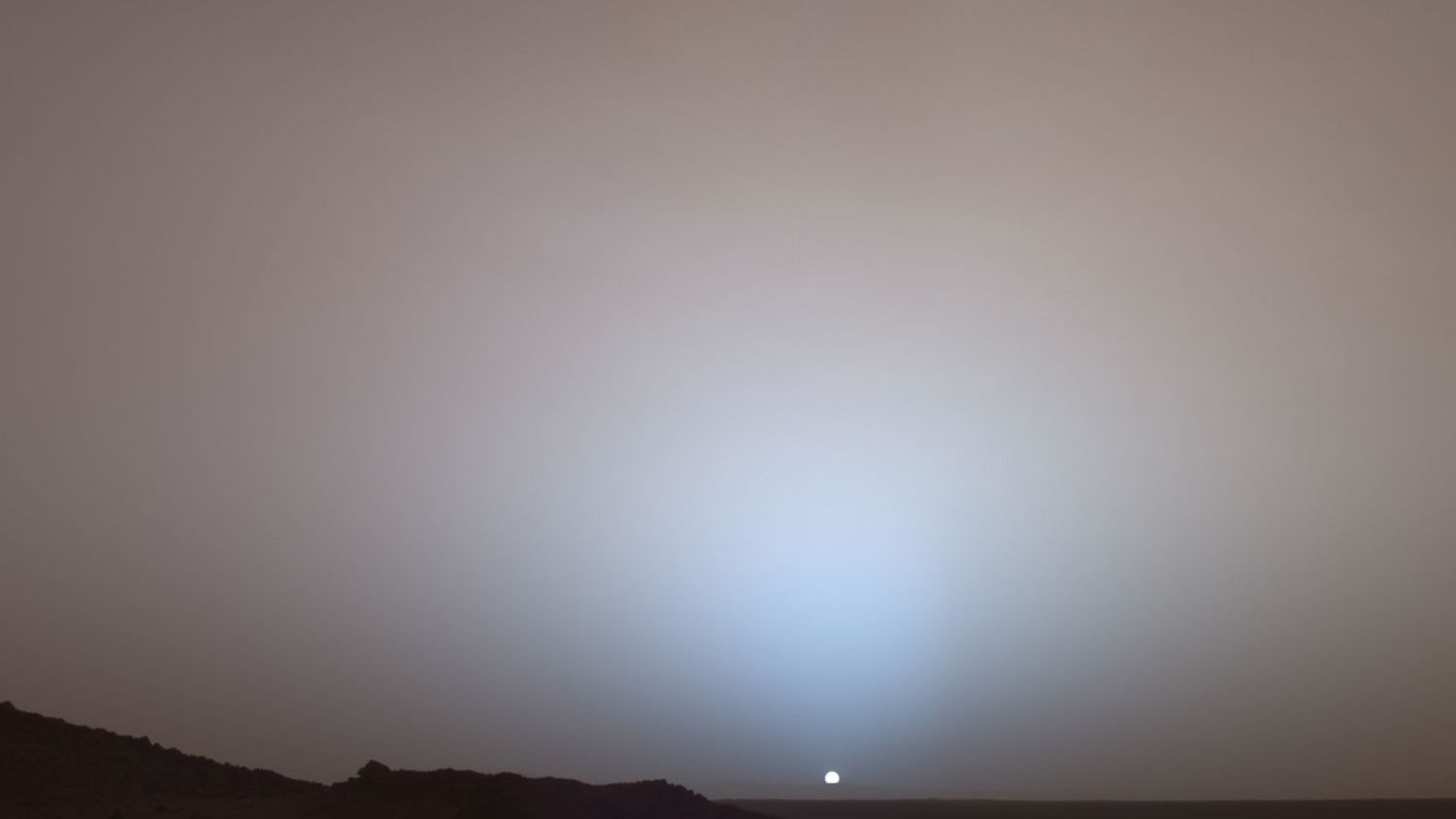
Martian Aerosols Reveal Dynamics of Dust and Cloud Transport – Image for illustrative purposes only (Image credits: upload.wikimedia.org)
Mars Express observations collected over nine full Martian years have revealed that dust and water ice particles regularly reach altitudes of 80 kilometers during the planet’s closest approach to the Sun. The measurements, taken by the SPICAM infrared spectrometer, indicate that particle sizes stay remarkably consistent across these great heights. This pattern points to large-scale atmospheric movements rather than simple local turbulence as the main driver of vertical distribution. The findings add new detail to how aerosols influence Mars’ climate and the movement of water vapor into the upper atmosphere.
Combining Instruments to Separate Dust from Ice
SPICAM could not tell dust apart from water ice on its own, so the research team developed a new approach that merged those readings with data from the Mars Climate Sounder and output from general circulation models. The combined method allowed them to classify particles across the full dataset spanning Martian years 28 through 36. This step proved essential because the two particle types behave differently and affect climate calculations in distinct ways. Without the extra context, earlier analyses had left some ambiguity about which material was present at each altitude.
Uniform Sizes Point to Global Winds
One of the clearest results is that particle diameters remain nearly the same from the surface up to the highest observed layers. If turbulent mixing against gravity were the dominant process, larger particles would settle out at lower altitudes and smaller ones would dominate higher up. The observed uniformity instead suggests that strong horizontal winds and large-scale circulation lift and carry material over long distances before it descends. These dynamics appear especially active near perihelion, when solar heating intensifies atmospheric motion.
Seasonal Cloud Patterns Across the Planet
The nine-year record also produced a detailed map of three major cloud systems. Polar Hood Clouds form over the winter poles and extend equatorward as seasons change. The Aphelion Cloud Belt appears in the tropics during the opposite season when Mars is farthest from the Sun. Mesospheric clouds, detected between 70 and 90 kilometers, become more frequent and thicker during both global and regional dust storms. Each feature shows clear links to the background dust load, with higher dust levels often coinciding with elevated cloud layers.
Water Vapor Transport and Climate Implications
High-altitude water ice clouds observed during dust events confirm that storms can loft water vapor well above the levels previously modeled. This upward transport may help explain how water escapes from Mars over geologic time. The same processes also affect how other trace gases are measured, because aerosols can scatter or absorb light used in remote sensing. Refined circulation models that incorporate these vertical pathways should improve forecasts of future dust seasons and water loss rates.
Overall, the study underscores that Mars’ thin atmosphere moves material on planetary scales far more efficiently than local mixing alone would allow. Continued monitoring from orbit will be needed to test whether these patterns hold during the next dust storm cycle and to track any long-term shifts tied to changing solar input.