

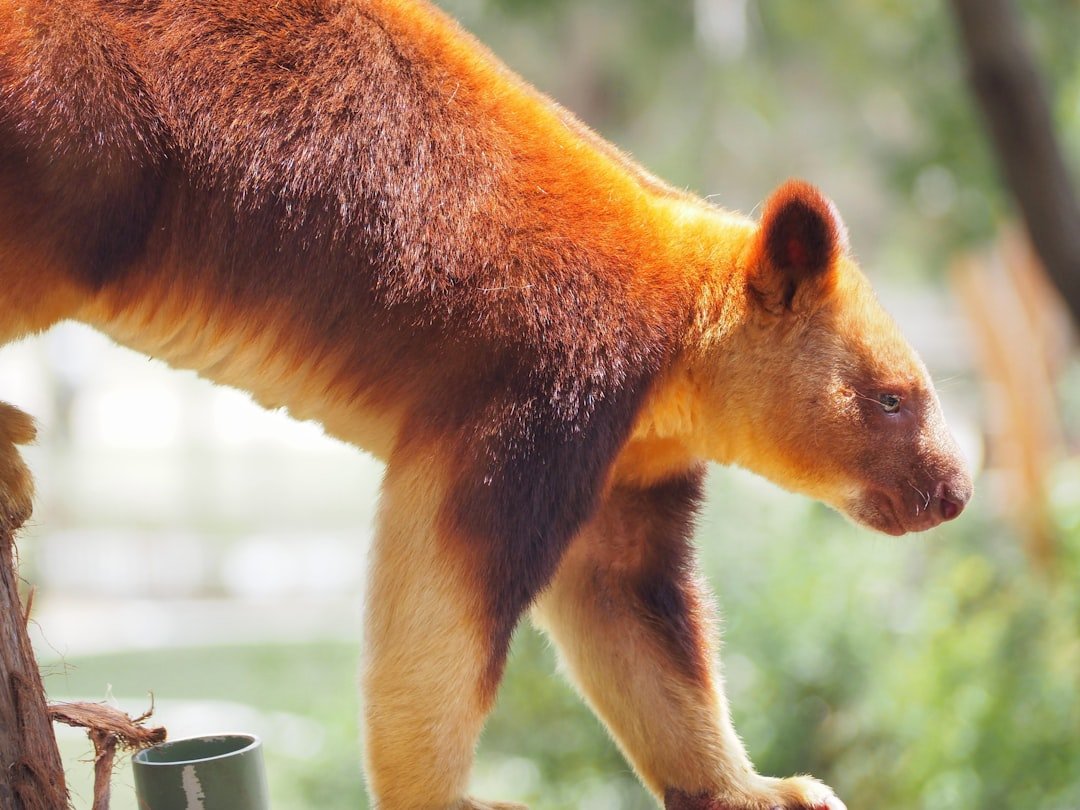
Ancestors Who Returned to the Trees (Image Credits: Unsplash)
Deep within the layered rainforests of Papua New Guinea, Indonesia, and northeastern Australia, tree-kangaroos pursue a life suspended among the branches. These marsupials, distant cousins to the bounding kangaroos of open plains, have evolved specialized traits for an arboreal existence. Their presence highlights the diversity of the macropod family and underscores the fragility of rainforest ecosystems.[1]
Ancestors Who Returned to the Trees
Most macropods descended to the forest floor millions of years ago, but tree-kangaroos reversed course, reclaiming the canopy as their primary habitat. This evolutionary divergence equipped them for a world of vertical navigation rather than horizontal hops. Scientists recognize around 14 species, each finely tuned to dense, humid environments.[1]
These animals rarely touch the ground, preferring the safety and abundance of leaves, fruits, and bark high above. Their nocturnal or crepuscular habits further conceal them from view, making sightings rare even in their native ranges. A slow metabolism allows extended rests after meals, conserving energy in this energy-demanding lifestyle.[1]
Adaptations for Acrobatic Living
Tree-kangaroos boast shorter, muscular limbs compared to their ground kin, with front legs nearly matching the hind ones in strength for gripping branches. Long, thick tails serve as counterbalances on slender limbs, while curved claws and padded feet enable precise climbing, even headfirst down trunks. Dense fur in shades from reddish-brown to gray provides camouflage amid the foliage.[1]
Impressive feats define their mobility: leaps of up to 30 feet between trees and drops from 60 feet to the forest floor without grave injury. A complex stomach ferments tough plant matter over 24 hours, extracting nutrients from their herbivorous diet. Mothers nurture joeys in pouches for eight to nine months, fostering skills vital for treetop survival.[1]
- Strong forelimbs and claws for bark gripping
- Long tail for balance on narrow branches
- Compact, bear-like build with rounded ears
- Multi-chambered stomach for fibrous foliage
- Ability to bound on all fours or hop bipedally[2]
Diversity Among the Branches
Species vary in appearance and range, from the woolly Matschie’s tree-kangaroo of Papua New Guinea’s Huon Peninsula to the chestnut-coated Goodfellow’s in Indonesian and Papua New Guinean forests. Lumholtz’s tree-kangaroo inhabits lower altitudes in Australia, while the elusive Wondiwoi was rediscovered after decades out of sight. Each occupies specific niches within mountainous or lowland rainforests.[1]
Conservation assessments reveal widespread vulnerability. The table below outlines select species and their statuses:
| Species | Primary Location | IUCN Status |
|---|---|---|
| Matschie’s | Papua New Guinea | Endangered[3] |
| Goodfellow’s | Papua New Guinea/Indonesia | Endangered[4] |
| Lumholtz’s | Australia | Near Threatened[4] |
| Golden-mantled | Papua New Guinea | Critically Endangered[5] |
Threats and Conservation Efforts
Habitat destruction from logging, agriculture, and mining fragments their forested homes, while hunting pressures local populations. Even minor changes disrupt these specialists, who rely on intact canopies for foraging and escape. Programs in protected areas and community partnerships aim to curb these losses, with some species like the tenkile showing population rebounds through targeted work.[1][6]
Tree-kangaroos also play ecological roles, dispersing seeds and aiding rainforest regeneration. Initiatives by zoos and organizations, such as the Tree Kangaroo Conservation Program, support breeding and habitat protection. Awareness grows, but sustained action remains essential for their survival.[4]
Key Takeaways
- Tree-kangaroos represent a rare arboreal branch of the kangaroo family, thriving 60 feet above ground.
- Over half of species face endangered or worse status due to habitat loss and hunting.
- Conservation blends local involvement with global efforts to safeguard rainforest biodiversity.
Tree-kangaroos embody the wonders concealed in rainforest heights, reminding us of nature’s intricate balances. Their persistence hinges on preserving the treetops they call home. What do you think about these canopy acrobats? Tell us in the comments.