

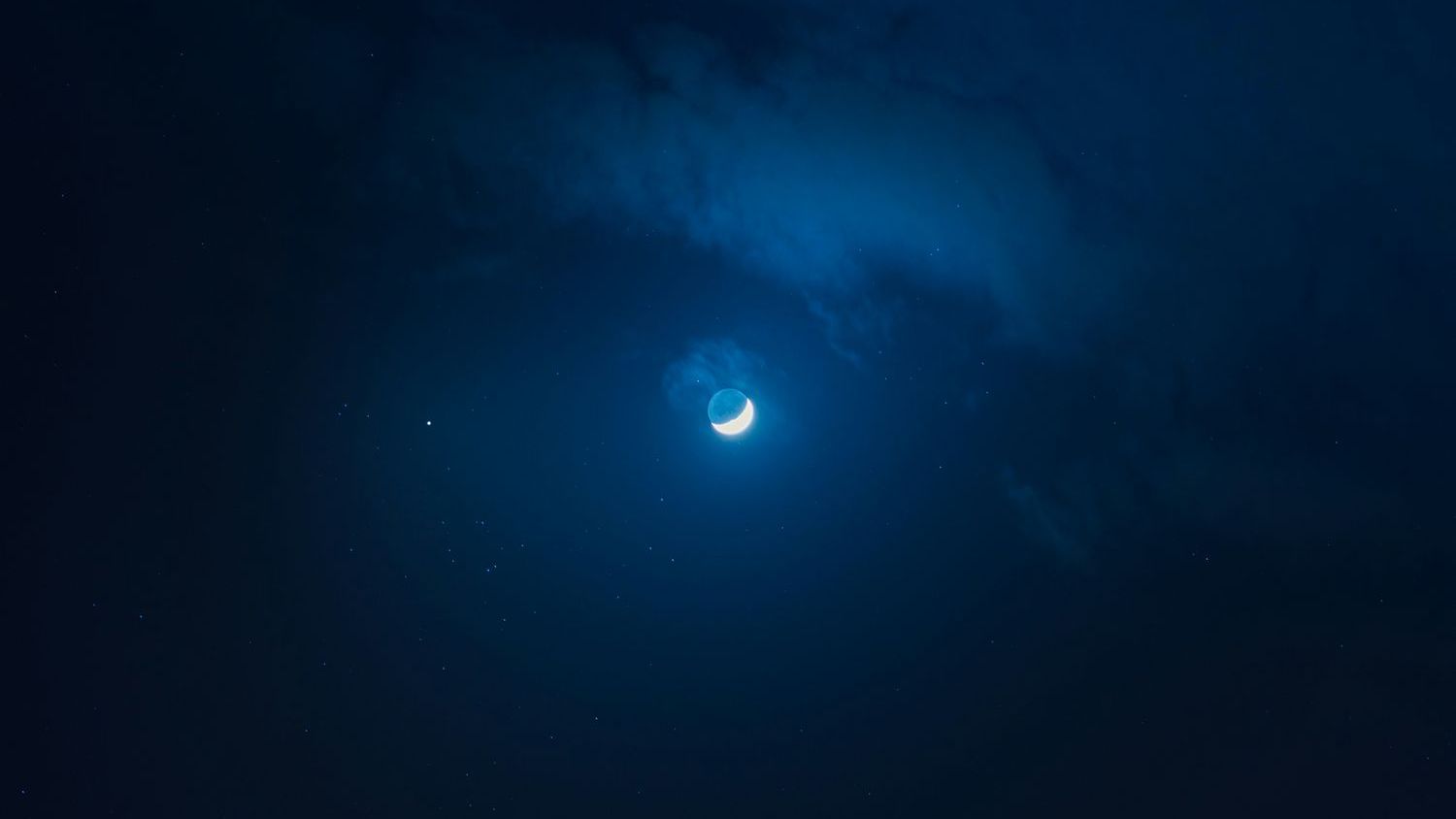
May 2026: What’s in the sky this month? Venus and Jupiter shine bright, Comet Tempel 2 is improving – Image for illustrative purposes only (Image credits: Unsplash)
Venus and Jupiter command attention in the evening sky throughout May 2026, drawing eyes westward soon after sunset.[1][2] Jupiter delivers extra excitement through multiple double shadow transits of its moons Europa and Ganymede. Predawn skies bring back Saturn and Mars alongside a delicate crescent Moon, as Comet Tempel 2 steadily improves in visibility for dedicated observers.
Venus Takes Center Stage After Sunset
Observers spot Venus low in the western sky within an hour after sunset, standing about 14 degrees above the horizon on May 1. The planet remains visible until around 10:30 p.m. local daylight time early in the month, extending to 11 p.m. by month’s end.[1] Its magnitude brightens slightly from –3.9 to –4.0 as it traverses Taurus toward Gemini.
Venus passes 6.5 degrees north of Aldebaran on May 2 and slips between the horns of Taurus on May 13. A waxing crescent Moon appears 2 degrees to its north on May 18, creating a striking trio the following evening with Jupiter about 20 degrees farther east. Through a telescope, Venus shows a gibbous phase, starting at 88 percent illuminated with a 12-inch disk and shrinking slightly while dimming in phase to 80 percent by May 31.
Twilight viewing proves ideal, as the planet’s glare demands steady skies for details on its creamy disk.
Jupiter’s Moons Stage Rare Double Events
Jupiter gleams at magnitude –2.0 in early May, fading just a touch midmonth, and hangs high in the west below Gemini’s Castor and Pollux. Visible until 1 a.m. at first, it sets earlier by nearly midnight later on. The gas giant’s disk measures 35 arcseconds across initially, revealing equatorial dark belts under good seeing conditions.[1]
The month’s highlight centers on the Galilean moons, particularly double shadow transits where shadows from Europa and Ganymede cross Jupiter’s face together. On May 15-16, Ganymede’s shadow enters at the eastern limb around 9:58 p.m. EDT, followed by Europa’s at 11:20 p.m. EDT. Europa transits during this time, though low on the East Coast; western viewers catch Ganymede’s larger, slower shadow exiting around 11:26 p.m. MDT.
May 22 brings another layered show: Ganymede transits from 9:57 p.m. EDT, with Europa following later; double shadows converge near 10:55 p.m. PDT when Jupiter sits 9 degrees high, favoring Alaska and Hawaii. A final double transit of Europa and Ganymede occurs May 29, again best from Hawaii. The waxing crescent Moon passes within 8 degrees west on May 19 and east on May 20.[3]
| Date | Event | Key Times (EDT approx.) | Best Viewing |
|---|---|---|---|
| May 15-16 | Double shadow: Ganymede then Europa | 9:58 p.m. Ganymede entry; 11:20 p.m. Europa shadow | Western U.S. |
| May 22 | Double shadows Ganymede/Europa + transits | 10:55 p.m. PDT shadows converge | Alaska/Hawaii |
| May 29 | Double transit Europa/Ganymede | Evening hours | Hawaii |
Predawn Skies Welcome Saturn and Mars
Saturn emerges low in the east by mid-May, reaching 7 degrees high an hour before sunrise around May 13. A waning crescent Moon rises half an hour earlier, positioning 6 degrees below the ringed world. Mars follows suit by May 15, appearing southwest of the thin Moon near New phase, both at similar altitudes roughly an hour before dawn; magnitude 1.3 requires scanning 7 degrees lower left.[1]
Mercury joins late-month action after superior conjunction on May 14, climbing to 10 degrees high 30 minutes post-sunset by May 31 at magnitude –0.6. Neptune lurks 8 degrees west of Saturn by then, 10 degrees up two hours pre-sunrise.
Key May Moon Moments:
- May 18: Crescent 2° north of Venus.
- May 19: Crescent near Jupiter (7° away).
- May 13: Crescent 6° below Saturn predawn.
- May 15: Thin Moon near Mars.
Comet Tempel 2 Brightens for Telescopes
Comet 10P/Tempel 2, one of the finest returns since its 1873 discovery, passes ninth magnitude and improves steadily. Target it after 1 a.m. local time when over 10 degrees high, ideally from dark sites; the Moon interferes less post-May 8. A 4-inch scope suffices from suburbs, while 6- to 8-inch instruments reveal texture at 150x near Sagittarius’ Teapot.[1]
Distinguish its lopsided coma – sharper on the dust side pushed by solar wind – from globular cluster NGC 6638. Eta Aquariids peak May 6 morning, though a waning gibbous Moon dims the 50-per-hour potential to under a dozen observed.[2]
Grab binoculars or a scope this May – Jupiter’s moon choreography and planetary parades await clear nights.