

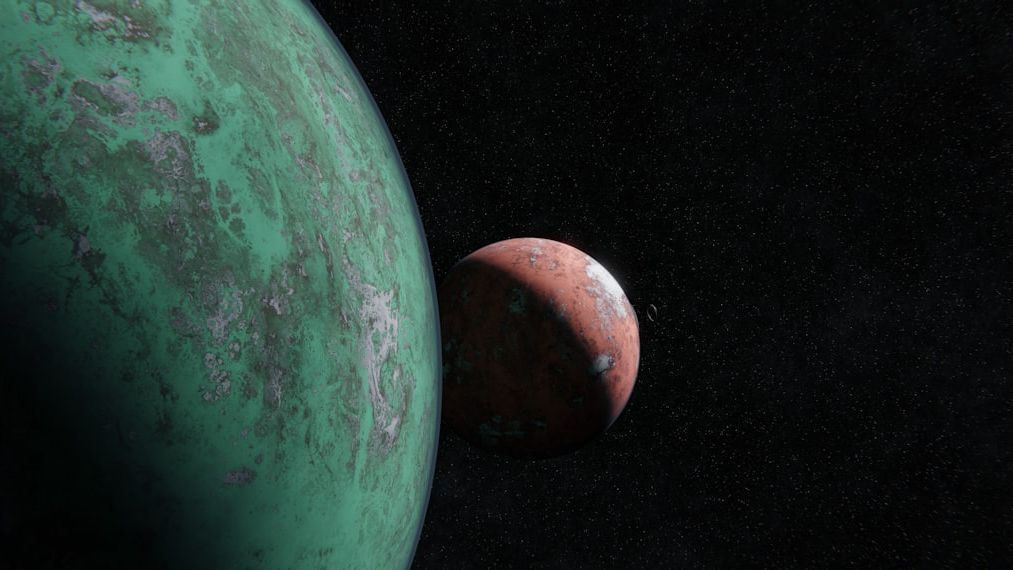
Close-In Planets Act as “Bouncers” to Create Rogue Worlds – Image for illustrative purposes only (Image credits: Unsplash)
Free-floating planets drift through the galaxy unbound by any star, their isolation raising questions about planetary fates across the universe. Recent research points to an unexpected culprit for their prevalence: planets orbiting close to their stars that disrupt and eject others during system formation. This mechanism accounts for why these wanderers outnumber certain bound planets by a wide margin, reshaping views on how solar systems evolve.
The Surprising Numbers Behind Free-Floating Worlds
Observations and models indicate that free-floating planets, or FFPs, exist in abundance. Scientists estimate they appear nineteen times more frequently than planets located beyond the snow line in their systems. That boundary marks the region around a star where temperatures drop low enough for compounds like water, ammonia, and methane to freeze into ice.
This disparity puzzled astronomers for years. Traditional formation theories struggled to explain such a high count of ejected worlds. The sheer volume suggests dynamic processes at play early in a system’s life, when gravitational tugs can send planets hurtling outward.
A Fresh Explanation from Planetary Dynamics
Researchers led by Xiaochen Zheng at the Beijing Planetarium proposed a compelling solution in a preprint shared on arXiv. They describe close-in planets – those hugging their star in tight orbits – as acting like bouncers in a crowded club. These inner worlds gravitationally interact with outer companions, often kicking them loose into interstellar space.
The model simulates early solar system chaos. Massive planets forming near the star gain enough influence to scatter smaller or more distant bodies. Over time, repeated encounters build up, culminating in ejections that leave the survivors in stable paths.
Mechanics of the Bouncer Effect
Close-in planets dominate because they form quickly from dense protoplanetary disks. Their proximity amplifies gravitational pulls on migrating outer planets, leading to close passes and high-speed deflections. Simulations in the study show how a single bouncer can destabilize multiple neighbors.
Not every system produces FFPs equally. Factors like disk mass and stellar type influence the odds. Still, the bouncer scenario aligns with surveys detecting FFPs in young clusters, where ejections remain fresh.
- Inner planets form first and grow massive.
- Outer planets migrate inward, risking encounters.
- Gravitational slingshots eject the losers.
- Surviving bouncers settle into hot orbits.
Broader Insights into System Stability
This theory bridges gaps in exoplanet data. Telescopes have spotted FFPs in regions devoid of stars, supporting the ejection narrative. It also explains why some systems host hot Jupiters – gassy giants in close orbits – alongside depleted outer zones.
Astronomers anticipate refined models as more data arrives. Upcoming missions may image young disks, revealing bouncers in action. The work underscores how violence shapes the calm architectures we observe today.
What It Means for the Galaxy’s Wandering Worlds
Rogue planets highlight the precarious nature of planetary birth. Billions likely roam our galaxy, invisible to direct starlight but potentially detectable through microlensing. Their abundance invites speculation on isolated habitability, though harsh voids pose challenges.
Future surveys could quantify bouncer prevalence, testing the model against reality. For now, the idea offers a vivid picture of cosmic eviction, reminding us that stability often follows upheaval.