

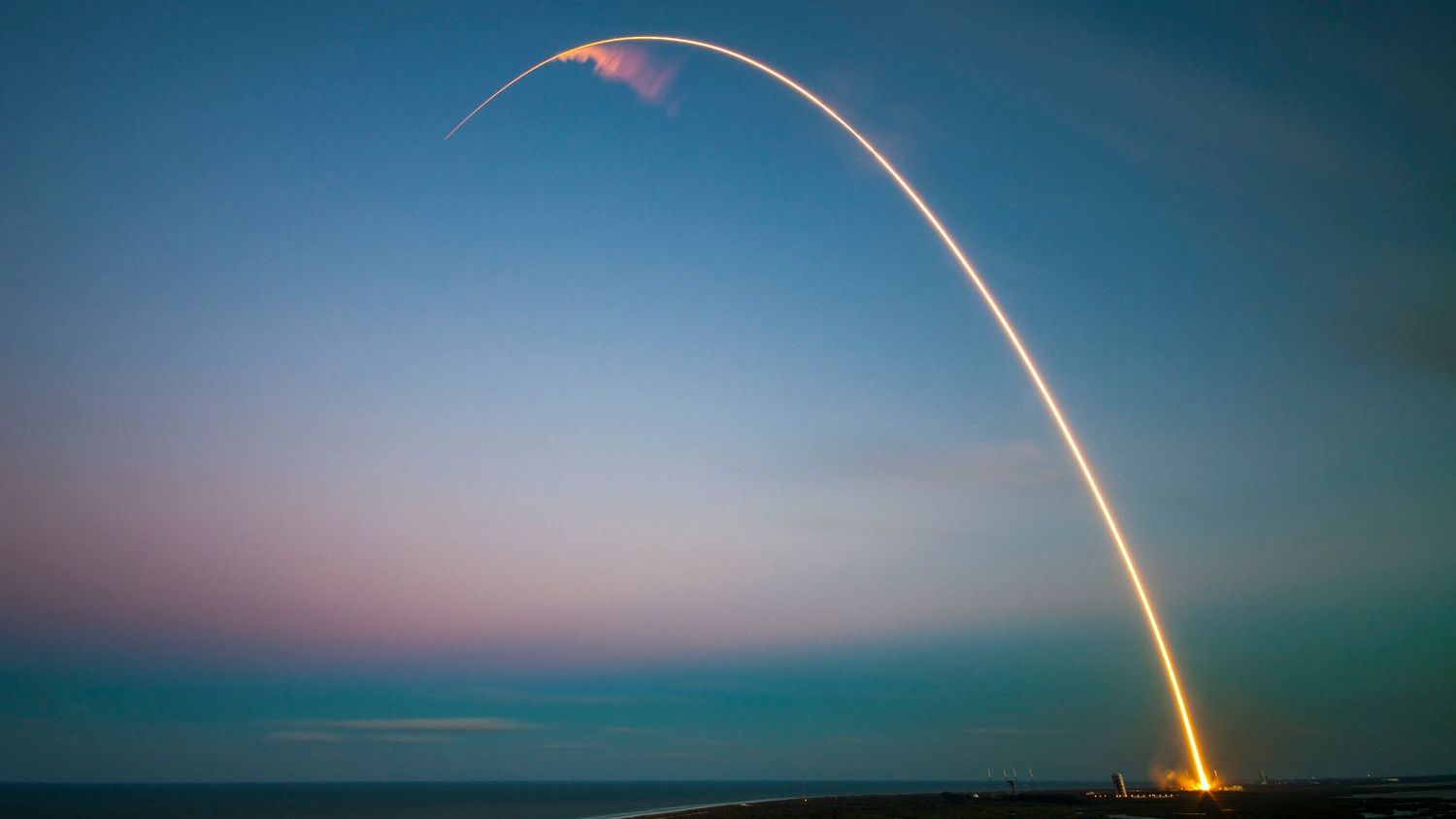
A European-Chinese spacecraft just launched to photograph something nobody has ever actually seen – the invisible shield that keeps the solar wind from sterilizing Earth – Image for illustrative purposes only (Image credits: Unsplash)
Kourou, French Guiana – A joint European-Chinese spacecraft built to capture the first large-scale images of Earth’s magnetic shield lifted off Tuesday aboard a Vega C rocket, beginning a three-year effort to observe how the planet’s protective boundary responds to the constant stream of charged particles from the Sun.
The Solar wind Magnetosphere Ionosphere Link Explorer, known as SMILE, separated into orbit less than an hour after liftoff and will now perform a series of engine burns to reach its final, highly elliptical path. From that vantage point the spacecraft can stare down at the dayside magnetopause and the auroral regions for extended periods rather than racing through them in minutes.
The mission’s core goal is straightforward yet unprecedented: turn an invisible boundary into something researchers can watch in motion.
A Boundary Scientists Have Measured but Never Watched
For decades, spacecraft have sampled the magnetopause one location at a time, giving scientists snapshots of how solar wind pressure shapes the boundary. Those point measurements have been essential, yet they leave large gaps in understanding how the entire shield flexes, compresses, or reconnects during solar activity.
SMILE changes that geometry. Its Soft X-ray Imager will record soft X-rays produced when solar wind ions collide with neutral hydrogen atoms high in Earth’s atmosphere. The resulting glow outlines the magnetopause across wide areas, revealing its shape and movement in ways scattered readings cannot.
Early images are expected once the spacecraft reaches its working orbit and its instruments complete checkout. The data should help refine models of how solar storms translate into geomagnetic disturbances around Earth.
Four Instruments Working as One
SMILE carries a focused suite of instruments chosen to map both the outer boundary and the inner effects of solar wind interaction. The Soft X-ray Imager serves as the primary camera, using lobster-eye optics to detect the faint X-ray emissions that trace the magnetopause.
Supporting it are an Ultraviolet Imager for auroral activity, a Light Ion Analyser to measure incoming solar wind particles, and a Magnetometer to record the local magnetic field. Together they create a more complete picture than any single previous mission has achieved.
ESA supplied the payload module and science data systems, while the Chinese Academy of Sciences provided the spacecraft platform that handles power, propulsion, and attitude control. This division of responsibilities has allowed the mission to proceed on schedule despite the technical complexity.
Why Better Images Matter for Everyday Technology
Space weather events can reach Earth in minutes and affect systems millions of people rely on daily. Strong geomagnetic storms have the potential to interfere with satellite operations, radio and GPS signals, power grids, and even polar flight routes.
Current forecasts still depend heavily on limited point data, which makes it harder to predict exactly where and when disruptions will occur. Continuous wide-field imaging from SMILE should improve understanding of the full chain of events that begins at the Sun and ends with effects near Earth.
The mission is not designed as an operational forecast tool, yet its findings are expected to strengthen the models used by space weather centers worldwide.
Next Milestones on the Road to First Science
Several critical steps remain before SMILE begins delivering its unique dataset. The spacecraft must complete a series of orbit-raising burns to reach the correct elliptical path with its high point above the North Pole.
Instrument commissioning follows, with particular attention to the Soft X-ray Imager and its novel optics. Only after those checks are complete will the first composite images of the magnetopause become available.
Over the planned three-year mission, SMILE will gather sustained observations that no earlier spacecraft has produced. Those records should clarify how Earth’s magnetic environment shifts under varying solar conditions and help scientists better anticipate the impacts of future solar activity.