

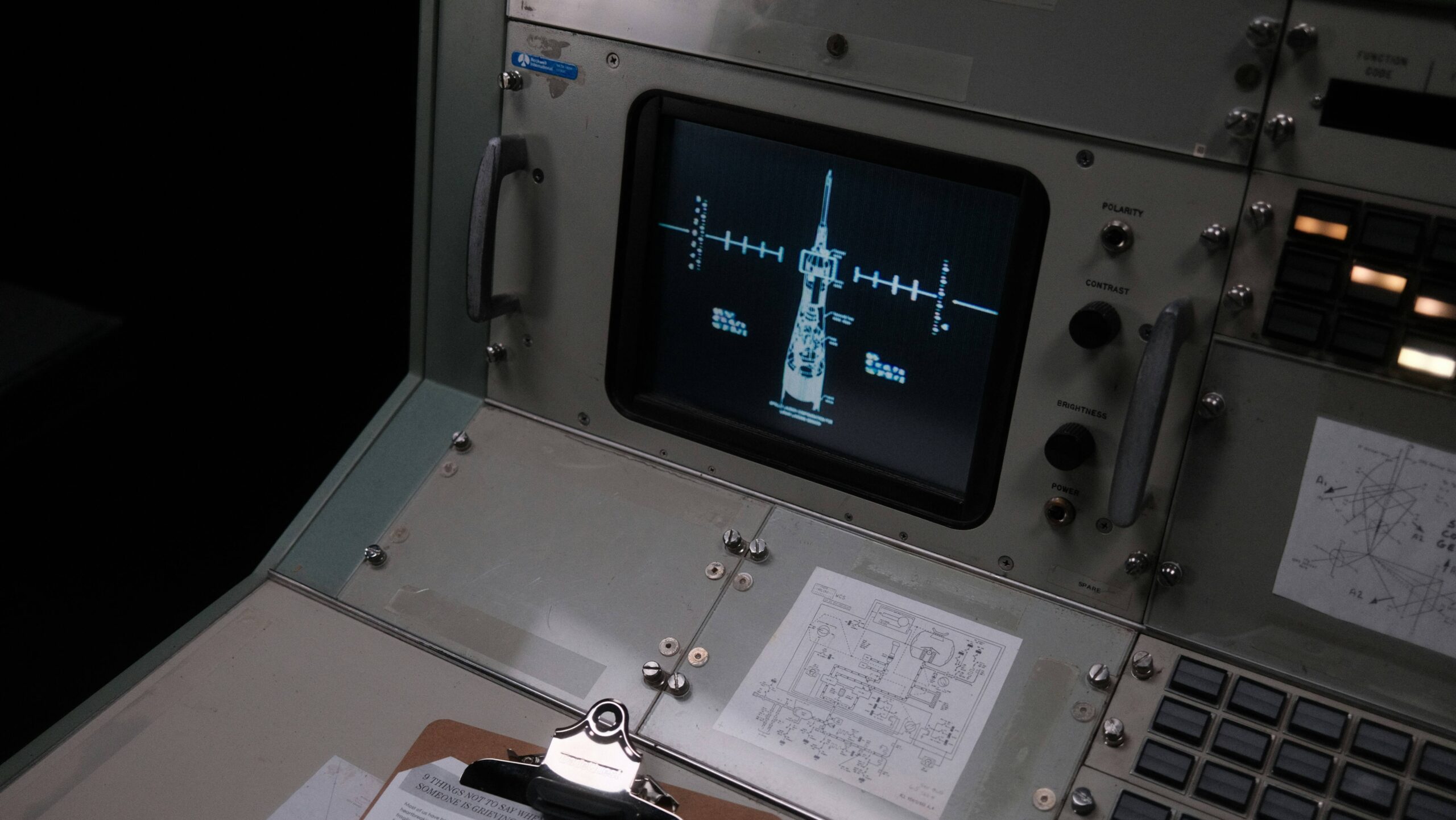
The Apollo Guidance Computer that landed humans on the Moon had less processing power than a modern microwave, and the engineers programmed it with rope memory that was hand-woven by women who were called “Little Old Ladies” in the official documentation – and the entire system worked because they were never wrong – Image for illustrative purposes only (Image credits: Unsplash)
The Apollo program succeeded in placing humans on the lunar surface with technology that today seems almost impossibly limited. The guidance computer aboard the spacecraft carried just 4 kilobytes of random-access memory and 72 kilobytes of read-only storage while running at a clock speed of 0.043 megahertz. A modern microwave oven possesses greater processing capacity than this machine, and a typical smartphone exceeds its performance by roughly 100,000 times. Despite these constraints, the system performed flawlessly because its software was not loaded through any conventional electronic means but instead physically woven into the hardware itself.
The Extreme Constraints That Shaped the Design
Engineers at MIT’s Instrumentation Laboratory faced strict requirements for size, weight, and reliability in the vacuum and radiation of space. The computer had to occupy no more than one cubic foot and weigh less than seventy pounds while storing enough instructions to manage navigation, guidance, and control for an entire lunar mission. Semiconductor memory of sufficient density did not yet exist in the mid-1960s, so the team turned to a solution that embedded the program directly into physical wiring. This approach eliminated any possibility of later software changes once the hardware left the factory. Every instruction had to be correct from the first thread, because the finished modules could not be patched or updated during flight. The resulting design achieved storage densities that were remarkable for their time, yet the method demanded absolute precision in every connection.
How Rope Memory Turned Software Into Hardware
The technology relied on core rope memory, a form of read-only storage in which copper wires were threaded through or around small ferrite cores. A wire passing through a core registered as a binary one; a wire routed around the core registered as a zero. In this way the entire flight program became a fixed physical pattern that could not be altered without rebuilding the module from scratch. Workers completed each module over approximately eight weeks of continuous effort. A full set of modules for one mission required months of labor. The finished assembly proved exceptionally reliable in the harsh environment of space, but the process left no room for even a single misplaced wire.
| Specification | Apollo Guidance Computer | Typical Modern Device |
|---|---|---|
| RAM capacity | 4 kilobytes | 8+ gigabytes |
| Clock speed | 0.043 megahertz | 3+ gigahertz |
| Read-only storage | 72 kilobytes | Hundreds of gigabytes |
The Skilled Hands That Built the Memory Modules
At a Raytheon facility in Waltham, Massachusetts, teams of women performed the intricate wiring. Many had previously worked in textile mills or at the Waltham Watch Company, where they had developed the steady hands and attention to detail required for precision assembly. They sat across long tables and used hollow needles to guide copper wire through thousands of ferrite cores according to diagrams prepared by programmers at MIT. Each completed module underwent inspection by three or four people before federal inspectors reviewed the work. One participant, Mary Lou Rogers, later described how the repeated checks ensured every connection met the exacting standards demanded by a system on which lives would depend. The process transformed abstract software into tangible hardware that could survive launch and operate without error.
The Nickname That Belied the Technical Demands
Engineers sometimes referred to the women as “Little Old Ladies,” or LOLs, in informal laboratory conversation. The term appeared alongside other lighthearted shorthand used inside the project, yet it understated the level of technical skill involved. The work required sustained concentration and an error rate approaching zero, because any mistake meant discarding weeks of effort and starting over. The affectionate label has persisted in later accounts, but the actual contribution was that of trained specialists producing mission-critical components under rigorous oversight. Their output formed an essential part of the guidance system that carried astronauts safely to the Moon and back. The story of the Apollo Guidance Computer ultimately illustrates how human craftsmanship and engineering ingenuity together overcame severe technical limits. The same careful attention that produced flawless rope memory modules remains a reminder that extraordinary achievements often rest on the steady work of many hands.