

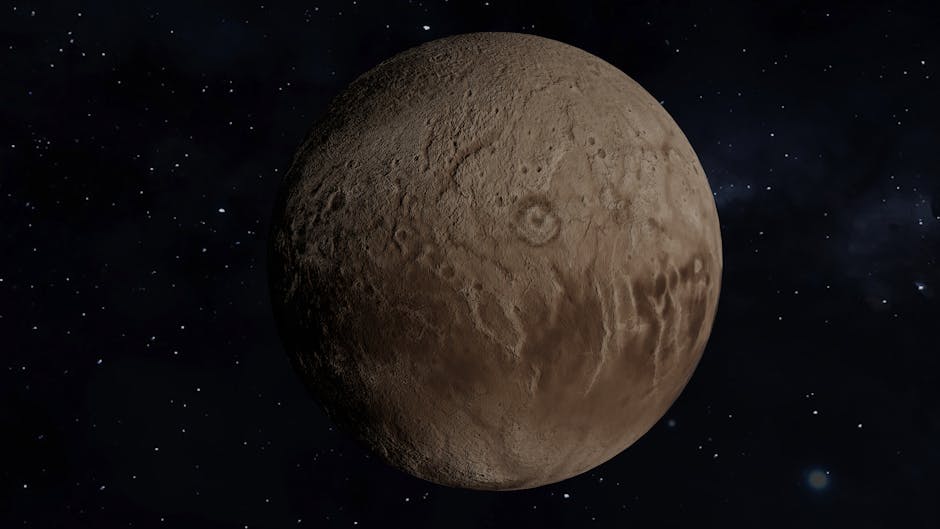
A small object past Pluto may have a thin atmosphere – Image for illustrative purposes only (Image credits: Pexels)
Researchers captured a fleeting stellar occultation that exposed a razor-thin atmosphere around the distant trans-Neptunian object known as 2002 XV93.[1][2] This small icy body, orbiting farther from the sun than Pluto, displayed gradual changes in a background star’s brightness during the event. The observation marks the first confirmed atmosphere on a solar system object smaller than Pluto and beyond its path.[3]_2002_XV93) Such a discovery upends expectations for these frozen relics from the solar system’s formative era.
A Rare Glimpse from Japanese Observatories
On January 10, 2024, telescopes in Kyoto, Nagano, and Fukushima prefectures tracked 2002 XV93 as it passed in front of a faint star identified by the Gaia space observatory.[4] Professional astronomers joined forces with an amateur observer equipped with a modest 25-centimeter instrument. The coordinated effort yielded critical data on the object’s silhouette against the starlight.
Instead of a sharp drop and recovery in brightness, the light curve revealed a subtle, prolonged fading followed by a gradual return.[5] This pattern pointed to refraction – light bending through a tenuous gaseous layer surrounding the object. The team, led by Ko Arimatsu of Japan’s National Astronomical Observatory, published their analysis in Nature Astronomy.[1]
Profiling the Enigmatic Plutino
Discovered on December 10, 2002, at Palomar Observatory by Chad Trujillo and Michael E. Brown, 2002 XV93 – formally (612533) 2002 XV93 – belongs to the plutino population.[3]_2002_XV93) These objects share Pluto’s 2:3 orbital resonance with Neptune, completing two laps around the sun for every three of the ice giant’s orbits. The body’s elliptical path spans from 34.6 AU at perihelion to 44.6 AU at aphelion, with a full orbit taking 247 years.
Estimates place its diameter at around 500 to 550 kilometers, making it a minor player compared to Pluto’s 2,370 kilometers.[1] Composed likely of water ice, rock, and organics, it reflects dimly with an albedo of about 0.04. No moons have been detected, leaving its mass and density unknown.
Unraveling the Atmospheric Evidence
The detected atmosphere exerts a surface pressure of 100 to 200 nanobars – roughly 50 to 100 times weaker than Pluto’s and 5 to 10 million times thinner than Earth’s.[2] Possible components include methane, nitrogen, or carbon monoxide, gases that could sublimate from surface ices or emerge from below. Arimatsu noted, “Finding an atmosphere around such a small object was genuinely surprising, and challenges the conventional view that atmospheres are limited to large planets, dwarf planets and some large moons.”[2]
At the time of observation, 2002 XV93 sat over 37 AU from the sun, where temperatures plunge low enough to freeze most volatiles solid. Yet the light-bending effect persisted across multiple observation sites, ruling out observational artifacts.
- Gradual light dimming indicated atmospheric refraction.
- Consistent signals from three locations strengthened confidence.
- Pressure levels suggest a sparse, extended envelope.
Challenging Models of Outer Solar System Bodies
Conventional wisdom held that objects this small and remote lack the gravity to retain atmospheres over billions of years. Pluto sustains its nitrogen-methane haze through seasonal sublimation, but 2002 XV93’s scale defies similar processes. “It was generally thought that an atmosphere would not exist on such a small object,” said co-author Junichi Watanabe.[1]
Two leading explanations have emerged. A recent comet impact could have vaporized ices, creating a temporary veil that might dissipate in years or decades. Alternatively, cryovolcanism – eruptions of volatile ices rather than molten rock – could supply gases steadily from the interior. Arimatsu added, “The discovery suggests that some small icy bodies in the outer Solar System may not be completely inactive or unchanging, as previously assumed.”[1]
Paths Forward for Deeper Insights
Future stellar occultations offer chances to monitor changes in the atmosphere’s extent or density. Space telescopes like NASA’s James Webb could probe its composition spectroscopically. Verification remains crucial, as Alan Stern of the Southwest Research Institute emphasized: “This is an amazing development, but it sorely needs independent verification.”[2]
This finding hints at hidden activity across the Kuiper Belt, where thousands of similar icy wanderers lurk. If cryovolcanism proves common, it reshapes our picture of these ancient survivors, revealing geological vigor in the solar system’s deep freeze. Ongoing scrutiny will clarify whether 2002 XV93 stands alone or heralds a new class of dynamic distant worlds.