

Charting New Distances: The Artemis II Mission (Image Credits: Flickr)
Washington – President Donald Trump turned the Oval Office into a stage for space achievement on April 29 when he hosted the crew of NASA’s Artemis II mission.[1][2] The astronauts had just returned from the first crewed lunar flyby in more than five decades, a voyage that pushed humanity’s boundaries and reignited national pride in exploration. Their visit highlighted the program’s rapid progress and set the tone for ambitious goals ahead.[3]
Charting New Distances: The Artemis II Mission
The Artemis II crew launched aboard the Orion spacecraft on April 1, embarking on a 10-day journey that culminated in a splashdown off California’s coast on April 10.[1][3] Commander Reid Wiseman, pilot Victor Glover, mission specialist Christina Koch, all from NASA, joined Canadian Space Agency’s Jeremy Hansen for the flight. They looped around the moon’s far side on April 6, reaching 252,756 miles from Earth – the farthest any humans had traveled since Apollo 17 in 1972.[2]
This test flight validated Orion’s systems for deeper space travel. The mission broke records without landing on the lunar surface, paving the way for future steps like Artemis III in 2027. Crew members adapted quickly to Earth after their odyssey, making public appearances before the White House call.[3]
| Mission Milestone | Date |
|---|---|
| Launch | April 1, 2026 |
| Lunar Flyby | April 6, 2026 |
| Splashdown | April 10, 2026 |
| Oval Office Visit | April 29, 2026 |
A Presidential Greeting Turns Festive
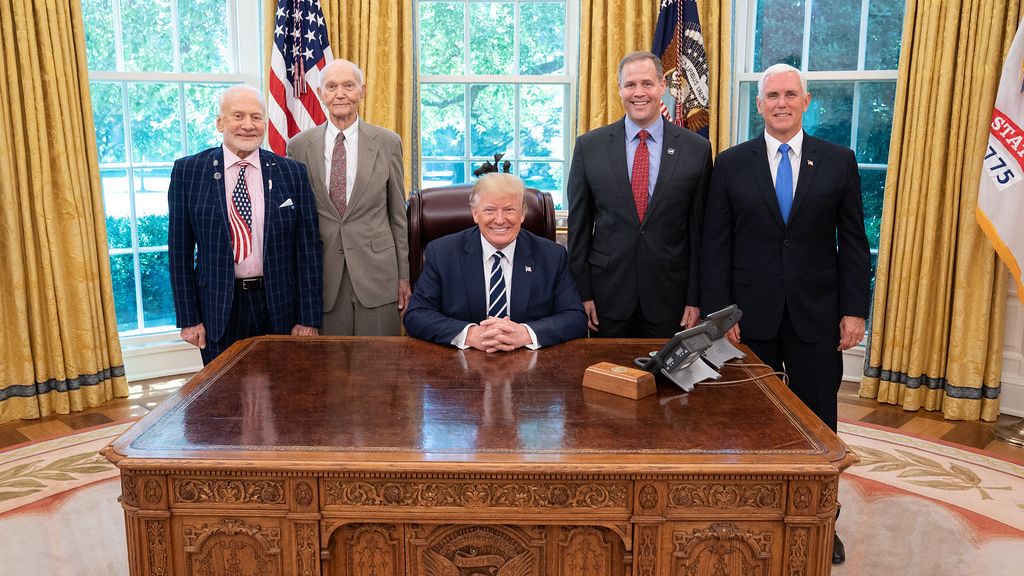
Trump gathered the quartet, NASA Administrator Jared Isaacman, and family members in the Oval Office for a 22-minute livestreamed event.[1][4] The astronauts, clad in blue jackets, stood behind the Resolute Desk beside a gold-plated moon model. Trump opened with hearty congratulations, emphasizing their role in American greatness.
“It takes people like this to make our country great,” Trump declared. “We’re very proud of these people. They have unbelievable courage.”[1] He commended their smarts and fitness requirements. Isaacman, whom Trump called a “great choice” for administrator, stood ready nearby. The group posed for the press before questions began.
Lighthearted Banter Meets Bold Ambitions
Trump injected humor into the proceedings, reflecting on astronaut qualifications. “By the way, to get in there, you have to be very smart. Have to do a lot of things physically good. So I would have had no trouble making it – I’m physically very, very good,” he remarked.[1] He turned to Isaacman: “Maybe a little bit of a problem – I don’t know, Jared. We’ll have to try it sometime. Is a president allowed to go up in one of these missions?” Isaacman replied, “We can get working on that, Mr. President.”[1][5]
Discussion shifted to NASA’s trajectory. Trump touted improvements since his first term, noting runways once overgrown with grass now hummed with activity. He credited the Space Force, launched under his watch, as a cornerstone of U.S. strength. Isaacman outlined next steps: Artemis III in 2027, with lunar landings eyed for 2028.[4]
What Matters Now
NASA eyes a crewed moon landing before 2029, ahead of schedule. Trump pegged the odds optimistically: “We have a good shot,” while cautioning against firm promises to avoid perceptions of shortfall.[2]
Space Talk Blends with Global Headlines
The gathering evolved into an impromptu press session. Reporters queried Trump on UFO files, promising releases of intriguing material soon. He fielded questions on Iran tensions, a Putin call, and former FBI Director James Comey’s indictment, weaving space themes throughout.[2][1] One probe about relocating NASA headquarters prompted Trump to relay it to Isaacman, who affirmed D.C.’s strategic value for stakeholder engagement.
The astronauts remained stoic observers, offering no remarks amid the exchange. Their presence amplified the moment’s symbolism, linking past triumphs to future horizons. Trump closed by reinforcing U.S. leads in space, from lunar orbits to Mars aspirations.
This Oval Office encounter affirmed Artemis’s momentum at a pivotal juncture. With commercial partners like SpaceX advancing landers and international collaborators on board, the program positions America for sustained deep-space leadership. The crew’s silent heroism spoke volumes, fueling optimism for landings that could redefine exploration eras.