

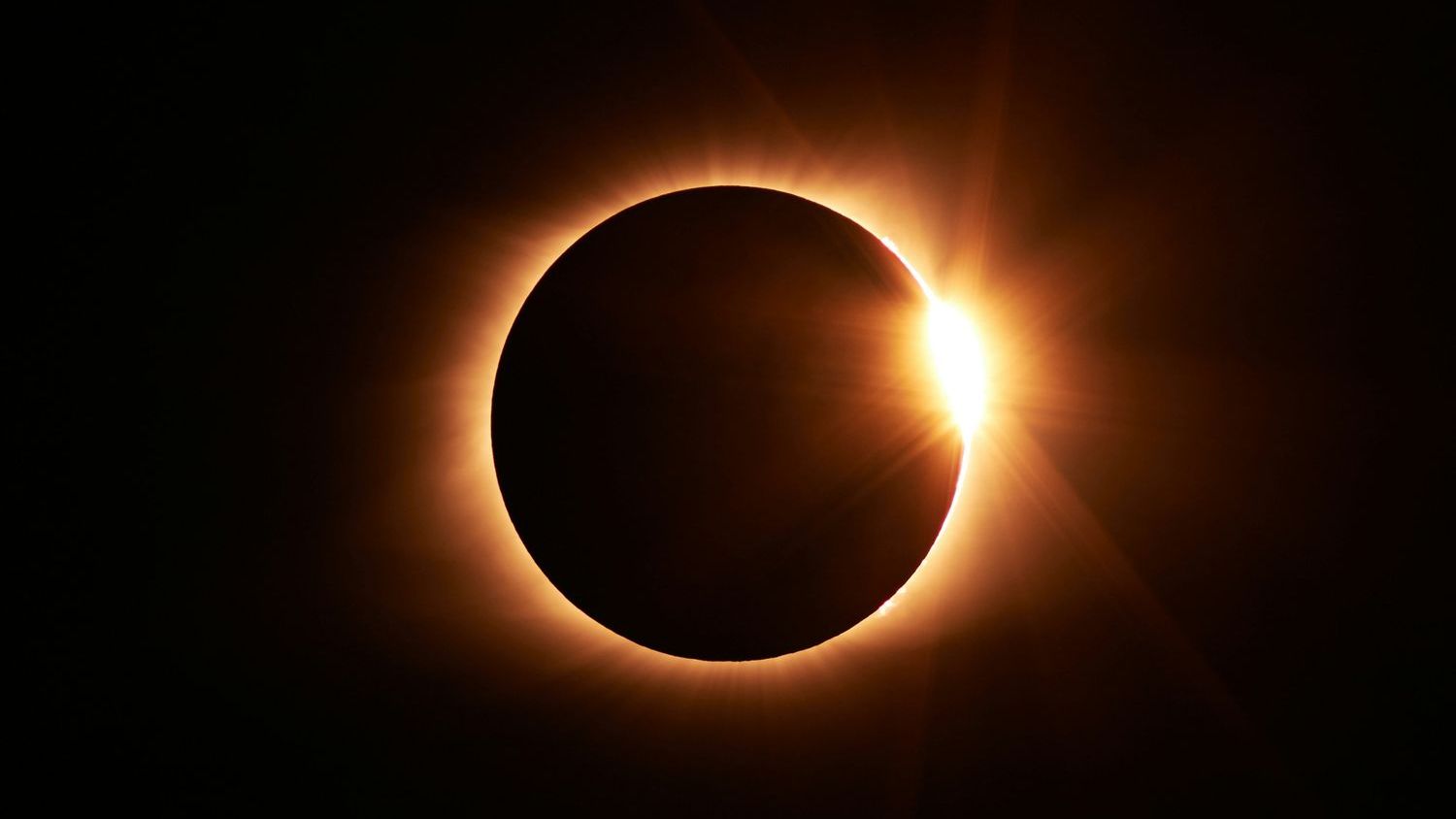
The moon is moving away from Earth at 3.8 centimetres per year – which means the total solar eclipses humans alive today get to see are something no future civilisation will ever witness – Image for illustrative purposes only (Image credits: Unsplash)
The Moon is drifting away from Earth at a steady 3.8 centimetres per year, a rate confirmed by decades of laser measurements. This gradual separation is quietly closing a narrow window in cosmic time during which total solar eclipses can occur. Human observers alive today sit inside that window, a coincidence that will not repeat for any future civilisation on this planet.
The Laser Measurements That Pinpoint the Drift
Apollo 11 astronauts placed a set of corner-cube reflectors on the lunar surface in 1969. Later missions added more arrays, including those left by Soviet Lunokhod rovers. Ground stations on Earth fire laser pulses at these mirrors and time the return signal to within a few picoseconds. The resulting data yield the most accurate distance record in lunar science and show the Moon receding at 3.8 centimetres annually.
The technique relies on tidal friction. Earth’s oceans bulge toward the Moon, and the planet’s rotation carries those bulges slightly ahead of the Moon’s position. Gravitational pull from the displaced water transfers angular momentum to the lunar orbit, pushing the Moon outward while lengthening Earth’s day by roughly 1.7 milliseconds each century. The ranging stations continue to record this motion with millimetre-level precision, confirming the rate year after year.
The Exact Alignment That Creates Totality
The Sun is about 400 times wider than the Moon and, on average, 400 times farther away. These proportions cancel out, so both bodies appear nearly the same size in Earth’s sky. When the Moon passes directly between Earth and the Sun at the right point in its orbit, it can cover the solar disc completely and reveal the faint corona. No other planet-moon system produces this precise match.
Early in the Earth-Moon system’s history the Moon orbited much closer, roughly 20,000 to 30,000 kilometres away. At that distance the lunar disc would have appeared far larger than the Sun, creating different eclipse geometries. Only after the Moon reached its present average distance of 384,400 kilometres did the conditions for modern-style total eclipses emerge.
When the Window Will Close
As the Moon continues to recede, its apparent size shrinks while the Sun’s remains essentially constant. In roughly 600 million years the lunar disc will no longer be large enough to cover the Sun even at closest approach. After that point only annular eclipses, with a bright ring of sunlight surrounding the Moon, and partial eclipses will remain.
The 600-million-year estimate carries some uncertainty tied to future changes in ocean basins and tidal resonances. Most projections place the end of totality between 500 million and 800 million years from now. Either way, the phenomenon is finite on geological timescales.
A Fleeting Privilege in Deep Time
Every total solar eclipse recorded by humans, from ancient Babylonian observations to the 2024 North American event and the 2026 path across Iceland and Spain, has occurred inside this limited interval. The same geometry will not exist for whatever life forms may inhabit Earth hundreds of millions of years ahead.
- The recession rate remains one of the cleanest long-term measurements in astronomy.
- Future observers will see only annular and partial eclipses once the Moon moves beyond the critical distance.
- The retroreflectors continue to function as a passive cosmic clock, recording the slow end of totality in real time.
The mirrors left on the Moon more than fifty years ago still return photons that carry this information. Each new measurement quietly advances the deadline for the last total eclipse the Earth-Moon system will ever produce.