

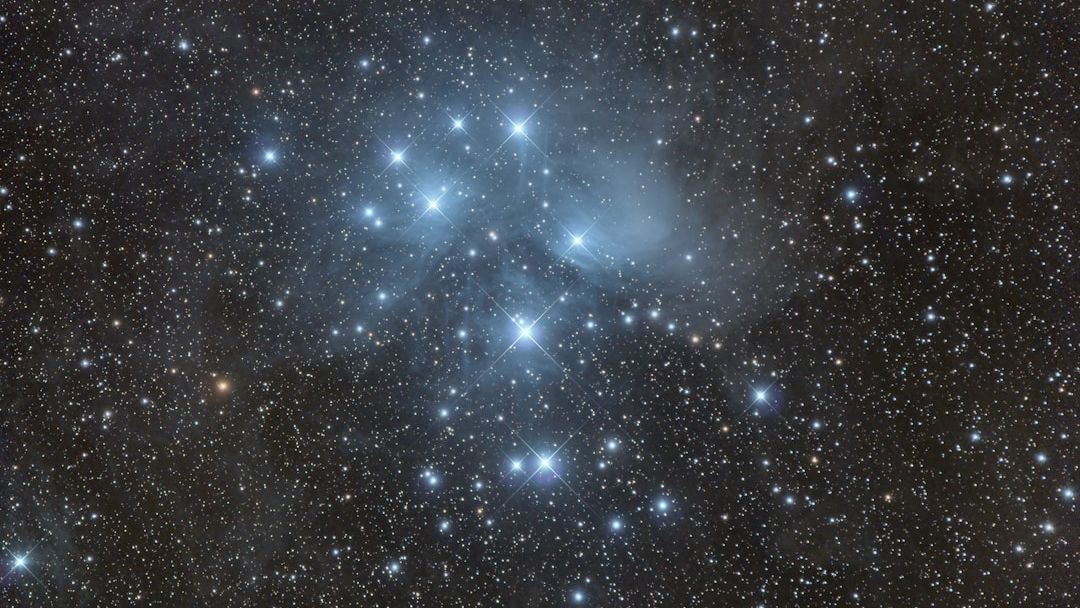
Clusters Reveal a Quieter Stellar Adolescence (Image Credits: Unsplash)
A new analysis from NASA’s Chandra X-ray Observatory has revealed that stars resembling our Sun in mass quiet their high-energy emissions much sooner than scientists anticipated. Researchers examined eight young star clusters and found these stellar youths produce only a quarter to a third of the expected X-rays during their formative millions of years.[1][2] This rapid calming carries significant weight for understanding how planets around such stars might retain atmospheres conducive to life. The findings, detailed in a paper published in The Astrophysical Journal, challenge prior models and offer a more optimistic view of early stellar neighborhoods.[3]
Clusters Reveal a Quieter Stellar Adolescence
Astronomers targeted open star clusters, where hundreds of stars born from the same gas clouds remain gravitationally bound. These environments provide a snapshot of stellar development at various stages. The study focused on clusters ranging from 45 million to 750 million years old – mere infants compared to our 4.6-billion-year-old Sun.[2]
New Chandra observations covered five younger clusters between 45 and 100 million years old, while archived data from Chandra and the ROSAT satellite filled in details for three older ones up to 750 million years. Featured examples include Trumpler 3, NGC 2353, and NGC 2301. Sun-like stars in these groups showed X-ray luminosities dropping about 15 times faster than predictions based on age and rotation rates.[3] Lower-mass stars, by contrast, sustained their X-ray activity longer.
Defying Expectations from Prior Models
Previous estimates relied on sparse observations and formulas linking X-ray brightness to a star’s spin and age. Slower rotation typically meant fainter emissions, but the data exposed a steeper decline during this “adolescent” phase. Three-million-year-old solar-mass stars blast out roughly 1,000 times more X-rays than today’s Sun, yet by 100 million years, that figure falls to about 40 times current levels – and even lower than models forecasted.[3]
“We can only see our Sun at this current snapshot in time, so to really understand its past we must look to other stars with about the same mass,” noted Eric Feigelson, a co-author from Penn State University. The team also drew on ESA’s Gaia satellite to confirm cluster membership, filtering out interloping foreground and background stars. This precise selection sharpened the X-ray measurements.
Such efficiency in data handling marked a leap from earlier efforts, which struggled with contamination in cluster fields.
Mechanisms Behind the Rapid Decline
The exact cause remains under investigation, but researchers point to evolving magnetic field generation inside these stars. Stronger, more chaotic fields in youth fuel intense X-ray production through coronal activity. As stars mature, this dynamo process apparently weakens faster in solar-mass examples, reducing both X-ray energy and accompanying high-speed particles.[2]
Konstantin Getman, the lead author from Penn State, highlighted the contrast with science fiction: “Our real observations reveal a natural ‘quieting’ of young Sun-like stars in X-rays… because their internal generation of magnetic fields becomes less efficient.”[3] Lower-mass counterparts lag in this slowdown, maintaining flare-prone behavior longer. Future work will probe these dynamo shifts further.
Boost for Planets in Young Systems
High X-ray fluxes can strip away planetary atmospheres, hindering water retention and organic molecule formation. This study’s portrait of quicker stellar mellowing suggests solar-mass stars foster gentler conditions sooner. Planets orbiting them might preserve protective layers, enhancing chances for habitable environments.
Vladimir Airapetian of NASA’s Goddard Space Flight Center reflected on our own origins: “It’s possible that we owe our existence to our Sun doing the same thing, several billion years ago.”[3] While uncertainties persist – such as exact timelines and particle fluxes – the results tilt toward optimism for exoplanet searches around young Sun analogs.
What Matters Now: This discovery refines models for stellar evolution and habitability, urging refined simulations for upcoming telescopes like the Habitable Worlds Observatory.
Bridging Gaps in Cosmic Youth
Prior to this, astronomers lacked comprehensive X-ray data for stars in the 45-to-750-million-year window. The blend of new and archival observations closed that void, offering benchmarks for theory. As Getman’s team continues analysis, including potential spin-down effects, the findings promise to reshape predictions for thousands of exoplanet hosts discovered by missions like TESS and JWST.
These quieter young Suns underscore the dynamic early lives of stars. Their swift taming not only safeguards nearby worlds but also illuminates the path our own star once followed, billions of years back.