

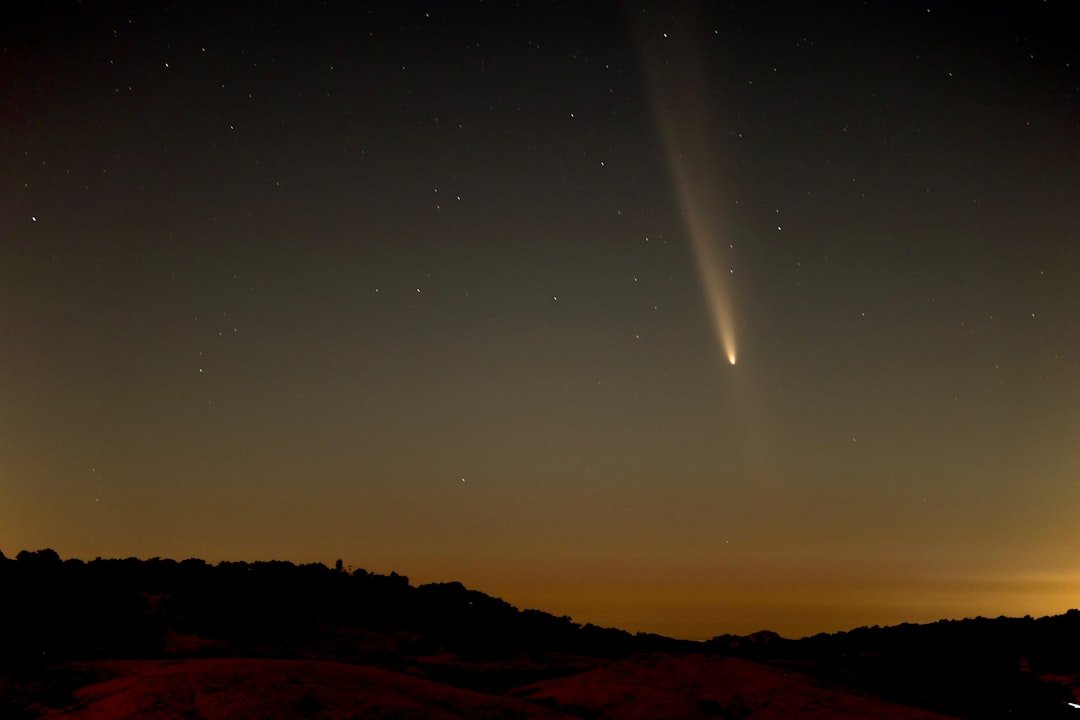
A Newly Discovered Wanderer from the Oort Cloud (Image Credits: Unsplash)
Payson, Arizona – A vivid emerald-green comet has drawn the gaze of skywatchers worldwide as it streaks through the predawn heavens. Comet C/2025 R3 (PanSTARRS) appeared prominently in the constellation Pegasus on April 9, displaying a striking green coma and a blue ion tail that spanned more than 10 degrees.[1][2] Astrophotographer Chris Schur immortalized this celestial display from his location in Payson, capturing the comet’s ethereal beauty against a dark horizon. As the comet brightens in mid-April 2026, observers from various latitudes now have a prime opportunity to witness this rare visitor from the outer solar system.
A Newly Discovered Wanderer from the Oort Cloud
Astronomers first spotted Comet C/2025 R3 (PanSTARRS) on September 8, 2025, when the Pan-STARRS 2 telescope on Haleakala in Hawaii detected it at a faint magnitude of 19.8.[3][4] This long-period comet hails from the distant Oort Cloud, a reservoir of icy bodies far beyond Pluto that occasionally venture inward due to gravitational influences.[5] Over the ensuing months, it grew brighter as it approached the inner solar system, transitioning from a telescope-only target to a potential naked-eye object.
By early April 2026, the comet had reached around 5th to 8th magnitude, positioning itself low in the eastern sky before sunrise.[6][7] Its path through the Great Square of Pegasus made it a standout feature for early risers. Perihelion, its closest approach to the Sun, loomed around April 19, followed by closest passage to Earth on April 26-27 at roughly 71-73 million kilometers.[8]
The Striking Colors of a Cosmic Jewel
The comet’s emerald-green coma immediately captivates viewers, a hallmark of active comets rich in diatomic carbon compounds that fluoresce under sunlight. This green hue contrasts sharply with the blue ion tail, formed by charged particles ionized by solar radiation and swept outward by the solar wind.[1] On April 9, this tail extended dramatically more than 10 degrees, rivaling the span of a fist held at arm’s length.
Such vivid displays occur as the comet sheds gas and dust while heating up near the Sun. The ion tail’s length underscores the comet’s high activity level during this apparition. Observers noted its glow intensifying daily, doubling in brightness by mid-April in some reports.[9]
Chris Schur’s Masterful Capture
Local astrophotographer Chris Schur, based in Payson, Arizona, seized the moment on April 9 at 3:55 a.m. local time. He employed a 135mm f/2 lens paired with a one-shot color camera, accumulating 28 minutes of total exposure.[1][10] Frames were stacked and registered to the initial image, preserving the sharp silhouetted horizon that frames the comet’s tail.
Schur’s technique highlighted the comet’s position in Pegasus, where it floated amid the constellation’s familiar asterism. His image quickly circulated among astronomy communities, showcasing the comet’s potential for stunning visuals even with modest equipment.[11] For more on the photo, see the original feature on Astronomy.com.[1]
Tips for Spotting the Comet Yourself
With the current date of April 15, 2026, Comet C/2025 R3 remains visible low in the east about 90 minutes before sunrise, particularly from mid-northern latitudes.[12] It may appear naked-eye under dark skies, rivaling brighter stars around magnitude 4 or better through April 20.
Here are key steps to observe it:
- Head to a site with a clear eastern horizon, away from light pollution.
- Arrive 90-120 minutes before local sunrise; check apps like Stellarium for exact position in Pegasus.
- Use binoculars or a small telescope for the tail; naked eye suffices for the coma if conditions are ideal.
- Face east-southeast; the comet sits near the Great Square until late April.
- Monitor weather; clear predawn skies enhance visibility, especially April 13-19.
From the UK and similar latitudes, it hugs the horizon but rewards patient viewers.[5]
Looking Ahead: The Comet’s Departure
After perihelion on April 19, the comet will fade as it recedes, though its outbound path may still offer views into late April.[13] Unlike short-period comets, this Oort Cloud interloper will not return for millennia, making its 2026 passage a once-in-a-lifetime event.
Recent images from Austria, Norway, and beyond confirm its global appeal, with tails stretching impressively in wide-field shots.[14][15]
Key Takeaways
- Comet C/2025 R3 (PanSTARRS) displays a rare emerald coma and long blue ion tail, best seen predawn in Pegasus.
- Discovered in 2025, it peaks in visibility mid-April 2026 before fading post-perihelion.
- Amateur setups like Chris Schur’s reveal its splendor; try binoculars from dark sites now.
This fleeting cosmic gem reminds us of the universe’s dynamic beauty, urging stargazers to step outside before it vanishes. What do you think about this emerald visitor? Tell us in the comments.