

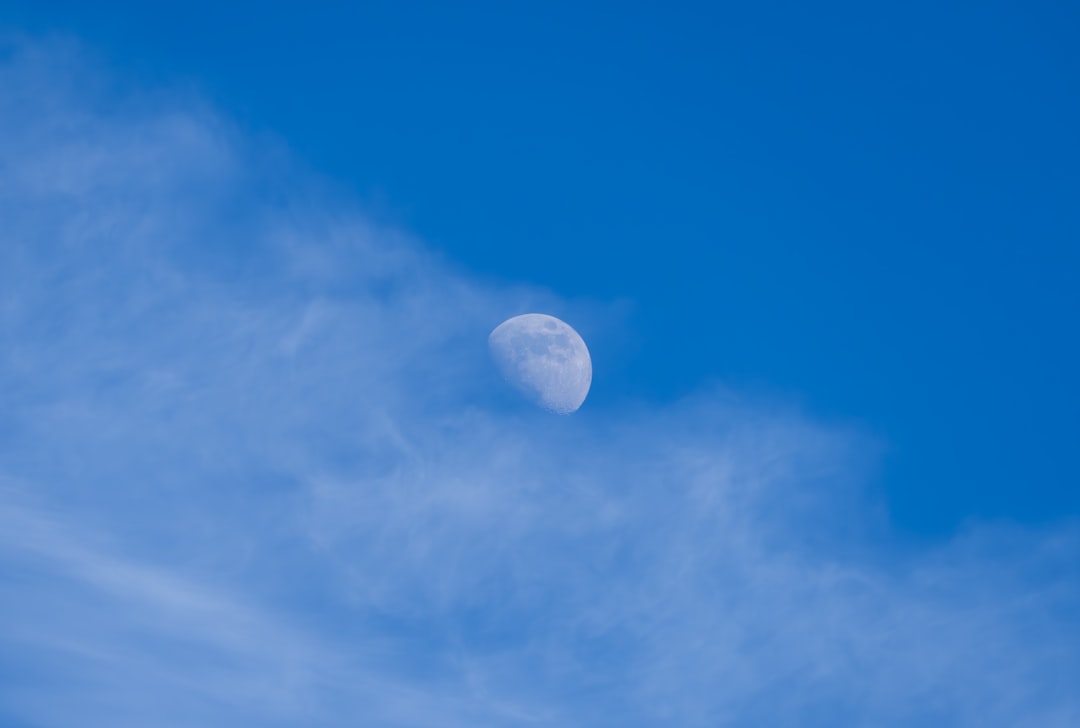
The Moon-Mercury Close Approach (Image Credits: Unsplash)
Stargazers have a prime opportunity this Wednesday morning to witness a striking alignment in the eastern sky. A slender waning crescent Moon positions itself just above the brilliant planet Mercury shortly before sunrise, offering a brief but rewarding view for early risers. This celestial duo, separated by about 5 degrees at their closest, highlights the dynamic motion of our night sky against the backdrop of dawn twilight.
The Moon-Mercury Close Approach
A delicate crescent Moon, illuminated to roughly 6 percent, hangs prominently in the predawn hours. It passes 5 degrees north of Mercury at 3 P.M. EDT, though the most visible moment comes earlier in the morning. Mercury, shining at magnitude 0.0, stands out as one of the sky’s brightest objects despite its proximity to the horizon.[1]
Observers may notice earthshine softly lighting the Moon’s darkened side, where sunlight reflected from Earth illuminates the lunar night. This effect adds a subtle glow to the thin crescent, making the scene even more enchanting. The pair rises with the Moon about an hour before the Sun and Mercury roughly 40 minutes ahead of sunrise.
Optimal Viewing Window
The best time to catch this event falls around 30 minutes before local sunrise, when the Moon sits about 6 degrees above the eastern horizon. Mercury appears lower, at just 2.5 degrees elevation and 4 degrees below the Moon. From locations around 40 degrees north latitude and 90 degrees west longitude, sunrise occurs at 6:22 A.M. local time, with moonrise at 5:13 A.M. and moonset at 5:52 P.M.[1]
Sunset follows at 7:39 P.M. from the same vantage, and the Moon reaches about 3 percent illumination by 10 P.M. local time. These timings shift slightly by location, so check local astronomical data for precision. The waning crescent phase enhances the challenge and beauty of the observation.
Chasing Mars and Neptune Nearby
Mars adds intrigue to the scene, positioned 4.2 degrees to the left of Mercury at magnitude 1.2. Though visible in binoculars or a telescope, its detection proves tricky amid the brightening twilight. The Moon passes 4 degrees north of Mars later at 9 P.M. EDT.[1]
Neptune, much fainter, lies above the horizon but remains elusive in the morning glow. The Moon glides 4 degrees north of it at 5 P.M. EDT. These additional alignments extend the day’s planetary interest, though morning conditions favor the brighter targets.
Essential Tips for Success
Binoculars offer the easiest way to pick out Mercury against the horizon haze. A telescope reveals its 6-inch-wide disk, 66 percent illuminated. Scan the east-southeast direction low on the sky, ideally from an unobstructed site free of trees or buildings.
- Arrive 45 minutes before sunrise to allow eyes to adapt to low light.
- Use a star-chart app or planetarium software to confirm positions.
- Pack optics away well before full daylight to protect equipment.
- Face east and look for the Moon first as your guidepost.
- Consider wider alignments, as other planets like Saturn may appear in pre-dawn views during this period.[2]
| Celestial Event | Time (EDT) | Separation |
|---|---|---|
| Moon-Mercury | 3 P.M. | 5° |
| Moon-Neptune | 5 P.M. | 4° |
| Moon-Mars | 9 P.M. | 4° |
Patience pays off in these twilight hunts, where steady air and clear horizons make all the difference. For more details, visit the original report from Astronomy Magazine.[1]
This April 15 display reminds us of the sky’s constant ballet, accessible even from urban backyards with minimal gear. Early mornings like this foster a deeper connection to the cosmos.
Key Takeaways
- Target 30 minutes before sunrise for Moon and Mercury in the east.
- Binoculars essential for Mercury; earthshine highlights the crescent Moon.
- Mars offers a bonus challenge; secure optics before dawn brightens.
What sights will you catch in the predawn sky? Share your observations in the comments.