

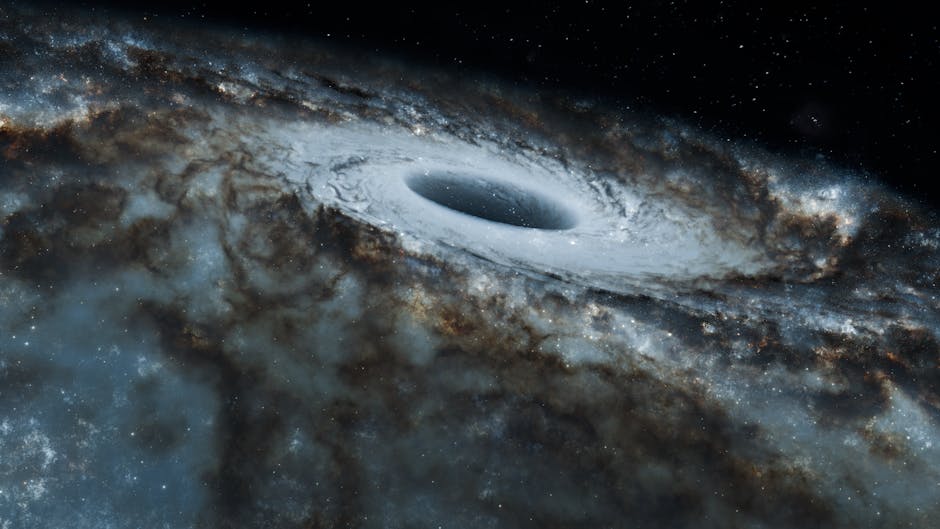
Dark Matter May Have Left Its Fingerprint in a Gravitational Wave. – Image for illustrative purposes only (Image credits: Pexels)
Dark matter accounts for the vast majority of matter in the universe, yet no experiment has ever captured a single particle of it. Physicists have long searched for indirect signs of this invisible substance, and a fresh approach now focuses on the ripples that black holes send through spacetime when they collide. The idea is straightforward in principle: if those black holes pass through a dense patch of dark matter before merging, the waves they produce could carry a detectable trace of that encounter.
The Scale of the Unknown
Astronomers estimate that dark matter makes up about 85 percent of all matter. Its gravitational pull shapes galaxies and clusters on the largest scales, but every attempt to register it directly has come up empty. Traditional detectors look for rare collisions between dark-matter particles and ordinary atoms deep underground. Those searches have grown more sensitive over the years without yielding a confirmed signal. The absence of results has pushed researchers to consider entirely different messengers that might reveal the same hidden component.
Ripples That Could Reveal More
When two black holes spiral together and merge, they distort the fabric of spacetime and send gravitational waves outward at the speed of light. These waves travel across cosmic distances and are now routinely recorded by observatories on Earth. The waveform encodes details about the black holes themselves, including their masses and spins. If the pair had moved through a cloud of dark matter, the extra mass and friction could alter the orbit slightly and leave a subtle imprint on the final signal. Until recently, no practical way existed to extract that imprint from the data.
Reading the Imprint
Researchers at MIT and partner institutions in Europe have developed a method that compares observed waveforms against theoretical models that include dark-matter effects. The technique isolates small deviations that would appear only if the black holes had interacted with an unseen medium. When the team applied the analysis to existing detections, one event stood out. The waveform showed a pattern consistent with passage through a dense dark-matter region, although the match remains tentative. The finding does not constitute a discovery on its own, but it demonstrates that the method can be applied to real data and can flag candidates worth closer study.
Next Steps and Remaining Limits
Future observations will test whether similar patterns appear in additional mergers. Detectors now under construction or planned for the coming decade will record events with greater precision, increasing the chance of spotting clearer signatures. At the same time, the approach carries built-in uncertainties: the density and distribution of dark matter around black holes are still poorly known, and alternative explanations for any deviation must be ruled out.
The work shows that gravitational-wave astronomy can serve as a new window on the invisible universe. Whether the first hint holds up or not, the technique itself expands the toolkit available to physicists and keeps the search for dark matter moving forward on multiple fronts.