

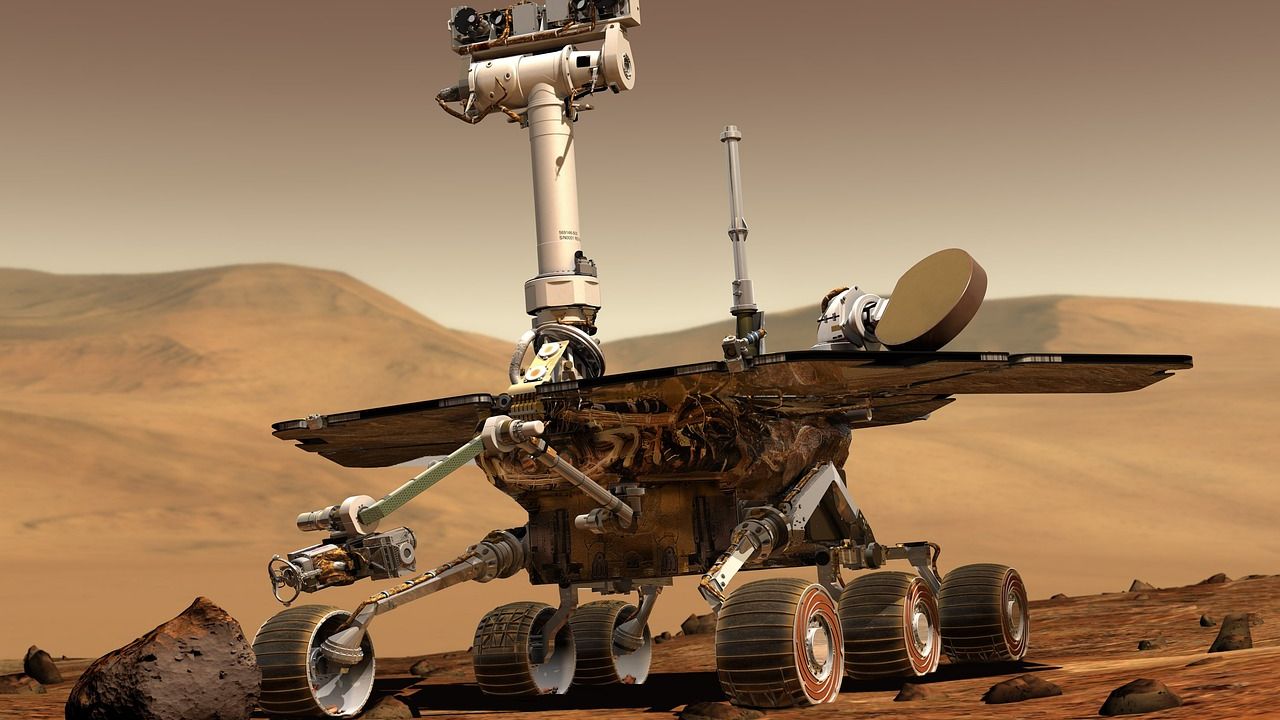
The fastest object ever built by humans is the Parker Solar Probe, currently flying through the Sun’s outer atmosphere at 430,000 miles per hour – fast enough to travel from Philadelphia to Washington in about a second – protected from 2,500-degree temperatures by a heat shield about four and a half inches thick that NASA engineers spent two decades figuring out how to make. – Image for illustrative purposes only (Image credits: Pixabay)
The Parker Solar Probe has set a new benchmark for human engineering by reaching speeds of 430,000 miles per hour while passing through the Sun’s outer atmosphere. This velocity, achieved during close approaches in late 2024 and again in March 2025, allows the spacecraft to cover the distance from Philadelphia to Washington, D.C., in roughly one second. The achievement stands out not only for its pace but also for the spacecraft’s ability to endure the intense conditions at such proximity to the star.
A Speed Record Rooted in Close Solar Passes
The spacecraft, comparable in size to a compact car, reached its top speed during a flyby just 3.8 million miles from the Sun’s surface. That distance marks the closest any human-made object has come to a star. NASA records confirm the same performance held steady on the subsequent approach, underscoring the consistency of the mission’s trajectory design.
While the raw number draws attention, the speed serves a practical purpose. It enables the probe to gather data from regions previously inaccessible to direct measurement. The mission team has used these high-velocity passes to position instruments inside the corona for extended observation periods.
A Four-and-a-Half-Inch Shield That Handles 2,500-Degree Heat
Protection comes from a compact heat shield measuring four and a half inches thick and eight feet across. The shield weighs about 160 pounds and features a carbon foam core between two carbon-composite plates. Its Sun-facing surface carries a white alumina ceramic coating that reflects incoming radiation.
During peak exposure the front side reaches roughly 2,500 degrees Fahrenheit. Four and a half inches away, on the shaded side, temperatures stay near 85 degrees Fahrenheit. This gradient allows the four instrument suites to operate in stable, office-like conditions despite the surrounding vacuum and particle radiation.
Shield Performance at a Glance
- Sun-facing temperature: ~2,500 °F
- Shaded-side temperature: ~85 °F
- Thickness: 4.5 inches
- Weight: ~160 pounds
Two Decades of Materials Development
Work on the shield began in earnest in the late 1990s after earlier mission concepts had stalled for lack of suitable materials. Engineers developed the carbon foam core, refined the reflective coating, and perfected bonding methods that withstand extreme temperatures. Testing occurred in stages across multiple facilities because no single Earth-based setup could replicate the full solar environment.
The integrated performance had to be verified through indirect simulations. Teams calibrated these partial tests carefully enough to predict real-world behavior accurately. The resulting shield has now completed multiple close approaches without compromising the spacecraft’s systems.
Direct Measurements Inside the Corona
The probe’s primary goal is to study the corona, the Sun’s outer atmosphere that reaches several million degrees despite the surface temperature of about 10,000 degrees Fahrenheit. Scientists have sought explanations for this temperature inversion for decades. The spacecraft now supplies direct data on solar wind acceleration, magnetic field structure, and plasma dynamics within the corona itself.
Recent findings have contributed to broader understanding of these processes. In recognition of the mission’s contributions, the Parker Solar Probe team received the 2024 Robert J. Collier Trophy from the National Aeronautic Association.
The visible success of the spacecraft rests on the engineering that keeps its instruments safe. That foundation, built over twenty years, continues to deliver measurements that were once considered out of reach.