

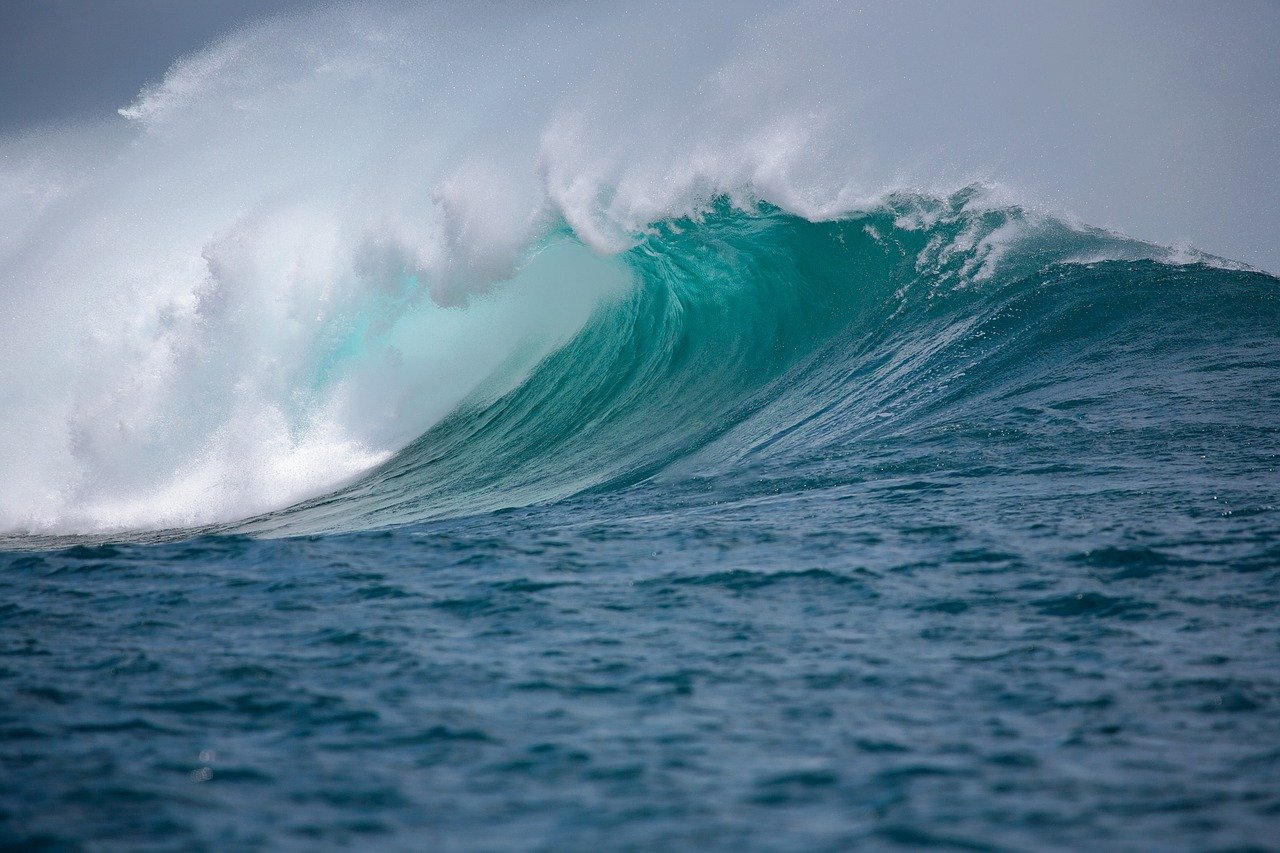
PlanetWaves: Decoding Waves Across Worlds (Image Credits: Pixabay)
Saturn’s largest moon, Titan, harbors vast seas of liquid methane and ethane under a thick nitrogen atmosphere. Scientists have long puzzled over the behavior of these hydrocarbon bodies, observed by NASA’s Cassini spacecraft but never directly witnessed in motion. A new computational model reveals that even mild breezes could generate towering waves on these alien lakes, reshaping our understanding of extraterrestrial ocean dynamics.[1]
PlanetWaves: Decoding Waves Across Worlds
Researchers at MIT developed PlanetWaves, the first model to simulate wave formation under diverse planetary conditions. This tool incorporates gravity, liquid density, viscosity, surface tension, and atmospheric pressure to predict how winds generate ripples and swells. Tested against two decades of data from Lake Superior, the model accurately forecasted wave heights and onset winds on Earth.
The innovation lies in its flexibility beyond Earth analogs. Previous efforts focused mainly on gravity’s role, but PlanetWaves quantifies liquid composition’s impact. Lead author Una Schneck, a graduate student in MIT’s Department of Earth, Atmospheric and Planetary Sciences, noted that earlier models overlooked these nuances.[1]
Titan’s Unique Recipe for Massive Waves
On Titan, low gravity – one-seventh of Earth’s – combines with lightweight hydrocarbons to amplify wave growth. A gentle wind, barely stirring ripples on earthly ponds, could produce waves up to 10 feet tall in Titan’s seas. These swells propagate slowly, creating a surreal vista of towering crests advancing at a leisurely pace.
“It kind of looks like tall waves moving in slow motion,” Schneck explained. “If you were standing on the shore of this lake, you might feel only a soft breeze but you would see these enormous waves flowing toward you, which is not what we would expect on Earth.”[1] The moon’s dense atmosphere aids momentum transfer from air to liquid, while the hydrocarbons’ low density and viscosity allow unchecked expansion.
- Low gravity reduces restoring forces, permitting taller peaks.
- Light liquids like methane and ethane lower inertia barriers.
- Thick atmosphere enhances wind stress on the surface.
- Low surface tension eases initial ripple formation.
- Reduced viscosity sustains wave energy over distances.
Contrasts with Earth and Beyond
Earth’s oceans demand stronger winds for comparable heights due to water’s density and higher gravity. Hurricane-force gusts might barely muster centimeters on a molten rock ocean like that theorized on exoplanet 55 Cancri e. Titan flips this script, where whispers of wind summon giants.
The model extends to ancient Mars, where thinning atmospheres demanded fiercer gales to sculpt Jezero Crater’s former waters. Super-Earth LHS 1140 b sees muted waves from earthly winds owing to steeper gravity. Venus-like Kepler 1649 b requires gales for sulfuric acid ripples.[1]
| World | Liquid | Wind for Significant Waves |
|---|---|---|
| Earth | Water | Moderate breeze for ripples |
| Titan | Methane/Ethane | Gentle breeze for 10 ft |
| 55 Cancri e | Molten rock | Hurricane-force for cm |
Shaping Landscapes and Future Missions
Cassini radar imaged Titan’s smooth lakes but detected no waves, possibly due to calm conditions during flybys. PlanetWaves suggests dynamic seas could erode shorelines, explaining sparse river deltas despite evident fluvial features. Taylor Perron, MIT professor, questioned whether waves dominate coastal evolution there.
Upcoming NASA missions, like the Dragonfly rotorcraft, may probe these lakes. Engineers must now account for potential swells in designs. “You would want to build something that can withstand the energy of the waves,” Schneck advised.[1]
The study appeared in the Journal of Geophysical Research: Planets, supported by NASA and the National Science Foundation. Co-authors hail from Woods Hole Oceanographic Institution, Cornell University, and the University of Miami.
Key Takeaways
- PlanetWaves predicts 10-foot waves on Titan from light winds, driven by low gravity and hydrocarbon properties.
- Waves move in slow motion, defying Earth intuition.
- Model aids landscape interpretation and mission planning across solar system and exoplanets.
This breakthrough invites us to rethink fluid dynamics on alien worlds, where familiar physics yields unfamiliar spectacles. As observations sharpen, Titan’s seas may yet reveal their restless nature. What surprises might future probes uncover there? Share your thoughts in the comments.