

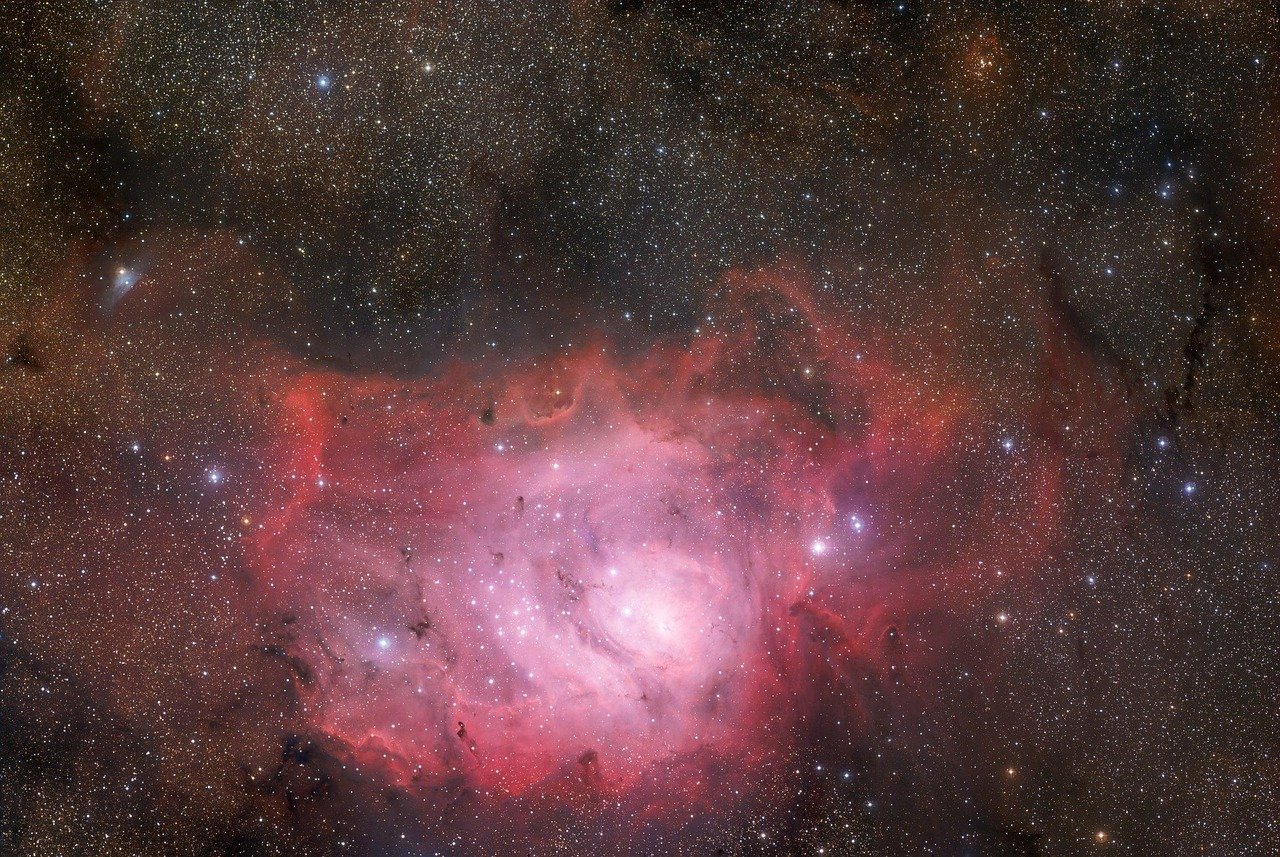
A Violent Birth in the Galactic Plane (Image Credits: Pixabay)
NGC 2359, widely recognized as Thor’s Helmet, glows prominently in the constellation Canis Major, roughly 15,000 light-years from Earth.[1][2] This emission nebula draws its mythical name from its striking resemblance to the Norse thunder god’s winged headgear, complete with billowing extensions that evoke ancient armor. Astrophotographer Bruno Araujo immortalized its intricate details from his location in Joinville, Santa Catarina, Brazil, showcasing how backyard observers can peer into deep space wonders.[1]
A Violent Birth in the Galactic Plane
Stellar winds of extraordinary force have shaped Thor’s Helmet into a vast interstellar bubble spanning about 30 light-years across.[3][4] At its core, interactions between ejected material and surrounding interstellar gas created the nebula’s distinctive ring and wing-like structures. This dynamic process highlights the raw power of massive stars in sculpting cosmic landscapes. Observers often spot it near the galactic plane, about 9 degrees northeast of brilliant Sirius.[5]
The nebula emits light primarily from ionized hydrogen, giving it a fiery red hue interspersed with blue and green filaments. Its complexity arises from multiple shock fronts where fast-moving gas collides with denser clouds. Such features make NGC 2359 a favorite target for telescopes starting from 8 inches in aperture. Professional images reveal finer details, but amateur captures like Araujo’s demonstrate accessibility for dedicated enthusiasts.
The Central Engine: Wolf-Rayet Star WR7
Wolf-Rayet stars represent the dramatic final chapters for the universe’s most massive progenitors, and WR7 anchors Thor’s Helmet with unrelenting intensity.[2] This star blasts material outward at speeds nearing 2,000 kilometers per second, far outpacing typical stellar winds.[6] Such outflows strip away outer layers, exposing a scorching core rich in heavy elements forged deep within.
These rare objects signal impending supernovae, as their instability builds toward cataclysmic explosion. WR7, also cataloged as HD 56925, powers the nebula’s glow through ultraviolet radiation that excites surrounding gases.[7] Here are key traits of Wolf-Rayet stars like WR7:
- Masses exceeding 20 times the Sun’s, evolving rapidly over mere millions of years.
- Surface temperatures surpassing 200,000 Kelvin, emitting intense spectra dominated by emission lines.
- Extreme mass loss rates, equivalent to shedding a solar mass every 10,000 years.
- Precursors to Type Ib or Ic supernovae, enriching galaxies with synthesized elements.
- Often surrounded by bubbles like NGC 2359, the first such nebula identified in 1917-1919 studies.[8]
Backyard Brilliance: Bruno Araujo’s Technical Triumph
Brazilian imager Bruno Araujo transformed a modest setup into a portal to deep space. He accumulated 9.7 hours of exposure using a 5-inch telescope paired with a one-shot color camera.[1] From the light-polluted skies of Joinville, his patience yielded sharp contrasts between the nebula’s bright shell and faint outer tendrils. This achievement underscores how modern sensors enable stunning results without observatory-scale gear.
Araujo’s work appeared in Astronomy Magazine’s Picture of the Day, inspiring global stargazers. His approach involved precise guiding and stacking multiple frames to combat atmospheric turbulence. Equipment like his highlights the democratization of astrophotography, where small apertures suffice for emission nebulae under dark conditions.
Legacy from Herschel to Modern Telescopes
William Herschel first noted NGC 2359 on January 31, 1785, through his 18.7-inch reflector, cataloging it amid sweeps of the southern skies.[9] Early 20th-century observations at Mt. Wilson confirmed its Wolf-Rayet nature, marking it as a pioneering example. Today, facilities like NOIRLab capture its intricacies in high resolution, revealing intricate filaments invisible to the eye.
Also designated Sh2-198 and Gum 4, the nebula spans the boundary between Canis Major and Puppis in some charts. Its position aids winter viewing from northern latitudes, though southern observers enjoy optimal overhead passes. Recent images, including those from 2026, continue to refine our understanding of its expansion rate.
Key Takeaways
- Thor’s Helmet spans 30 light-years, powered by WR7’s supersonic winds.
- Amateur setups like 5-inch scopes reveal its glory with extended exposures.
- As a pre-supernova laboratory, it offers clues to massive star endpoints.
Thor’s Helmet stands as a testament to the universe’s sculptural violence, where myth meets astrophysics in a distant glow. As WR7 hurtles toward its explosive finale, the nebula evolves, reminding us of cosmic impermanence. What captures your imagination about this stellar spectacle? Share your thoughts or images in the comments.