

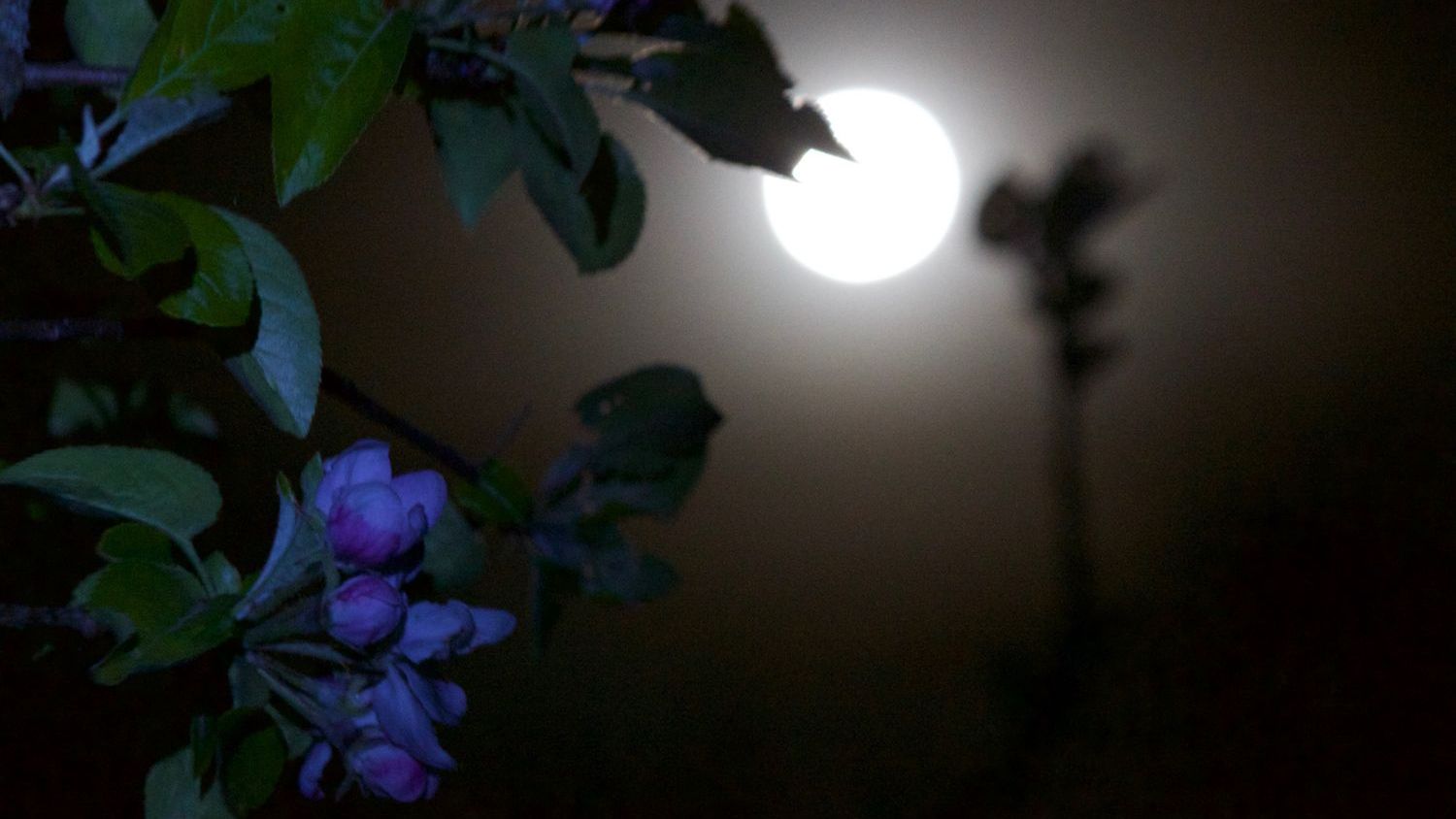
May’s full ‘Flower Moon’ rises tonight: Here’s what to expect from the ‘micromoon’ – Image for illustrative purposes only (Image credits: upload.wikimedia.org)
As spring settles in across the northern hemisphere, gardens and wildfields alike fill with vibrant blooms, setting the stage for an astronomical highlight. Tonight, the full Flower Moon rises near sunset, offering a serene companion to evening strolls and outdoor gatherings. This year’s version arrives as a micromoon, subtly smaller than usual, yet perfectly timed to cast a gentle light on the season’s renewal.[1][2]
Roots in Nature’s Rhythm
The Flower Moon earned its name from the profusion of flowers that carpet landscapes in May. Native American tribes observed this pattern closely, dubbing it the Budding Moon among the Cree or the Planting Moon for Dakota and Lakota peoples.[3][2] Other traditions called it the Egg Laying Moon, Frog Moon, or Moon of the Shedding Ponies, reflecting wildlife stirring after winter.[3]
European settlers adopted similar terms like Milk Moon or Hare Moon, tying the lunar cycle to pastoral life. Henry David Thoreau noted these Indigenous names in his journals, underscoring their deep ties to the land. This full moon coincides with May Day, a midpoint between the spring equinox and summer solstice, amplifying its role in seasonal celebrations.[4][2]
What Makes It a Micromoon
The moon follows an elliptical orbit around Earth, swinging closest at perigee and farthest at apogee. When full near apogee, it becomes a micromoon, appearing about 5 percent smaller and 10 percent dimmer than average.[3] On May 1, 2026, it reaches peak fullness at 1:23 p.m. EDT, standing roughly 249,793 miles away – over 10,000 miles beyond the typical distance.[4]
Though the difference proves hard to spot with the naked eye, the moon spans just 29.72 arcminutes across, narrower than its usual 31.[1] This contrasts sharply with supermoons, which dazzle at perigee. The subtlety invites closer inspection, perhaps through binoculars, revealing craters under softer illumination.
Prime Viewing Opportunities
The moon looks fully round from late April 30 through May 2, tracing a low arc across the sky. It rises in the southeast around sunset – check local times, such as 8:16 p.m. in New York or 8:03 p.m. in Los Angeles – and climbs highest near midnight before dipping west at dawn.[1][3] Positioned in Libra, it neighbors stars like Spica in Virgo and Zubenelgenubi, with Antares’ red glow in Scorpius nearby by evening’s end.[4]
Seek clear horizons free of city lights for the best show. The low angle at moonrise often lends a yellow-orange tint from atmospheric scattering, enhancing its springtime allure. Here’s how to make the most of it:
- Arrive early at sunset for the dramatic rise against the horizon.
- Use binoculars to pick out surface details amid the dimmer glow.
- Pair it with blooming landscapes for a full sensory experience.
- Track nearby planets like Venus or Jupiter if visible in the west.
Weather permitting, this setup turns ordinary evenings into memorable ones.[1]
A Month of Lunar Surprises
May 2026 stands out with two full moons, a pattern that designates the second as a Blue Moon – not from color, but rarity.[2] That later event peaks at 4:45 a.m. EDT on May 31, also qualifying as a micromoon just before apogee on June 1.[2] Together, they bookend the month with distant, understated luminosity.
This duo underscores the moon’s unpredictable dance, offering stargazers double the chances to connect with the night sky. The Flower Moon kicks off the sequence, priming eyes for the blue finale.
Echoes in Folklore and Modern Life
Old tales warn against washing clothes under this moon, claiming they wear out quickly, while others deem it auspicious for proposals.[2] Such lore highlights humanity’s long gaze at the heavens, blending observation with superstition. In spiritual circles, it evokes growth and transformation, mirroring floral emergence.
Today, it draws urban dwellers to parks and rural folk to fields, fostering quiet reflection amid busy lives. As the micromoon’s light filters through petals, it reminds viewers of nature’s quiet persistence.
This Flower Moon, though modestly scaled, weaves seamlessly into spring’s tapestry. Its rise tonight invites a pause, a breath of fresh air under shared skies, linking ancient watchers to those peering upward now.