

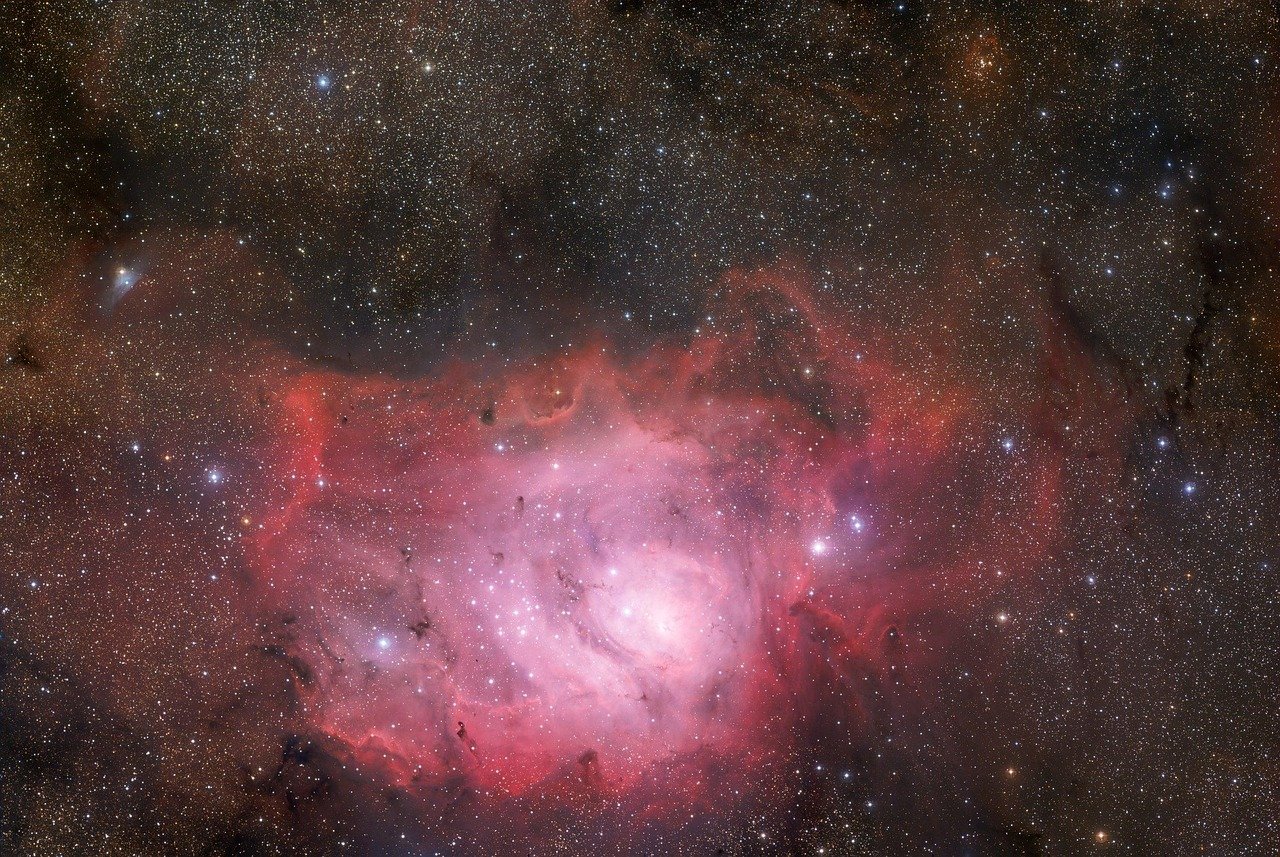
A Discovery Shrouded in Misconception (Image Credits: Pixabay)
In the northern constellation Cepheus, roughly 1,400 light-years from Earth, Sharpless 2-174 emerges as a faint, rose-shaped emission nebula that has captivated astronomers.[1][2] Known as the Valentine Rose Nebula, this delicate structure earned its romantic nickname from its floral appearance, highlighted in various sky images over the years. Astrophotographer Luigi La Bella from Melilli, Italy, recently showcased its intricate details through a meticulously crafted exposure, reigniting discussions about its origins and peculiarities.
A Discovery Shrouded in Misconception
Astronomers first cataloged Sharpless 2-174 as an HII region, a cloud of ionized hydrogen, in Stewart Sharpless’s famous 1959 survey of emission nebulae.[3] Later observations revealed it as something far more intriguing: an ancient planetary nebula, formed from the outer layers shed by a dying low-mass star. This shift in understanding marked a pivotal moment, transforming a seemingly ordinary gas cloud into a relic of stellar evolution. Its asymmetry and faint glow set it apart from brighter, more symmetrical counterparts.
The nebula’s position near the North Star, at a declination of about 81 degrees north, makes it the northernmost object in the Sharpless catalog.[4] This location challenges imagers in the Southern Hemisphere, who rarely glimpse it. Yet, its elusive beauty has drawn dedicated astrophotographers worldwide, each contributing to a richer portrait of this cosmic bloom.
Unpacking the Nebula’s Unique Structure
Sharpless 2-174 spans a modest angular size, appearing delicate against the starry backdrop of Cepheus. Emission from ionized gases, primarily hydrogen and oxygen, gives it a rosy hue in long-exposure images. Unlike typical planetary nebulae that form tidy shells around their progenitors, this one displays irregular, elongated features, hinting at a turbulent ejection process eons ago.
- Faint emission nebula with reflection components in some views.
- Asymmetric shape resembling a blooming rose petal.
- Located 3.5 degrees from key Cepheus markers.
- Visible primarily under dark northern skies.
- Challenges imagers due to low surface brightness.
Radio investigations and optical studies have mapped its surroundings, confirming interactions with interstellar dust.[5] These elements combine to create a complex, multi-layered object that defies simple classification.
The Offset White Dwarf GD 561
Central to the nebula’s mystery lies the white dwarf GD 561, positioned offset from the gaseous shell – just below a prominent bright star along the nebula’s blue edge.[1] Early theories posited that the star had “abandoned” its planetary nebula, drifting away after the ejection. Alternative explanations suggest GD 561 ionizes an unrelated interstellar cloud, illuminating it without a direct genetic link.
This discrepancy puzzled researchers, as most planetary nebulae retain their central stars near the core. Detailed spectra and proper motion studies continue to probe whether the offset results from the nebula’s expansion or the star’s peculiar velocity. GD 561’s role remains a key focus, underscoring the nebula’s status as an outlier in stellar remnants.
Capturing the Valentine Rose’s Glow
Luigi La Bella achieved his striking image of Sharpless 2-174 by accumulating 27 hours of HOO (hydrogen-alpha and oxygen) exposures with a 5-inch f/7 refractor telescope and a one-shot-color camera.[1] Such dedication overcomes the object’s dimness, revealing subtle blues and pinks. The resulting photograph, featured on Astronomy Magazine, highlights the nebula’s pronounced edges and surrounding stars.
Amateur astronomers often employ narrowband filters to isolate emissions, stacking hours of data for clarity. La Bella’s work exemplifies how accessible equipment now rivals professional observatories in unveiling deep-sky treasures. Community forums buzz with similar efforts, sharing tips on guiding and processing for optimal results.
Key Takeaways
- Sharpless 2-174 blends planetary nebula traits with emission cloud characteristics, 1,400 light-years distant.
- GD 561’s offset position fuels debates on its connection to the nebula.
- Advanced astrophotography reveals details invisible to the naked eye.
Sharpless 2-174 stands as a testament to the universe’s complexity, where ancient stellar deaths sculpt enduring beauties. As technology advances, future images may resolve lingering questions about this Valentine Rose. What draws you to deep-sky wonders like this? Share your thoughts in the comments.